Explain why the opening character identifies an operator and depends on a relationship, rather than working as an isolated picture.
Rps 3352 II, manuscript pp. 1, 2
Inside this lesson 5 teachings · 2 source pages
The language of this teaching
- Character
- A graphic sign treated here as a personal credential.
- Pact
- The agreement that the text claims makes service possible.
- Correspondence
- A supposed affinity linking a material with a spiritual class.
Begin with the witness
The manuscript begins by borrowing Solomon’s name and addressing the children of wisdom. That is a claim of authority within the book, not evidence that a biblical king wrote these pages. Our witness is the seventeenth-century Latin manuscript Rps 3352 II. Its first page introduces an art called Rabidmadar and places a character beneath the opening explanation. The character therefore arrives inside an argument about knowledge and access. Read the opening prose and the drawing together: the writing announces a guarded teaching, while the drawing offers a means by which a particular person is supposed to enter that teaching.
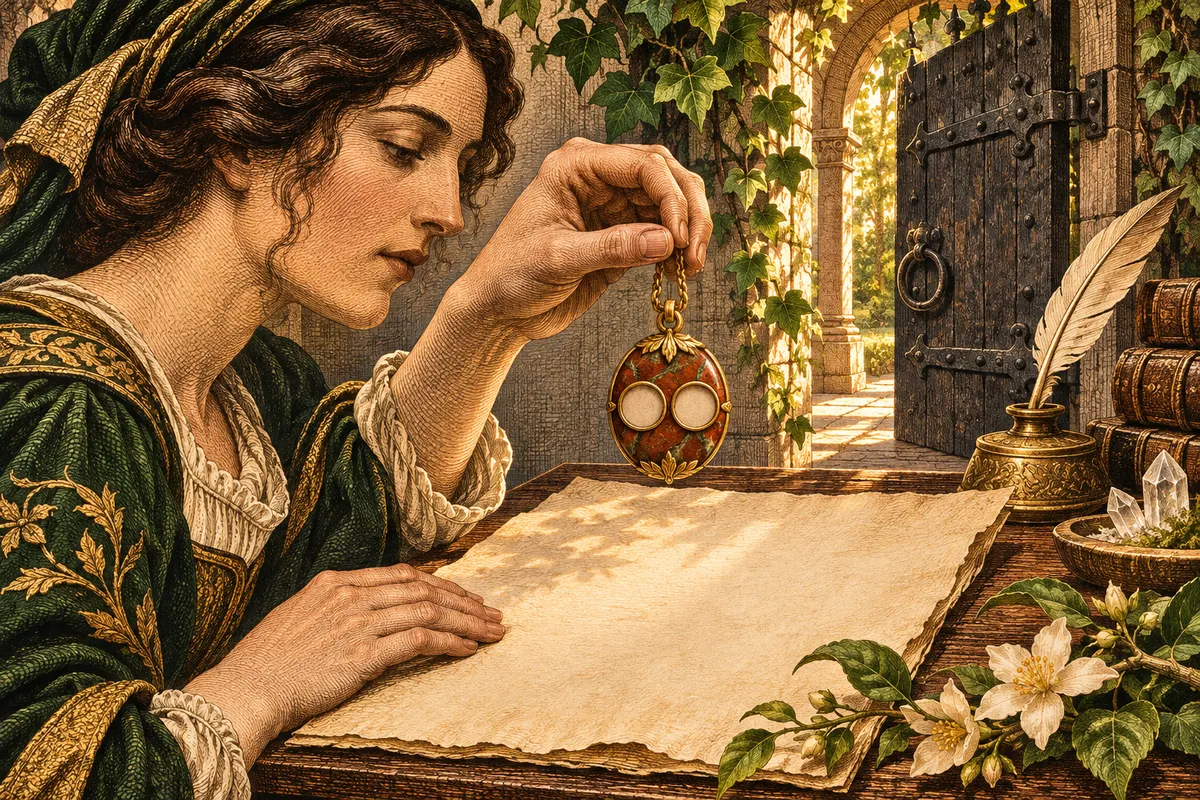 OCCULT HALL · INTERPRETIVE ILLUSTRATION
A named token at the threshold
A jasper token and open document evoke the manuscript’s connection between personal identity, a character and an agreement.
The two spaces are personal
On the following page, the author explains the compartments marked A and B. They receive the operator’s personal names, making the character specific to its bearer. This is more like a named credential than an interchangeable ornament. The text also distinguishes where men and women should carry it, revealing the social assumptions of its period. Those distinctions belong to the historical prescription; they are not universal rules about people. What matters for interpreting the drawing is the movement from a general design to a named object. The manuscript asks the reader to connect a visible form with an identifiable participant.
Four relationships in one character
The opening joins the bearer, the material and a claimed agreement. These are related features, not interchangeable explanations.
Choose a part to look closer.
Names A and B
The two compartments identify the bearer through personal names, turning a general design into a sign for someone particular.
Read all the connections
- Names A and B
- The two compartments identify the bearer through personal names, turning a general design into a sign for someone particular.
- Stone support
- The optional jasper or heliotrope adds a claimed solar affinity, a material relationship distinct from the bearer’s personal identity.
- Agreement
- The surrounding prose connects service with joined participants, making the sign part of an obligation rather than an independent guarantee.
- Recognition
- Characters distinguish participants within the account, so their meaning depends on who supposedly recognizes them and under which relationship.
The same object can identify a person, carry an affinity and signify a relationship.
Material adds a second relationship
The opening permits an alternative stone support and discusses green jasper or heliotrope. It connects that material with solar spirits. This introduces a second kind of fit: the character identifies a person, while its substance is associated with a class of spirits. Neither feature should be collapsed into the other. A name answers who bears the object; a material correspondence answers why this substance is considered suitable. The manuscript’s claim is relational at both levels. Our illustration leaves the pendant uninscribed so that it can show this relationship without pretending to reproduce the manuscript’s exact character or manufacture a historical talisman.
A pact changes the meaning of the sign
The prose then says that spirits serve those joined to them by agreement, and treats characters as distinguishing signs between participants. The image is not presented as sufficient by itself. That observation changes how the whole opening should be read: possession, recognition and obligation are linked. The author also withholds some explanation under the language of secrecy. Consequently the reader receives both a promise of access and a warning that not everything has been explained. We can study that rhetorical strategy without accepting the promised powers as established facts or turning the passage into instructions for making a pact.
Look at the passage itself.
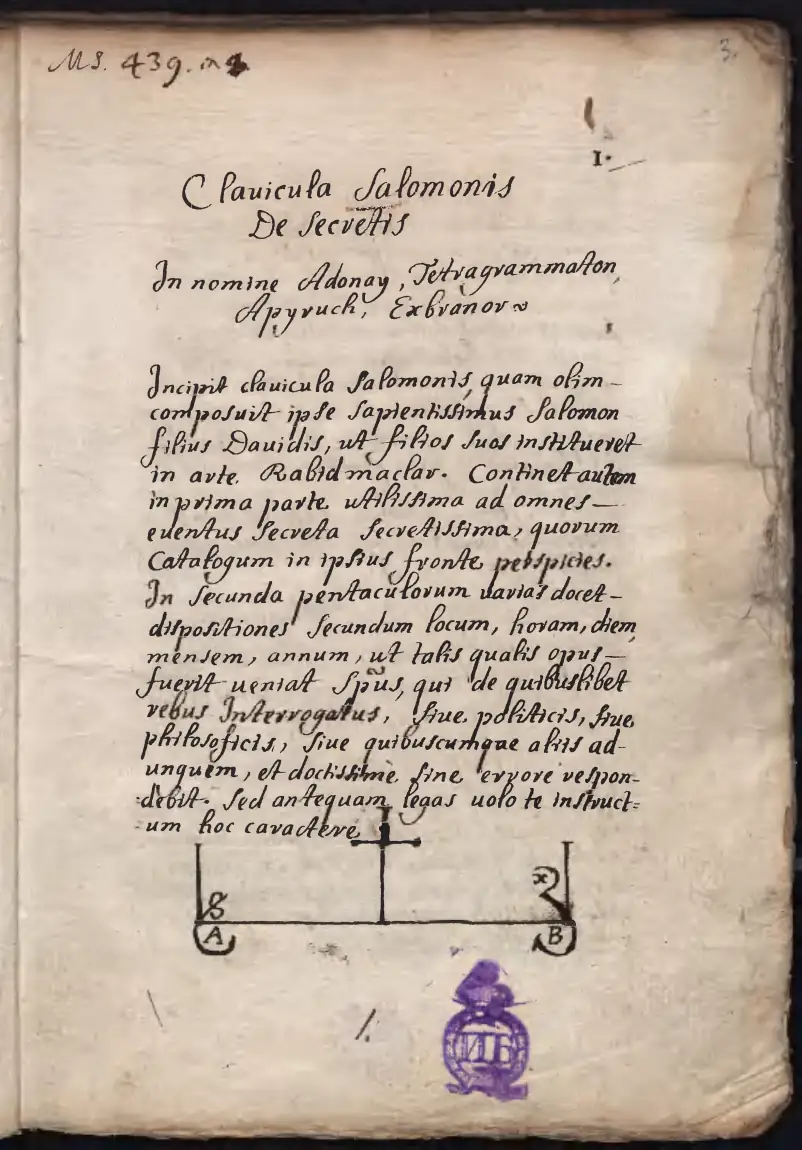 Open the book
Manuscript p. 1
Rps 3352 II, manuscript pp. 1, 2; original page from the complete hosted facsimile.
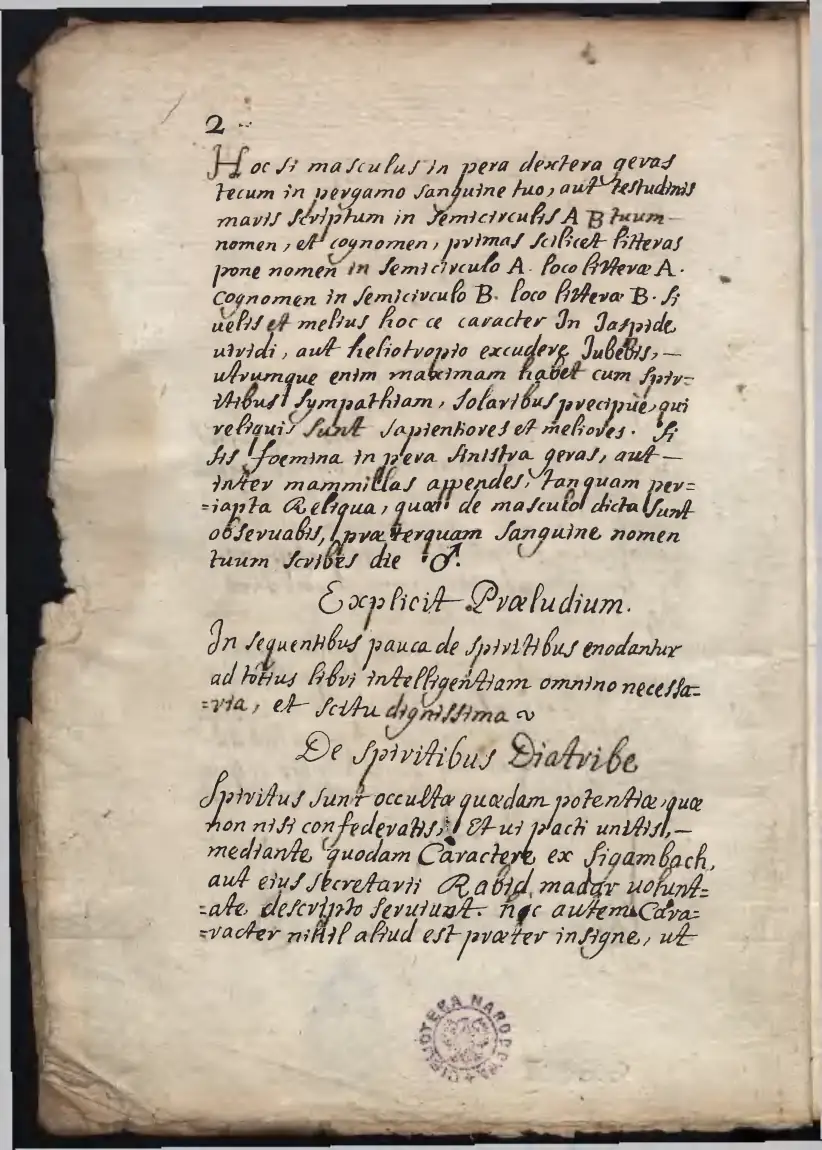 Open the book
Manuscript p. 2
Rps 3352 II, manuscript pp. 1, 2; original page from the complete hosted facsimile.
Read the claim at its proper scale
This introduction teaches a useful way to approach the rest of the book. Ask what a sign identifies, what material carries it, who supposedly recognizes it, and what prior relationship makes it meaningful. These questions are more informative than asking only whether a drawing looks powerful. They also prevent later names and figures from being treated as decorative extras. The surviving page documents what a historical writer wanted a reader to believe about authority. It does not independently demonstrate that spirits appeared or agreements produced results. Keep the manuscript’s argument vivid while distinguishing its assertions from evidence of actual events.
Read the evidence: A character belongs to someone
Use the manuscript pages below to test the interpretation. This is a close-reading exercise: compare what the page says, how its argument works, and where its claim stops.
- 01
Locate identity
Find the A and B compartments on the first page, then follow the explanation on the second. Describe the move from a blank place to a named bearer without copying or performing the prescription.
- 02
Separate the connections
Write two sentences: one explaining the names, another explaining the stone. Check that neither sentence treats identity and solar affinity as the same claim.
- 03
Test the premise
Locate the discussion of joined participants below the opening. Explain why removing agreement from the account would change the author’s stated theory of the character.
The text makes the sign part of a relationship, not an isolated guarantee.
The text beside the teaching.
These selected pages accompany this free lesson. Enlarge a page and compare its details with the teaching.
Manuscript p. 1
Rps 3352 II, manuscript pp. 1, 2; original page from the complete hosted facsimile.
What to carry into the next lesson
- The opening character combines a general design with the bearer’s names.
- Material affinity and personal identity perform different jobs.
- The text makes the sign part of a relationship, not an isolated guarantee.
The opening character combines a general design with the bearer’s names.
Can you explain it in your own words?
Try answering first, then open the explanation to compare your reasoning.
01Why do A and B matter?
They make the character personal by providing places for the bearer’s names.
02Does the text say the drawing works independently?
No. It connects characters with an agreement and with recognition between participants.