Explain how the Petit Albert connects ordinary desires with a theory of hidden natural powers.
Petit Albert, 1765; Opening of Le Trésor, introductory address; Printed p. 8: the audience and hidden powers of nature; Printed p. 9: weekday rulers and the defense of figures.
Inside this lesson 5 teachings · 3 source pages
The language of this teaching
- Occult property
- A supposedly hidden natural power whose effects are more apparent than its cause.
- Compilation
- A work assembled from varied materials, traditions or sources rather than necessarily composed as one uniform argument.
- Correspondence
- A meaningful relationship asserted between things such as a planet, day, metal or image.
A small book promises a large world
The Petit Albert introduces itself as a treasury: a small volume containing secrets useful to many kinds of people. Its opening addresses city merchants and country workers, nobles and ordinary householders, young people and those responsible for families. That broad audience is central to the book’s identity. Hidden knowledge is presented as something that can enter everyday life, not merely a discipline reserved for a secluded philosopher. The promise of a treasure also describes the reader’s relationship to the book. Owning and understanding a compact collection is represented as gaining access to benefits otherwise scattered or concealed.
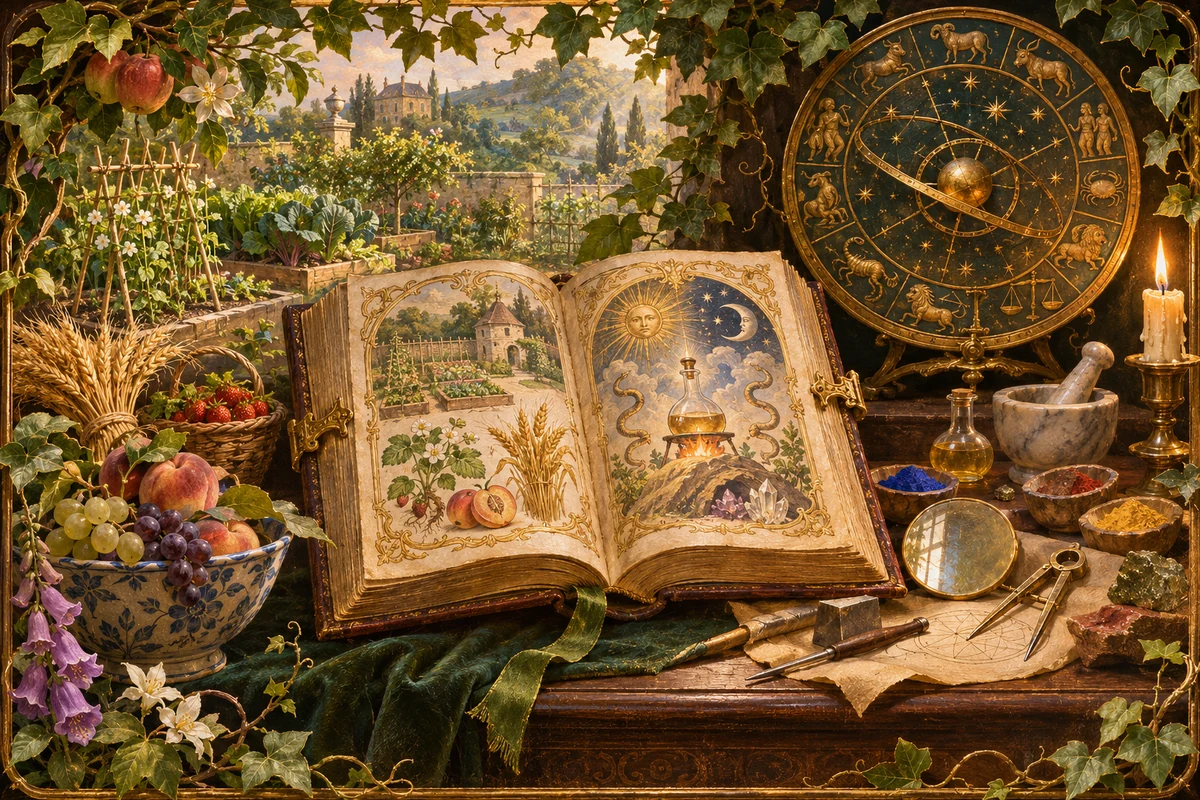 OCCULT HALL · INTERPRETIVE ILLUSTRATION
A treasury of useful wonders
The treasury brings practical crafts, natural marvels and celestial claims into one collection.
Occult means hidden within nature
The introduction says that its surprising secrets do not exceed the hidden powers of created nature. It locates those powers throughout heaven, air, earth and water. This gives the collection a common explanation despite its varied subjects. A curious effect can be treated as a natural property whose cause is not immediately visible. The distinction matters when reading the later pages. The compiler does not place every extraordinary claim in the same category as a demonic intervention. He argues that a larger natural order contains influences and relationships that ordinary experience does not fully disclose.
Benefit, explanation, evidence
Three questions make the treasury easier to navigate.
Choose a part to look closer.
Desired benefit
Household security, livelihood and knowledge explain why very different secrets could appeal to the merchants, workers and families addressed by the introduction.
Read all the connections
- Desired benefit
- Household security, livelihood and knowledge explain why very different secrets could appeal to the merchants, workers and families addressed by the introduction.
- Proposed explanation
- Material properties, celestial correspondences and spirits offer different immediate explanations, even when the compiler places them within one enlarged natural order.
- Offered evidence
- Cited authorities, alleged experience and reports from others provide different kinds of support; the treasury’s confident tone does not erase those distinctions.
Ordinary desires organize much of the book’s appeal.
The stars connect distant things
The next page explains the stars’ influence through their relations, positions and aspects. It then names the seven weekday rulers: Sun, Moon, Mars, Mercury, Jupiter, Venus and Saturn. These correspondences connect the daily calendar with a wider cosmos. A material object or a chosen moment can consequently be interpreted as part of a larger relationship rather than as an isolated tool. This is the bridge between household concerns and celestial learning. The book suggests that a knowledgeable reader can benefit from favorable relationships that are already present in nature, while ignorance leaves those relationships unnoticed or poorly used.
Words and figures need a defense
The introduction anticipates objections to its use of unusual words and figures. It insists that such forms need not be understood as diabolical and appeals to ancient Hebrew sages and a legendary transmission associated with Charlemagne. These are arguments for legitimacy, not independent proof of the stories they tell. The book wants readers to accept certain inscriptions as compatible with religion and natural knowledge. That defense helps explain why a practical recipe collection repeatedly cites learned authorities. Its claims depend not only on promised usefulness but also on a story about where trustworthy knowledge comes from.
Look at the passage itself.
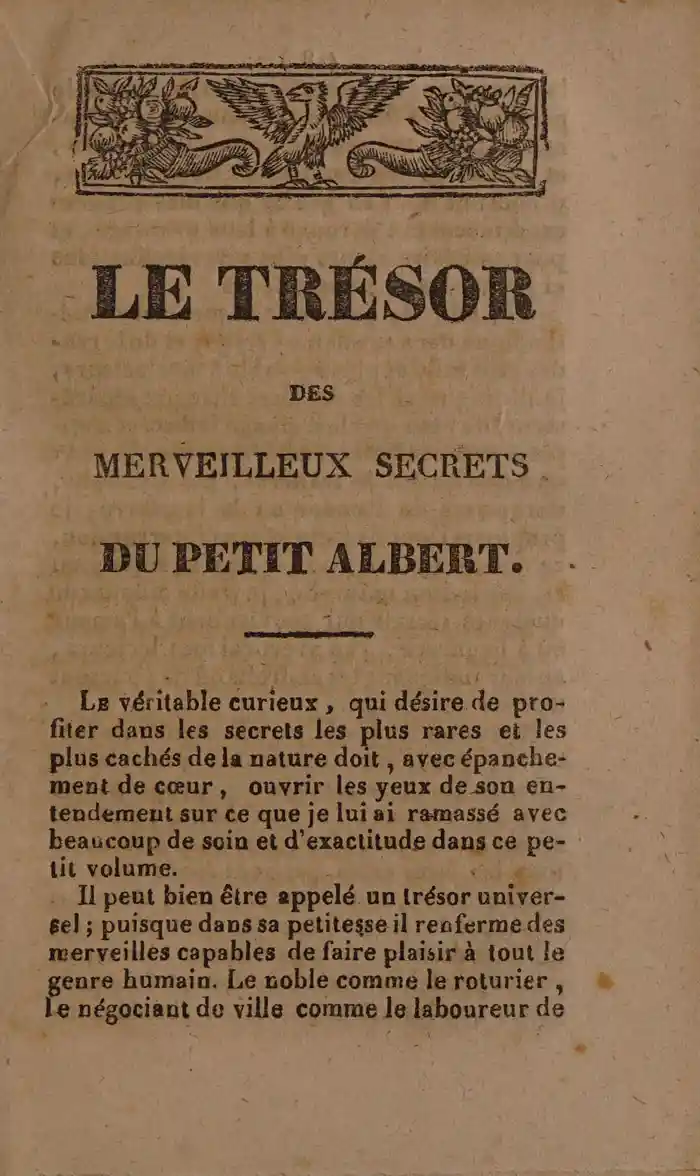 Open the book
Opening of Le Trésor, introductory address
Read the complete source page alongside this lesson. Explain how the Petit Albert connects ordinary desires with a theory of hidden natural powers.
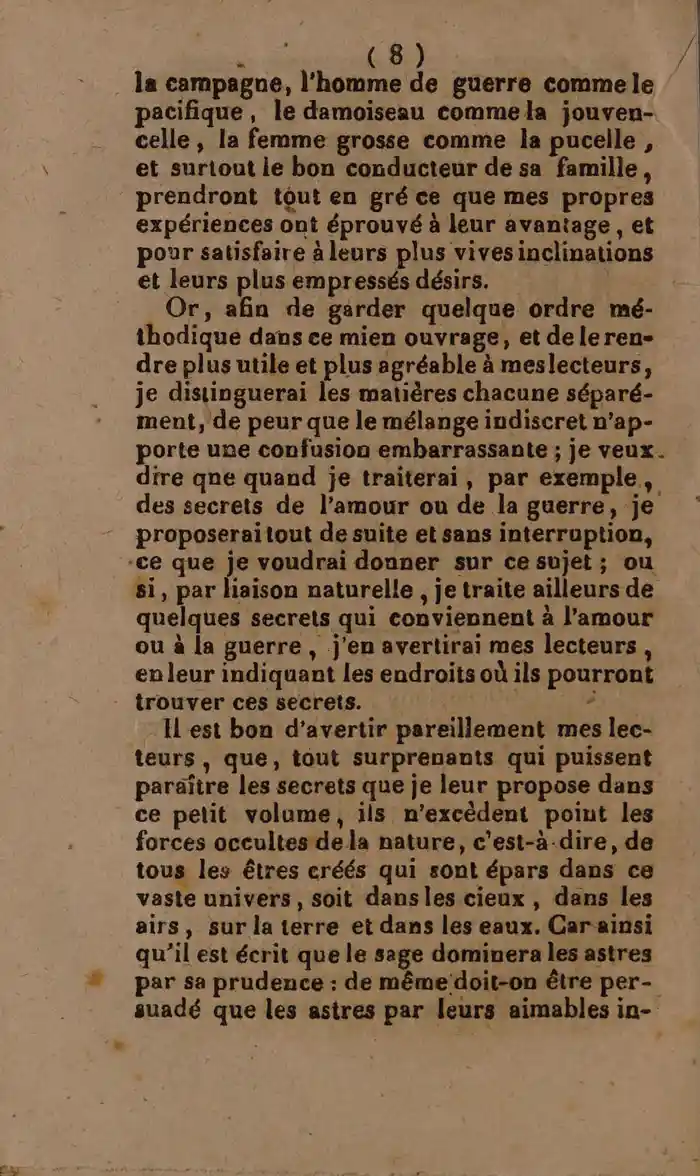 Open the book
Printed p. 8: the audience and hidden powers of nature
Read the complete source page alongside this lesson. Explain how the Petit Albert connects ordinary desires with a theory of hidden natural powers.
A treasury is also a compilation
The opening promises orderly groups of subjects and references where related material reappears. That is an important reading instruction. The volume gathers different sorts of claims, anecdotes and practical lore, and they do not all rest on the same evidence. Some passages appeal to personal experience; others quote authorities or describe reports from other people. The course follows those differences rather than treating the whole book as one tested system. Its nine lessons are an editorial route through the 1765 witness. The complete pages preserve the broader collection, including material beyond the selected teaching path and passages whose historical claims require careful qualification.
Classify three promises
Imagine a reader encountering a household secret, a planetary talisman and a story about a protective spirit in the same volume.
- 01
Identify the desired benefit
State the ordinary human concern behind each promise: livelihood, security, knowledge or favorable relationships. This shows why seemingly different subjects could appeal to the same household reader.
- 02
Identify the explanation
Ask what the passage invokes: a material property, a celestial correspondence or the action of a spirit. The introduction gives these claims a common natural framework, but their immediate explanations still differ.
- 03
Identify the evidence offered
Record whether the compiler cites an authority, claims personal experience or repeats another person’s report. These distinctions prevent the treasury’s confident tone from making every passage appear equally well supported.
The collection becomes easier to navigate when benefit, explanation and evidence are considered separately.
The text beside the teaching.
These selected pages accompany this free lesson. Enlarge a page and compare its details with the teaching.
Opening of Le Trésor, introductory address
Read the complete source page alongside this lesson. Explain how the Petit Albert connects ordinary desires with a theory of hidden natural powers.
What to carry into the next lesson
- Ordinary desires organize much of the book’s appeal.
- Hidden natural powers provide its broad explanatory framework.
- Different passages make different kinds of evidential claims.
Compare the audience named on the opening pages with the seven weekday rulers on the following page. Notice how quickly the household opens onto the cosmos.
Can you explain it in your own words?
Try answering first, then open the explanation to compare your reasoning.
01Why do practical secrets and celestial learning appear together?
The compiler presents celestial influence as one part of the hidden natural order that a knowledgeable reader can use for ordinary concerns.
02Why does the book call itself a treasury?
It presents a compact collection as a valuable store of hidden knowledge useful to a wide audience.
03Does its defense of mysterious figures prove their effects?
No. It explains how the compiler legitimizes them within his account of nature and religion.