Explain the opening three-part program and how characters, promised effects and conditions of access depend on one another.
L’Art Magique manuscript, opening grimoire section; reading scans 8, 9.
Inside this lesson 5 teachings · 2 source pages
The language of this teaching
- Character
- A written or drawn sign associated with a person, spirit or relationship within the manuscript’s system.
- Office
- The function or kind of effect assigned to a particular spiritual agent.
- Key
- The manuscript’s metaphor for the conditions that make its other teachings accessible.
The book announces its power
The opening grimoire page introduces a book of the Clavicles of Solomon and attributes its supernatural secrets to the power of demons. That statement establishes the kind of causation the writer wants the reader to imagine. The effects are not explained as the independent properties of a drawing or an object. They are placed within dealings with invisible agents. Solomon’s name supplies an inherited authority, while the actual witness before us is the French L’Art Magique manuscript. Begin with what this particular page promises, rather than assuming that every book bearing Solomon’s name teaches the same system.
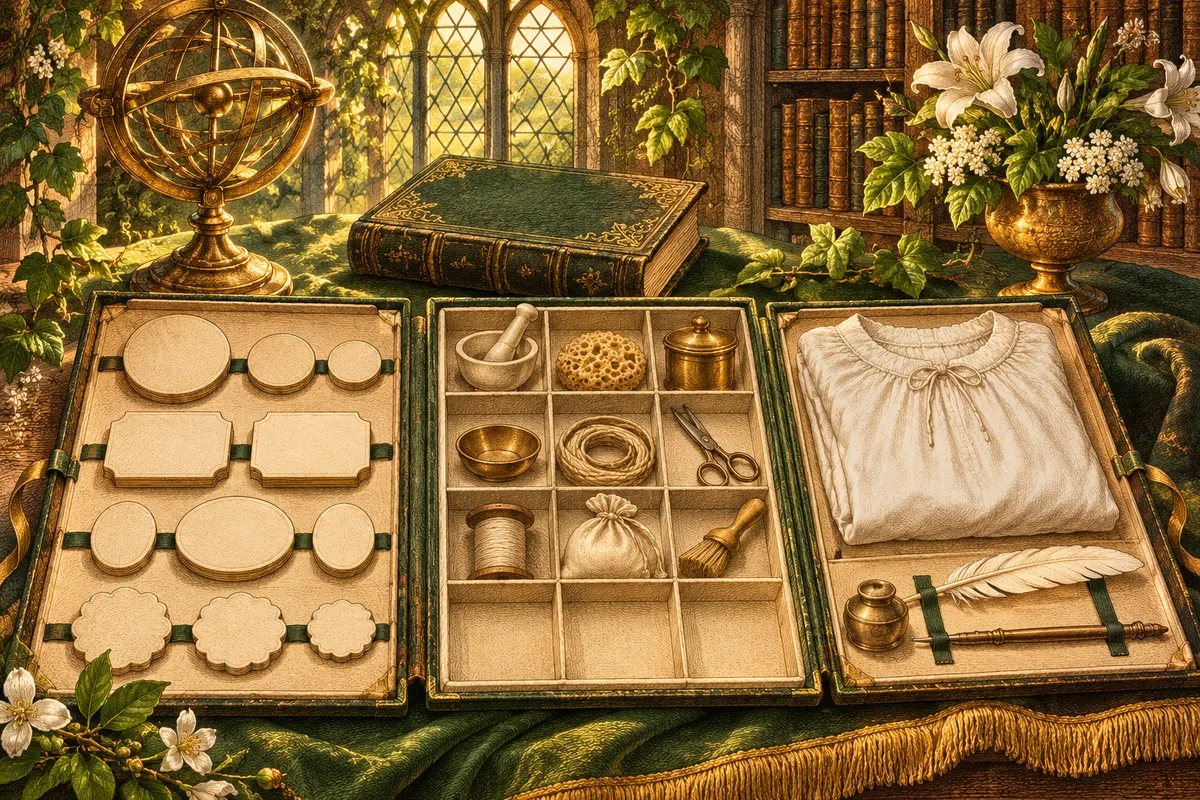 OCCULT HALL · INTERPRETIVE ILLUSTRATION
The manuscript’s three promises
Three groups of objects evoke the opening program’s linked concerns: characters, extraordinary effects and the key to accessing them.
The first part gives a language of approach
The first part is described through characters: visible signs by which spirits may be invoked and made to come, each according to its power. A character is therefore more than an emblem of a general idea. In the book’s account, it belongs to an addressable relationship between a practitioner and a particular agency. Notice the limiting phrase about power. The spirits are not all interchangeable, and the requested effect depends on which agency is approached. This opening prepares the reader for later distinctions of name, rank and office. It makes classification part of the imagined operation of the art.
Three promises in the opening program
The opening announces related areas of teaching, without supplying a perfectly separated modern table of contents.
Choose a part to look closer.
Characters and agreement
The first announced area connects characters with the relationship through which spirits are claimed to serve, making signs part of a larger argument.
Read all the connections
- Characters and agreement
- The first announced area connects characters with the relationship through which spirits are claimed to serve, making signs part of a larger argument.
- Extraordinary secrets
- The second area promises remarkable results, directing the reader from spiritual names toward the particular outcomes the book claims to explain.
- The key to the others
- The third is announced as a key to the preceding material, linking access and preparation rather than simply adding another isolated catalogue.
Use the program as the manuscript’s promise, then compare it with the order of the surviving pages.
The second part concerns what might happen
The second part promises extraordinary secrets effected through the same demonic agency. Here the emphasis shifts from addressing a spirit to the results attributed to that contact. The distinction resembles the difference between knowing whom to ask and knowing what that person is said to accomplish. The manuscript will connect both questions, but they are not identical. Reading only a list of marvelous results would miss the relationships that supposedly produce them; reading only the signs would miss their purposes. This is why an illustration of three connected chambers suits the passage better than a decorative collection of unrelated seals.
The third part claims to unlock the others
The third part is called the key to the others. The opening immediately turns toward the operator’s character, personal naming and ways the sign is to be carried or inscribed. This movement is significant even before every detail is interpreted. The book’s promise depends on conditions attached to the person seeking access. Its key is not merely another catalogue of wonders. It concerns the connection between the reader and the system being described. The manuscript’s sequence is less tidy than a modern textbook’s contents page, so treat the three parts as an announced program rather than forcing every following paragraph into a perfectly separated chapter.
Look at the passage itself.
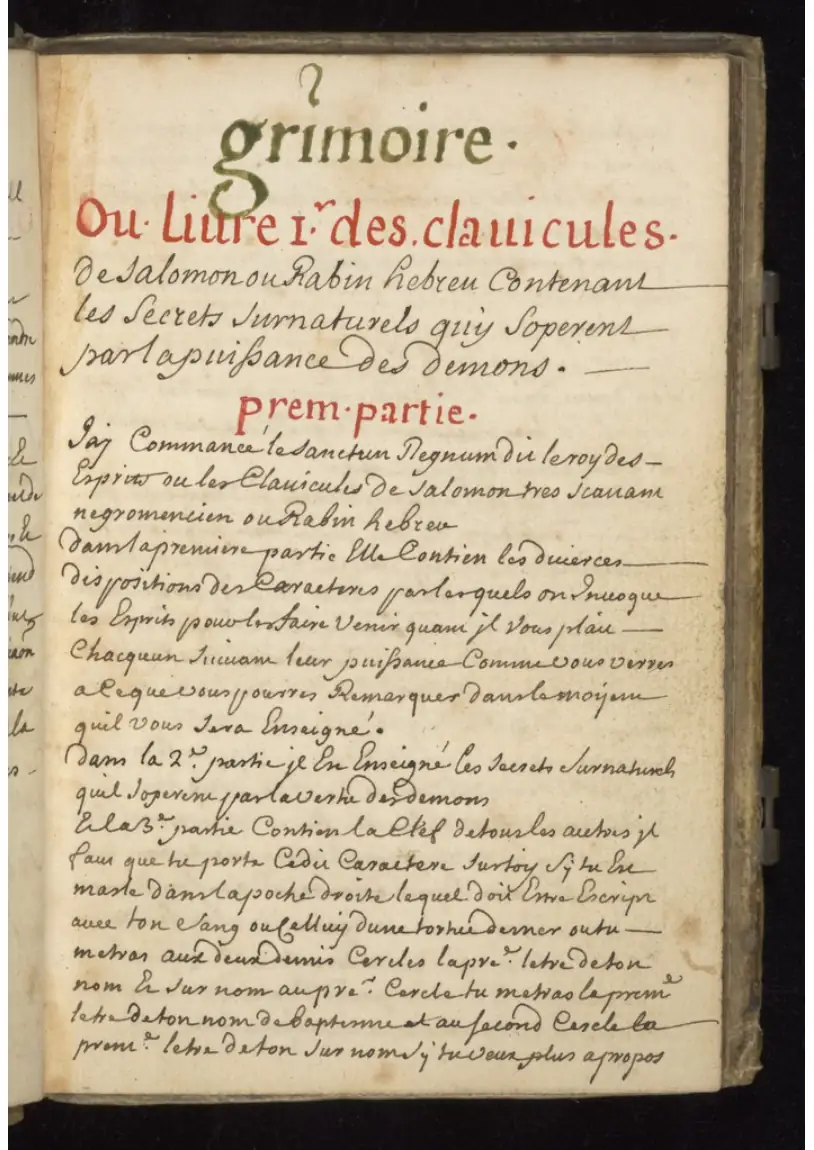 Open the book
The three-part program
Read the first, second and third parts announced on this opening grimoire page.
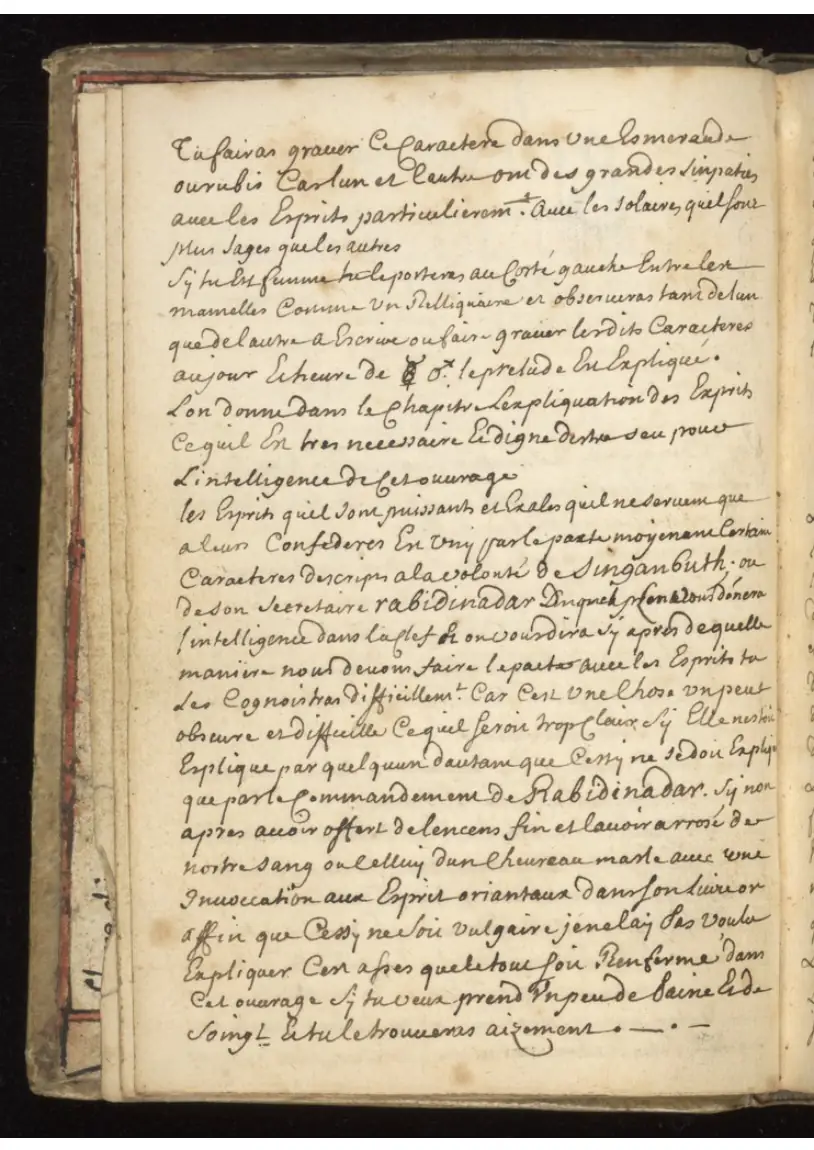 Open the book
From character to pact
Follow the movement from the personal sign toward conditions of spiritual access.
The program leads into an obligation
The next page moves from the personal character toward the difficulty of making a pact and the authority of named intermediaries. That is the practical consequence of the opening architecture: access is represented as a relationship governed by conditions. The first page’s promise of command is therefore qualified almost immediately. A reader is invited into a world of powerful signs, but also into a structure of obligation. Our first lesson follows that tension. It explains why the manuscript places signs, effects and access together without presenting its claims as demonstrated outcomes or filling its gaps from a later printed edition.
Make a three-part reading map
Draw three boxes headed Approach, Effect and Access. Use the opening page to explain why the boxes need connecting lines.
- 01
Place the characters
Under Approach, write that characters distinguish and address spirits according to their powers. Add a line toward Effect and explain that a sign’s role depends on the agency and purpose attached to it. This keeps the drawing inside the book’s argument instead of treating every symbol as an isolated object with a universal meaning.
- 02
Place the extraordinary secrets
Under Effect, record the promised category of extraordinary results. Do not invent a list that the opening paragraph has not yet supplied. Write a question beside the box: which later entry explains a particular result, and which agent is assigned to it? The question gives you a concrete method for following the subsequent lessons.
- 03
Connect the operator
Under Access, place personal identity and the pact discussion that follows. Draw lines back to both earlier boxes. Explain that the reader’s relationship to the art is another required part of the manuscript’s model. Finish by distinguishing this reconstruction of the text’s reasoning from a claim that its promises have been independently verified.
The three parts describe connected functions: addressing an agency, seeking an effect, and meeting the conditions the book attaches to access.
The text beside the teaching.
These selected pages accompany this free lesson. Enlarge a page and compare its details with the teaching.
The three-part program
Read the first, second and third parts announced on this opening grimoire page.
What to carry into the next lesson
- The opening places extraordinary effects within relationships with spiritual agents.
- Characters, effects and access are distinct but connected concerns.
- The manuscript’s own sequence is the guide; a later edition should not silently replace it.
Draw three boxes headed Approach, Effect and Access. Use the opening page to explain why the boxes need connecting lines.
Can you explain it in your own words?
Try answering first, then open the explanation to compare your reasoning.
01Why is a character more than a decorative symbol in this opening?
The text assigns it a role in addressing spirits according to their powers, so its meaning depends on an agency and a purpose.
02Why should the three-part program not be treated as a perfectly modern table of contents?
The manuscript announces categories but moves directly between their connected concerns. Its surviving sequence does not require sharply separated modern chapters.