Explain how the first invocation transforms a vessel into a place of revelation, and distinguish the operator, witness and divine presence.
Recto I.1–17; Griffith and Thompson, vol. I (1904), printed pp. 21–23.
Inside this lesson 5 teachings · 2 source pages
The language of this teaching
- Vessel-inquiry
- A form of divination in which a vessel is treated as the place where an answering presence may appear.
- Operator
- The person directing the inquiry and speaking its authoritative words.
- Witness
- The person expected to perceive and report the appearance; here the text specifies a young medium.
Start with the request
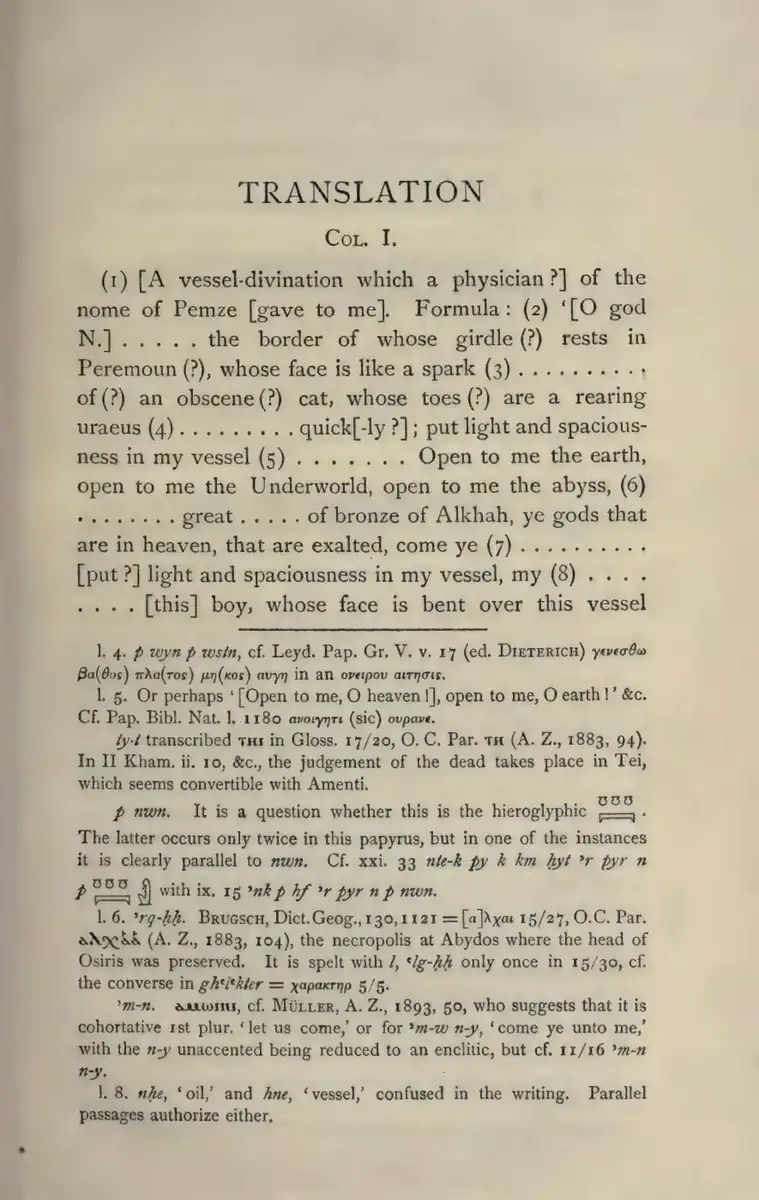
The opening column asks for light and spaciousness in a vessel. That pairing is the key to the passage. Light would make something perceptible; spaciousness would give the arriving powers somewhere to appear. The bowl is physically small, yet the invocation addresses it as the threshold of an extensive world. Read the requests that follow: earth, underworld and abyss are to open, and heavenly gods are invited to come. The text is arranging access between levels of existence. Its desired result is an encounter from which knowledge can be obtained, rather than the production of an interesting reflection alone.
 OCCULT HALL · INTERPRETIVE ILLUSTRATION
The vessel opens into a world
The luminous vessel interprets the invocation’s request for light and spaciousness and the opening of earth, underworld and abyss.
The small object and the great world
Notice the change of scale. A human face bends over a vessel while the words name immense regions outside ordinary human reach. This makes the vessel a meeting place between a domestic object and a cosmological map. The invocation does not explain that map as a tidy diagram; it activates its parts through repeated requests to open. Our illustration therefore makes the bowl contain an expansive sky. That is an interpretation of the passage’s spatial language, not a reproduction of a drawing on the papyrus. The surviving column is writing, and the hand-copy volume lets you inspect that script separately.
Three roles in one inquiry
The speaker, the person who looks, and the beings expected to appear have different jobs. The first column refers to a boy whose face is bent over the vessel and later asks for that witness’s eyes to be opened. The operator supplies authoritative speech; the witness is expected to perceive the scene; the divine company supplies the answer. A sentence such as “open to me” belongs to the operator’s voice, while the act of seeing may belong to the witness. Keeping those roles separate prevents a common misreading in which every action is attributed to one solitary magician.
What the vessel gathers
Follow the relationships made by the first surviving invocation.
Choose a part to look closer.
Opened regions
Earth, underworld and abyss are called to open, giving the small vessel access to a much larger sacred geography.
Read all the connections
- Opened regions
- Earth, underworld and abyss are called to open, giving the small vessel access to a much larger sacred geography.
- Authoritative speech
- The operator identifies the inquiry with Isis and claims extraordinary names, presenting the request as more than ordinary human speech.
- A seeing witness
- The young witness bends toward the vessel and is expected to perceive the arrival that the operator’s words request.
- An answering company
- Heavenly gods are invited to enter the encounter, connecting the vessel’s expanded space with the hope of obtaining knowledge.
A small object becomes a meeting place through the relationships the invocation establishes.
Why Isis enters the passage
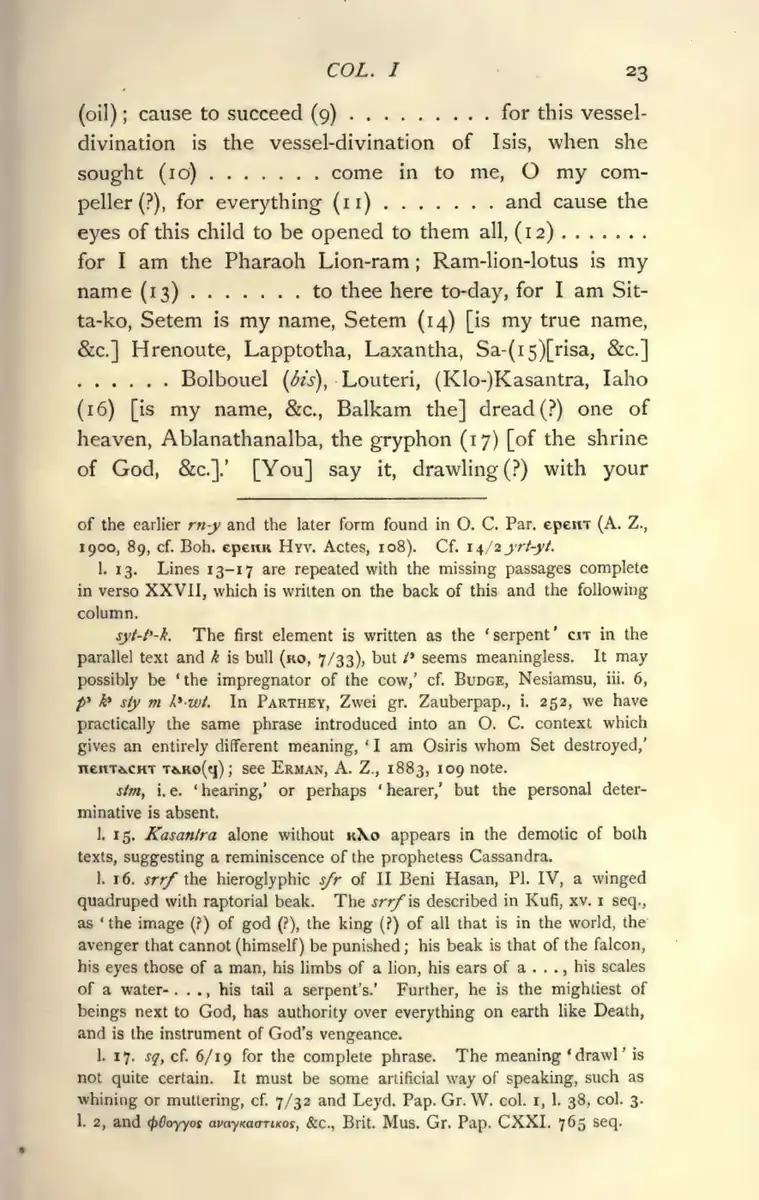
The invocation identifies this inquiry with the vessel-divination of Isis. It then moves into emphatic statements of the speaker’s extraordinary identity, including the composite name Lion-ram and other names. Within the text’s logic, the operator is claiming a precedent and a voice with more authority than an ordinary request. Isis is not added simply to decorate the page with an Egyptian deity. Her search supplies a model for seeking knowledge through a vessel. The surviving wording is damaged, so the precise missing object of that search should not be supplied as though the papyrus still stated it.
Look at the passage itself.
 Open the book
Recto I · the opened vessel
Read lines 4–8 for light, spaciousness, opened regions and the witness.
 Open the book
Recto I · the precedent of Isis
Read lines 9–17 for Isis and the speaker’s claimed names.
An opening that survives in fragments
The square brackets and gaps on the facing translation matter here because they mark the edge of what we can actually know. Much of the first invocation is lost, but the requests for light, spaciousness and opened regions remain legible enough to establish its main movement. Later repetitions elsewhere on the papyrus help the editors reconstruct some names. The useful reading habit is to separate that reconstruction from the surviving request. We can explain what the vessel is being asked to become without inventing a complete original speech or claiming that the promised appearance was demonstrated to occur.
Map the opening invocation
Make a reading map from the two source pages. This exercise follows the text’s allocation of space and authority; it does not require performing the procedure.
- 01
Find the desired change
Underline the requests for light and spaciousness in the translation. Explain in your own words why the second request adds something that brightness alone cannot provide. A strong answer describes a place capable of receiving an encounter, rather than merely a clearer view of the bowl’s contents.
- 02
Follow the named regions
List earth, underworld, abyss and heaven as they appear in the opening. Draw arrows toward the vessel to represent the requested access. Do not turn that list into a fixed hierarchy unless the words themselves establish one; the passage emphasizes opening and arrival more than a diagram of ranked layers.
- 03
Assign the voices
Identify one action belonging to the speaker, one attributed to the witness and one expected from a divine presence. Then explain how the mention of Isis supports the operator’s claim. This separates the human roles from the mythic authority used to make the inquiry persuasive within its own religious world.
The vessel’s importance comes from the relations established around it: opened regions, an authoritative voice, a seeing witness and an expected answer.
The text beside the teaching.
These selected pages accompany this free lesson. Enlarge a page and compare its details with the teaching.
Recto I · the opened vessel
Read lines 4–8 for light, spaciousness, opened regions and the witness.
What to carry into the next lesson
- The bowl is presented as a threshold between human inquiry and a larger cosmos.
- Operator, witness and answering presence are distinct roles.
- The appeal to Isis gives the inquiry a mythic precedent.
A small object becomes a meeting place through the relationships the invocation establishes.
Can you explain it in your own words?
Try answering first, then open the explanation to compare your reasoning.
01Why are both light and spaciousness requested?
Light makes an appearance perceptible, while spaciousness presents the small vessel as a place capable of receiving the divine encounter.
02What can we conclude despite the damaged opening?
The surviving requests establish the vessel as a meeting place for cosmic regions and divine visitors; they do not preserve every name or the complete original invocation.