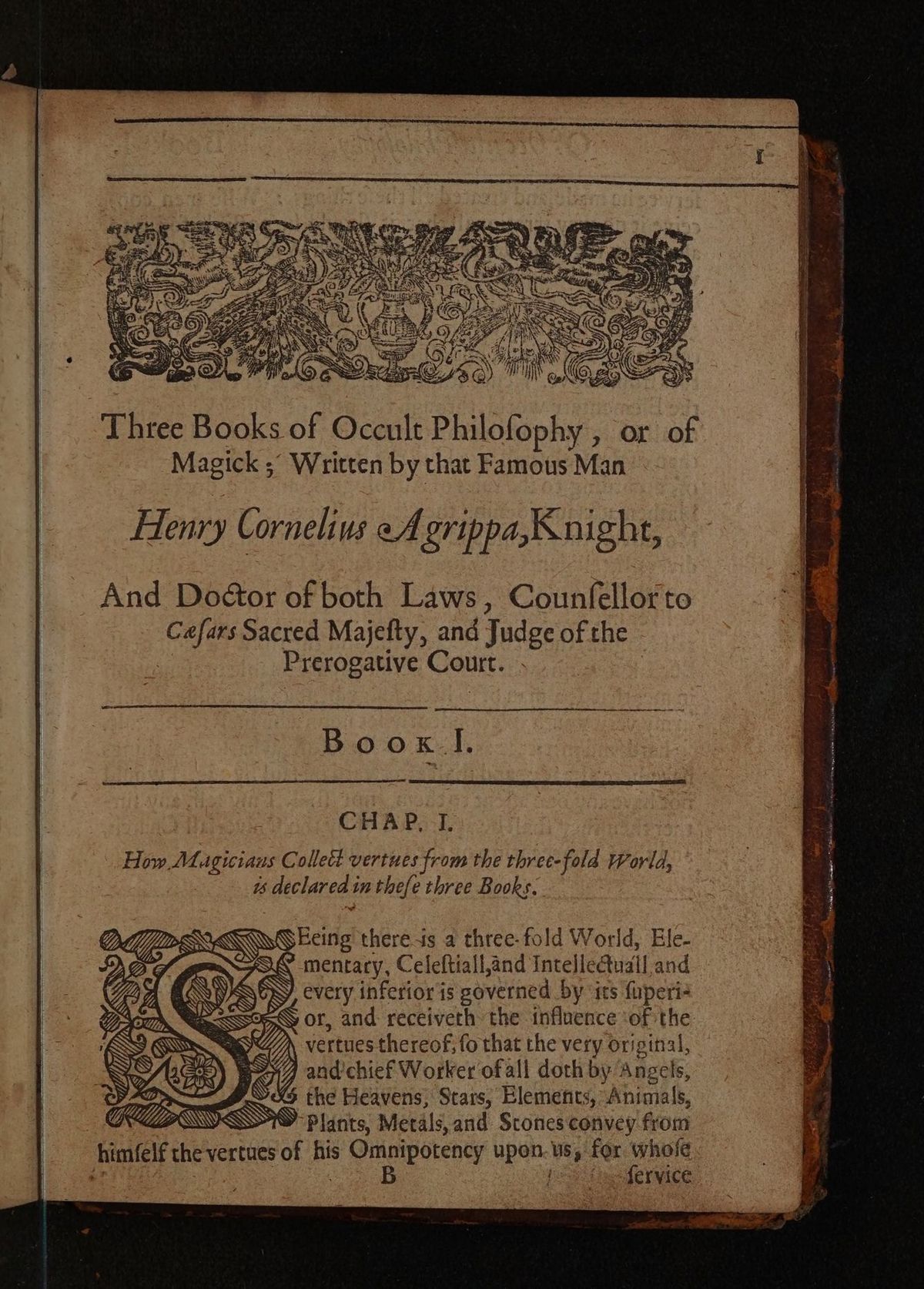
From the 1651 edition
Agrippa opens Book I by naming the elemental, celestial, and intellectual worlds. Find the three in the paragraph beneath the decorated initial.
If you pick up a stone, how does Agrippa get from its particular powers to angels and God, and why would a student trace the route back?
Put an object in the right world
Start at the large decorated S. In his first sentence Agrippa names three worlds. The elementary world includes your stone and the ordinary materials from which bodies are made. The celestial world is the region of the heavens and stars. The intellectual world includes the angelic intelligences through which divine purposes are carried out. “Intellectual” here names an order of spiritual beings. A person thinking about the stone still stands in the elementary world.
Use three lines on a page. Put the stone on the bottom, a star on the middle line, and an angel above both. Put God above the diagram as its source. You have just given a place to four of the actors in Agrippa’s opening sentence.
 OCCULT HALL · INTERPRETIVE ILLUSTRATION
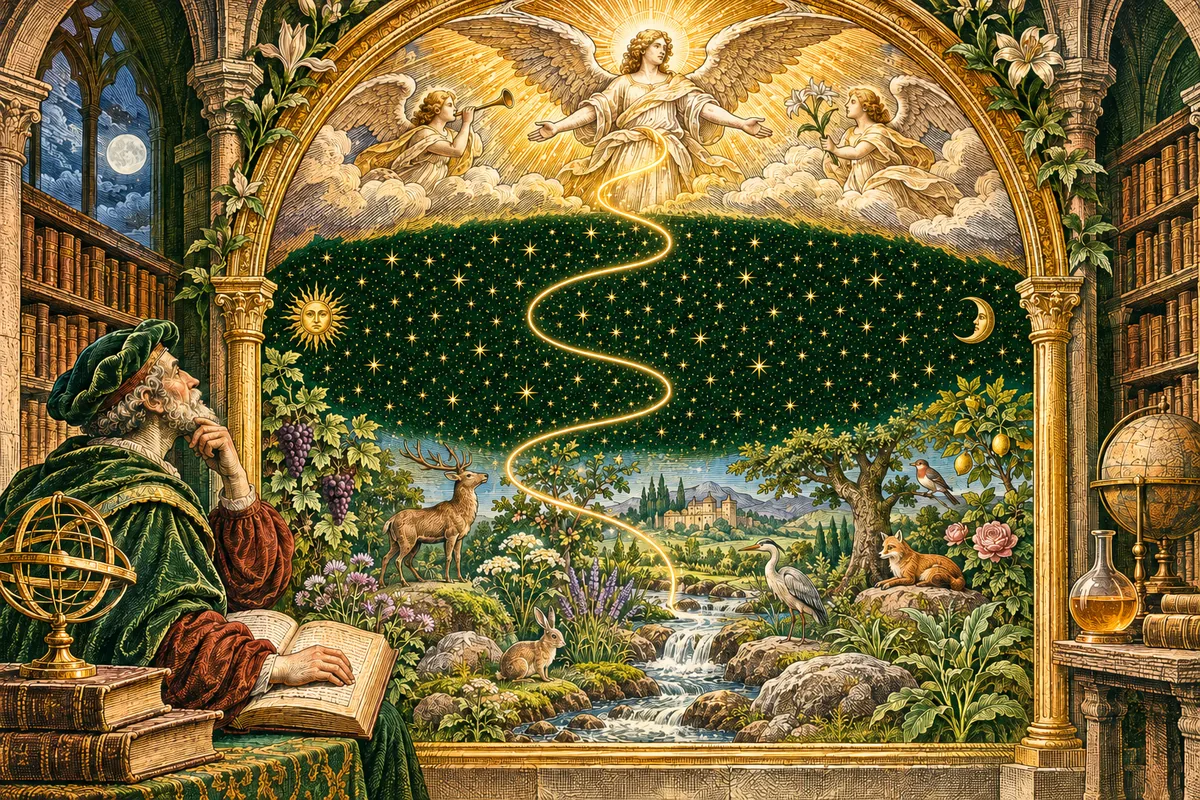
PICTURE THE TEACHING Three realms of one cosmos
The garden, stars, and angelic light distinguish Agrippa's three created worlds within one connected cosmos.
“Elementary, Celestiall”
1651 editionPage 1 Follow the direction of a power
Read “inferior” and “superior” as relative positions in that picture. Agrippa thinks a stone has its own capacity to act. The word for that capacity in the heading is “vertue.” If your stone is a lodestone, one such capacity is attracting iron. The attraction happens here, at the bottom of your drawing. Agrippa would still ask how a material body came to possess so particular a gift.
Draw downward arrows. In his scheme God gives power through intermediaries. The angel belongs to the spiritual order. The heavens convey influences. The stone receives a particular capacity in its material form. The list of animals, plants, metals, and stones names recipients in the lower world. Each item in the list need not pass its power along to the next.
SEE THE CONNECTION · AN ILLUSTRATED TEACHING How a stone belongs to three worlds
Agrippa traces material powers upward through celestial and intellectual causes, while influence travels toward the material recipient.
✦One connected cosmos✦Choose a part to look closer.
Elementary world
A stone belongs to the material world, where a learner first encounters the particular effect requiring explanation.
Read all the connections
- Elementary world
- A stone belongs to the material world, where a learner first encounters the particular effect requiring explanation.
- Celestial world
- The heavens mediate influences that Agrippa thinks distinguish the powers received by stones, plants, metals, and living bodies.
- Intellectual world
- Angels and intelligences connect celestial government with divine purposes; they are intermediate causes rather than independent ultimate sources.
- Divine source
- God stands above the three created worlds as their source, giving Agrippa's descending account of influence its ultimate beginning.
The learner's upward investigation reverses the direction of influence in Agrippa's model.
“every inferior is governed by its superior”
1651 editionPage 1 Read the diagram as a student
The opening page describes influence coming down. On the next page Agrippa invites the reader to ascend those same degrees. Beginning with the stone, a student learns what natural things can do. Mathematics and astrology are then supposed to reveal their heavenly relationships. Ceremonial religion prepares the student to approach their divine source.
That second arrow explains why the book begins with materials. In Agrippa’s world a person hoping to draw on a celestial influence would first need to know which material could receive it. The three books teach successive parts of one proposed practice. Returning to the top of the diagram now means understanding more about the stone with which you started.
ON THE ORIGINAL PAGE Look at the passage itself.
Open the book 01Agrippa · printed page 1
Agrippa opens Book I by naming the elemental, celestial, and intellectual worlds. Find the three in the paragraph beneath the decorated initial.
“Angels, the Heavens, Stars, Elements”
1651 editionPage 1
Reading exercise
Draw the two sets of arrows in different colors. At the bottom write “the stone attracts iron.” Label one arrow with what Agrippa thinks is given and the other with what the learner tries to discover.
Test your reading
A reader places the stars below the stone because the student studies stones first. What has the reader confused?
Check your answer
The learner begins below and travels upward in understanding. Agrippa’s proposed causes run in the opposite direction. Studying the stone first tells you the order of the investigation. It leaves the stars above the stone in his account of how influence arrives.