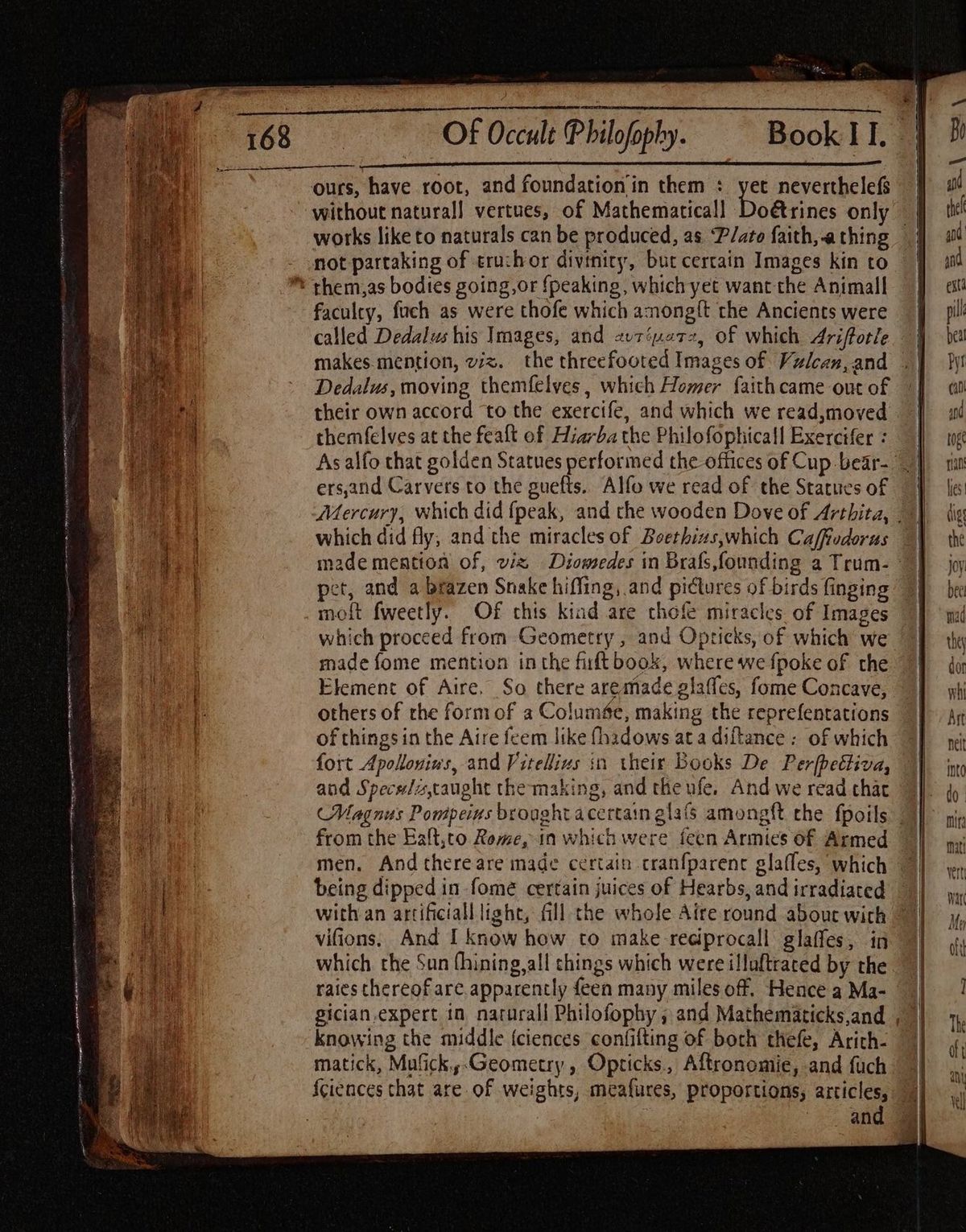
From the 1651 edition
Follow the change of examples from the wooden dove to curved mirrors. Both let Agrippa ask how a maker produces wonder.
How can a wooden bird appear to do something alive, and what does Agrippa think that teaches a magician to study?
Ask what the wooden dove imitates
Look halfway down the first long paragraph of examples. Agrippa reports an ancient story about a flying dove made of wood. Take the description at the level he gives it. An observer would see an artifact performing one recognizable action of a bird. The page supplies no plans for a machine and no record of Agrippa testing one. Its flight is a report he expects his reader to consider.
Now look a few lines higher. The translator speaks of things that lack the “Animall faculty.” A made object might move or make a sound while lacking the self-sustaining life Agrippa attributes to an animal. What interests him is how far a maker can reproduce one outward operation through an arrangement of materials and motions.
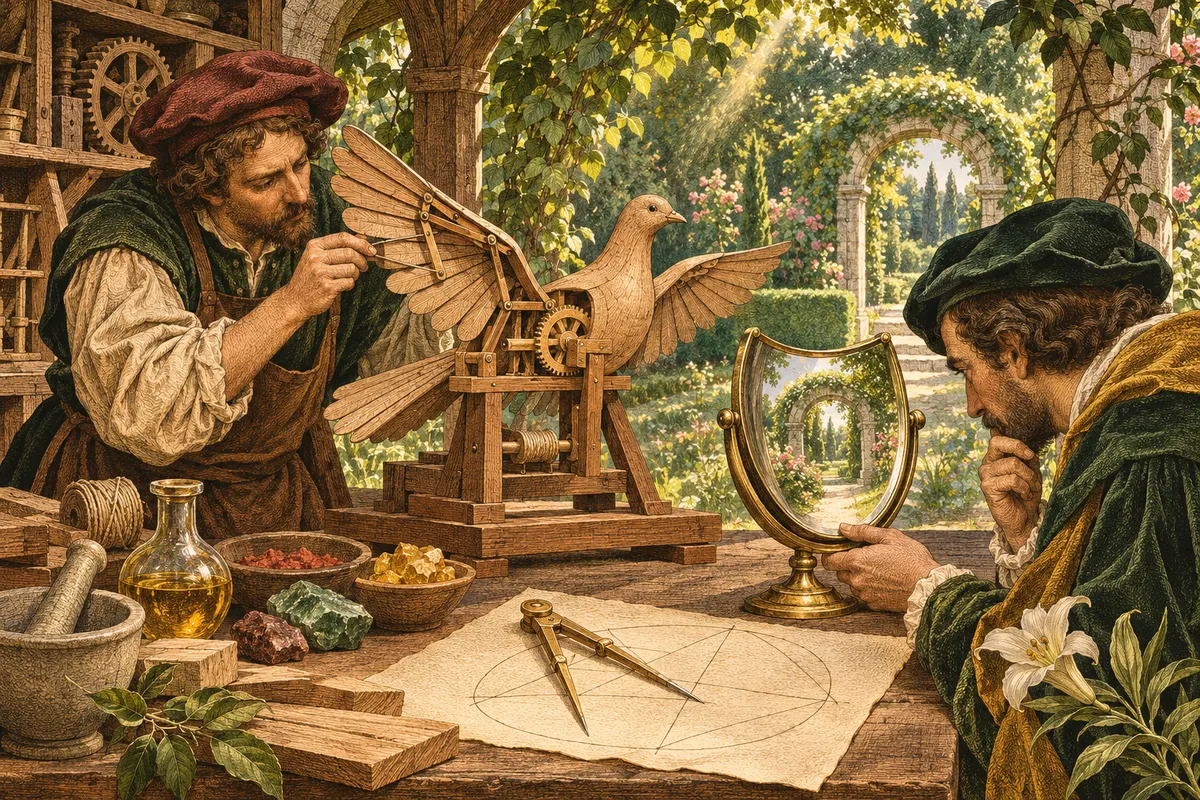 OCCULT HALL · INTERPRETIVE ILLUSTRATION
PICTURE THE TEACHING How materials become a mechanical wonder
The crafted bird and curved mirror connect natural materials with the mathematical relations that shape their effects.
“the wooden Dove of Arthita, which did fly”
1651 editionPage 168 Let the curved mirror explain the change of subject
After the musical statues and hissing bronze snake, the examples shift to shaped mirrors. The book calls them “glasses.” A concave mirror has a reflecting surface that curves inward. The shape changes the directions in which it sends light. Under suitable conditions the reflected rays can form an image that appears to occupy a place away from the mirror’s surface.
Notice what a maker has to understand to obtain a chosen effect. Moving the object, changing the curvature, or moving the viewer changes what can be seen. Geometry describes the shape and positions. Optics concerns the path of light. Agrippa treats an appearance that startles a viewer as something the maker might deliberately arrange.
SEE THE CONNECTION · AN ILLUSTRATED TEACHING How materials become a mechanical wonder
Agrippa uses artificial marvels to connect natural materials with mathematical relations and the maker's understanding.
✦Material + relation + craft✦Choose a part to look closer.
The wooden dove
The reported flying dove imitates a living action through an artifact, but the account does not supply construction plans or direct verification.
Read all the connections
- The wooden dove
- The reported flying dove imitates a living action through an artifact, but the account does not supply construction plans or direct verification.
- The curved mirror
- Curvature, object distance, and viewing position change the image, giving a clearer example of effects that depend on geometrical relations.
- The maker's knowledge
- A maker coordinates material properties with mathematical arrangements, explaining why a finished object can accomplish more than its ingredients considered separately.
A reported marvel and an intelligible optical example support different degrees of reconstruction.
“Geometry, and Opticks”
1651 editionPage 168 Read the list of subjects as a curriculum
At the foot of the page Agrippa lists optics alongside arithmetic, music, geometry, and astronomy. “Middle” describes their place between the study of physical things and the study of mathematical relations. To choose a mirror you have to know something about an actual reflecting material. To place it successfully you have to reason about shapes and distances.
This is how Agrippa opens the book on celestial magic. He has already made room for forms of wonder that depend on mathematical skill. When later chapters appeal to proportion in the heavens, his reader has an earthly example of what proportion can do. The example makes that next step intelligible. The mirror itself demonstrates a relationship between shape and an image.
ON THE ORIGINAL PAGE Look at the passage itself.
Open the book 01Agrippa · printed page 168
Follow the change of examples from the wooden dove to curved mirrors. Both let Agrippa ask how a maker produces wonder.
“the middle sciences”
1651 editionPage 168
Reading exercise
Draw a viewer, an object, and a mirror. Label one material question and one geometrical question a maker would ask. Then write beside the wooden dove the single action the old report claims for it.
Test your reading
If the wooden dove could truly fly, would Agrippa have to count it as a living bird to make his argument?
Check your answer
No. A maker’s ability to imitate flight is exactly the distinction he needs. An outward action can arise from a constructed arrangement. The mirror gives him a second instance in which a skilled maker can account for an apparently marvelous effect.