Read the spirit catalogue through Weyer’s declared purpose, and distinguish the copied promises from the editor who exposes them.
Johannes Weyer, Pseudomonarchia daemonum (1577), scan 468, cols. 911–912; scan 469, cols. 913–914
Inside this lesson 5 teachings · 2 source pages
The language of this teaching
- Pseudomonarchia
- Weyer’s title for the false or pretended monarchy organized in the spirit catalogue.
- Office
- A capacity or service assigned to a spirit, rather than merely its appearance.
- Editorial frame
- The statements around a reproduced text that guide how its claims are to be understood.
The catalogue has a frame
The Pseudomonarchia does not arrive here as an independent secret handbook. It appears near the end of Johannes Weyer’s large 1577 De praestigiis daemonum, a work concerned with demonic deception. Our reader preserves that entire volume, including the materials before and after the appendix. The short address to the reader is therefore the first necessary lesson. Weyer announces that he is publishing this material to expose the vanity, fraud, delusion and blasphemy of people who boast of being magicians. Those are his accusations, not a neutral description of a profession. They identify the hostile frame surrounding the attractive promises that follow.
 OCCULT HALL · INTERPRETIVE ILLUSTRATION
The physician and the forbidden catalogue
The physician and the printed volume evoke Weyer’s decision to expose a spirit catalogue within his critical work on demonic deception.
A title can change an argument
Near the end of the preface, Weyer supplies titles under which this material circulated: an office or book of the offices of spirits, together with a Solomonic title concerning princes and kings of demons. He then gives it his own name, Pseudomonarchia daemonum. The prefix points toward a false or pretended monarchy. This is an interpretive intervention: a collection that organizes powers by royal and noble ranks becomes evidence, for its editor, of a deceptive kingdom. The earlier titles describe what spirits supposedly do; the new title questions the authority of the whole arrangement before any individual entry is read.
Two voices surround one catalogue
The same printed appendix preserves promises of power and an editor’s argument against pursuing them.
Choose a part to look closer.
Earlier title
The book of spirit offices describes a collection of attributed capacities, presenting named figures as sources of knowledge and service.
Read all the connections
- Earlier title
- The book of spirit offices describes a collection of attributed capacities, presenting named figures as sources of knowledge and service.
- Copied entries
- Individual paragraphs state appearances, ranks and offices confidently, but their statements remain the claims of the reproduced catalogue itself.
- Weyer’s purpose
- The editorial preface says publication exposes deception and blasphemy, giving the copied material an explicitly hostile interpretive frame.
- Deliberate omissions
- Weyer admits leaving out words to discourage imitation, so the surviving printed witness cannot guarantee a complete earlier procedure.
A faithful reading attributes each claim and preserves the editor’s admitted limits.
Publication is not endorsement
The following page begins with Bael, Agares and Marbas. Its verbs sound confident: a spirit appears, teaches, answers, governs or transforms. A reader who opens directly at that page can easily mistake those statements for Weyer’s own recommendations. The preface prevents that shortcut. There are at least two voices in the volume: the catalogue’s voice, which describes claimed services, and the editor’s voice, which exhibits the catalogue as a problem. Our lessons retain both. We can explain an entry accurately without treating its promises as verified events or assuming that Weyer became a practitioner merely because he printed them.
Omission is part of the evidence
Weyer explicitly says that he has deliberately left out words in different places so that an excessively curious reader will not imitate the folly. That admission matters for the surviving text. It means this printed witness should not be presented as a complete ritual system whose gaps can confidently be filled from imagination. Nor does it tell us exactly which absent wording belonged at every point. A later manuscript or edition may supply different material, but that would require a separate comparison. The honest description is a deliberately mediated publication: rich evidence for a tradition, yet shaped by a writer who wished to interrupt its use.
Look at the passage itself.
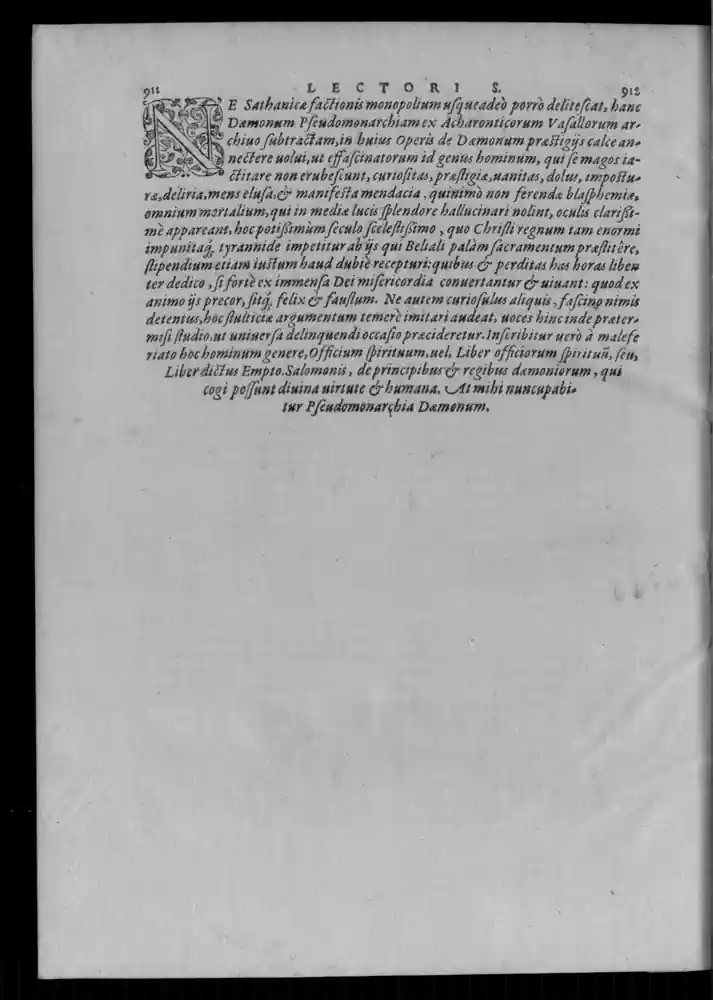 Open the book
Part 3, page 208 · original scan 468 · columns 911–912
Weyer states his purpose, acknowledges deliberate omissions and gives the earlier titles of the work.
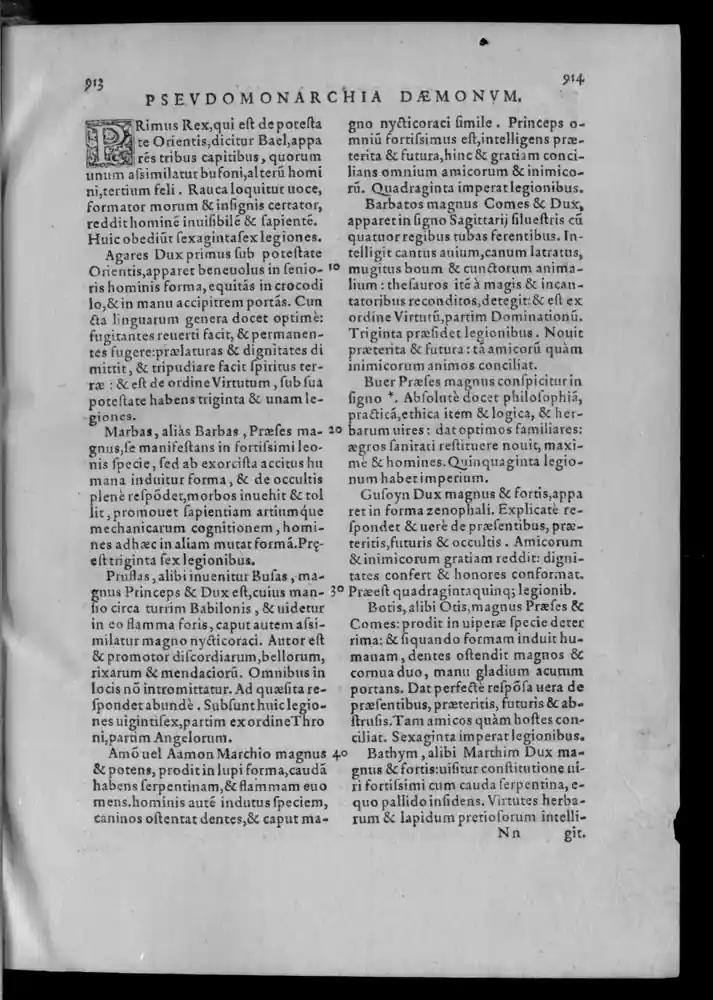 Open the book
Part 3, page 209 · original scan 469 · columns 913–914
The first spirit entries begin immediately after that critical preface.
Criticism has its own historical limits
Weyer is important in the history of criticism of witch prosecutions, but this does not make his position identical to modern disbelief in every supernatural claim. The preface remains intensely Christian and speaks of a satanic faction, repentance and divine mercy. Its explanation is theological as well as polemical. Reading him carefully means resisting two easy caricatures: an approving occult master on one side and a wholly secular debunker on the other. Begin instead with the exact task he assigns this appendix. He wants readers to see deception clearly, while the copied catalogue continues to reveal the extraordinary knowledge and influence that its earlier readers desired.
Separate the two voices
Use the opening preface and Bael’s first entry as a small exercise in attribution. You are identifying speakers and claims, not testing an operation.
- 01
Identify the promise
Write a sentence beginning, ‘The catalogue says that Bael…’ and complete it with one capacity named in the entry. Keeping that opening makes clear who is responsible for the claim and avoids silently turning a printed assertion into an established fact.
- 02
Identify the editor
Next write, ‘Weyer publishes this catalogue because…’ and summarize his stated concern with exposing deception. Do not replace his theological language with a modern explanation he did not give. The two sentences should now describe distinct levels of the same document.
- 03
Record the limit
Add a final note that Weyer admits omitting words. Explain why this matters when someone calls the 1577 appendix a complete practical manual. Your answer should distinguish the completeness of our facsimile from the completeness of the earlier material Weyer chose to reproduce.
The whole volume is preserved, while the printed appendix itself remains a selective and critical witness. Those two kinds of completeness should never be confused.
The text beside the teaching.
These selected pages accompany this free lesson. Enlarge a page and compare its details with the teaching.
Part 3, page 208 · original scan 468 · columns 911–912
Weyer states his purpose, acknowledges deliberate omissions and gives the earlier titles of the work.
What to carry into the next lesson
- The copied catalogue and its critical editor speak with different voices.
- The title challenges the authority of a supposed spirit monarchy.
- A complete facsimile can preserve a deliberately incomplete reproduced text.
The copied catalogue and its critical editor speak with different voices.
Can you explain it in your own words?
Try answering first, then open the explanation to compare your reasoning.
01Why does printing a spirit entry not prove Weyer endorsed it?
His preface says he reproduces the material to expose deception, and he distinguishes his critical purpose from the catalogue’s promises.
02What can we safely infer from his admission of omissions?
This is a deliberately mediated witness. We cannot identify every missing word or reconstruct a complete operation from that admission alone.