Pseudomonarchia daemonum
Thirteen readings of a contested spirit monarchy
 AN OCCULT HALL ILLUSTRATION
Enter its world.
The Pseudomonarchia daemonum appears near the end of Johannes Weyer’s 1577 De praestigiis daemonum. It preserves a rich catalogue of named spirits while framing their promises through a critic’s warnings. Weyer’s place in the history of opposition to witch prosecutions should not be confused with approval of the magic he reproduces.
Our thirteen lessons follow particular passages: the editor’s preface, the anatomy of an entry, promised learning, royal retinues, truth and deception, voices of the dead, treasure and custody, unseen music, and the argument in the margins. Each includes an individual modern illustration, a teaching diagram, original commentary and a close-reading exercise.
The reader preserves the complete 520-scan Latin volume in three color reading parts, divided at Books III and V. These are reading parts of one historical volume, not three original volumes. The Pseudomonarchia is in part 3: its title is page 207, preface page 208, catalogue pages 209–218 and concluding citation pages 218–219. Those correspond to original scans 467–479. Printed numbers 911–934 count columns, not PDF pages.
- The complete 520-scan 1577 Latin volume in three color reading parts
- Thirteen substantial lessons and thirteen individual illustrations
- Names, appearances, learned offices and contested truth
- Weyer’s critical preface and marginal interruptions
Thirteen disputed crowns
One free introduction · 12 member lessons
Why this number?
13 lessons form our expanded editorial path through this collection. The course count is a modern study arrangement, not the number of chapters, beings or stages stated by the historical authors.
Your way through.
Follow the teachings step by step, work through concrete examples, and connect each explanation with its cited passage.
A catalogue published against magic
Read the spirit catalogue through Weyer’s declared purpose, and distinguish the copied promises from the editor who exposes them.
14 min · Free introduction
An entry is more than a monster
Separate name, rank, appearance, office and retinue in the opening spirit entries.
14 min · Member lesson
The curriculum hidden in the catalogue
Compare the particular kinds of learning promised by Buer, Vapula and Cimeries.
14 min · Member lesson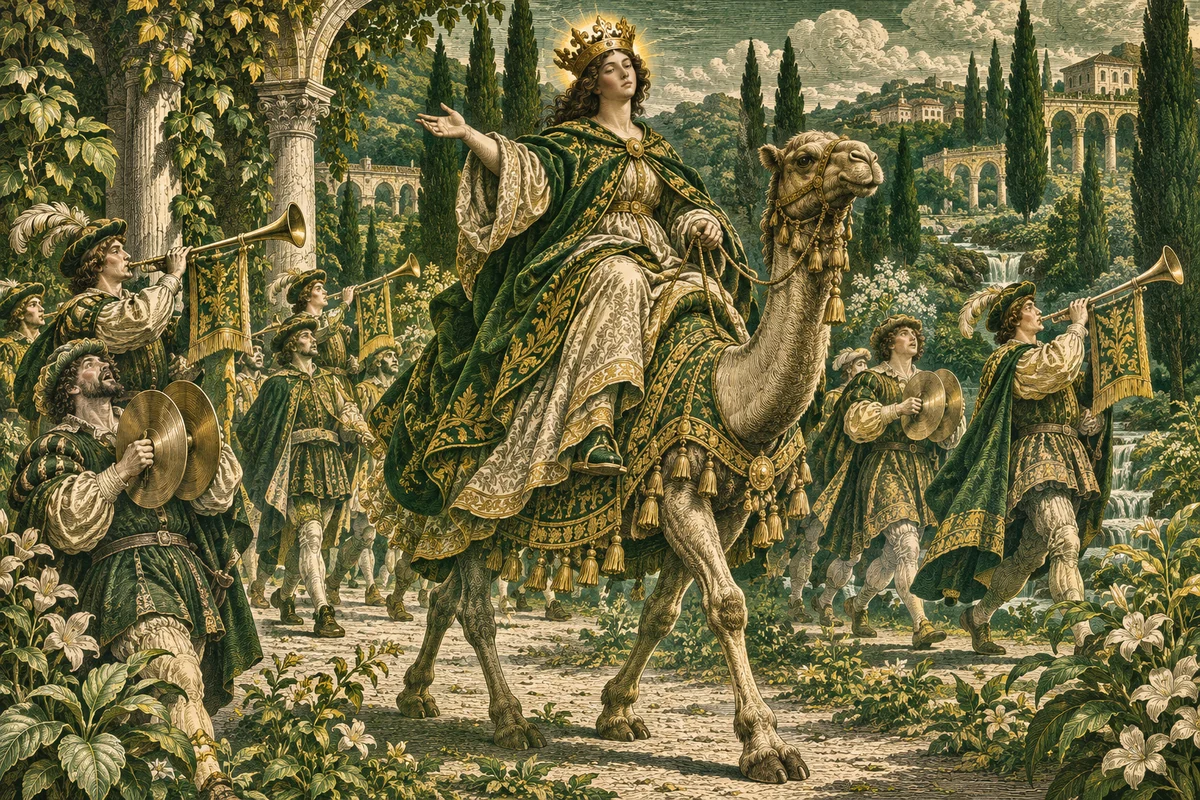
Royal power arrives with a sound
Explain how Paymon’s appearance, retinue and promised knowledge construct authority, while preserving the entry’s competing explanations.
14 min · Member lesson
When the catalogue doubts its own answers
Compare conflicting claims about truth, trust and constraint without silently repairing the historical wording.
14 min · Member lesson
Souls, bodies and voices are different things
Distinguish Murmur’s questioning of souls, Gamygyn’s visible respondents and Bifrons’s movement of bodies.
14 min · Member lesson
Hidden treasure is not the same as access
Distinguish discovering a treasure, answering about it and overcoming its claimed guardians in the offices of Pursan and Amy.
14 min · Member lesson
Music that has no visible player
Compare Amduscias’s unseen instruments with Phoenix’s alluring song and articulate speech.
14 min · Member lesson
The critic speaks from the margin
Read the concluding citation alongside Weyer’s interruptions, and explain why the page is a debate rather than an unqualified ritual manual.
14 min · Member lesson
The office of reconciliation
Compare promises to reconcile enemies, restore favor, and confer honor, distinguishing social relationships from information about them.
11 min · Member lesson
Changing form, changing capacity
Distinguish a spirit’s appearance, a human transformation, acquired understanding, and altered matter in the catalogue’s promises.
11 min · Member lesson
Plants, stones, and the learned arts
Explain how knowledge of natural substances joins philosophy, reasoning, astronomy, and workmanship in the catalogue’s educational promises.
11 min · Member lesson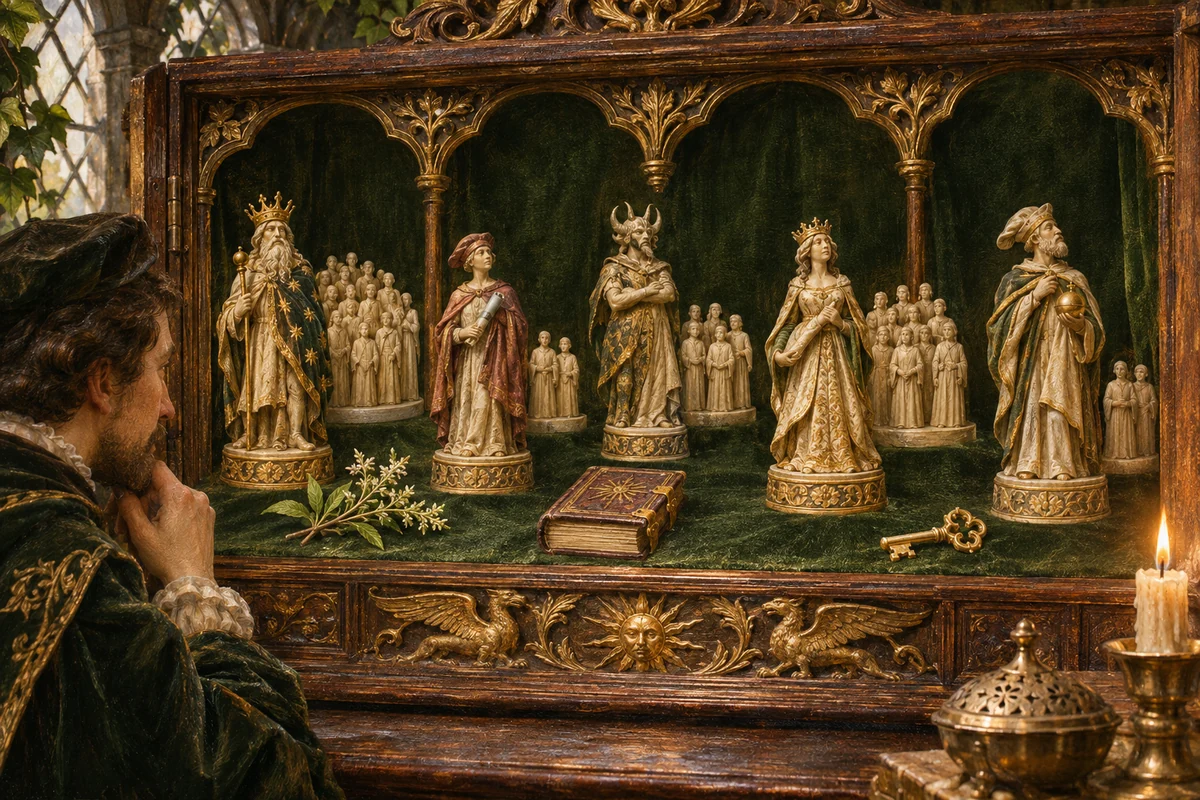
Rank, retinue, and capacity
Test whether royal titles and legion counts actually predict a spirit’s attributed knowledge or behavior in this witness.
11 min · Member lessonThe source beside you.
Members can explore the complete edition. Begin with the free introduction and its selected source pages.
The complete book awaits.
Pseudomonarchia daemonum
The complete historical editions and page-turning readers belong to the member library. Free introductions include the source excerpts used in their teaching.
Books & dates
De praestigiis daemonum, 1577 · reading part 1 of 3Johannes Weyer · 1577
De praestigiis daemonum, 1577 · reading part 2 of 3Johannes Weyer · 1577
De praestigiis daemonum, 1577 · reading part 3 of 3Johannes Weyer · 1577
Guided readings and teaching diagrams are original Occult Hall commentary. Imagined scenes are modern illustrations, separate from the historical source pages.
Petit Albert
Thirteen readings through talismans, elemental peoples and household wonders