Read the Juggler as a diagram of Papus’s whole system, and distinguish its symbolic teaching from its later fortune-telling use.
Papus, The Tarot of the Bohemians (English edition, 1892), p. 105, p. 107, p. 111.
Inside this lesson 5 teachings · 3 source pages
The language of this teaching
- Arcanum
- A named figure or division of the pack, treated here as a unit of symbolic teaching.
- Quaternary
- A four-part arrangement in which the fourth term can join a completed group to another cycle.
- Microcosm
- The human being understood as a small-scale expression of a wider order.
Begin with this book’s own pack
Papus asks us to imagine a pack as a portable arrangement of ideas. Its seventy-eight cards divide into twenty-two major figures and fifty-six minor cards, the latter arranged in four suits of fourteen. Our twenty-two lessons follow his discussion of the major figures, carrying the suit grammar and reading methods alongside them. This is an editorial path through his book. The Juggler opens it because Papus believes the first figure contains the principles that the remaining cards develop. We begin by looking, before memorizing a list of meanings.
 OCCULT HALL · INTERPRETIVE ILLUSTRATION
The whole pack upon one table
An original interpretation of the Juggler as mediator between three levels and keeper of four symbolic tools.
Read the figure vertically
At the top Papus sees the sign of universal life; below are the earth and its growth; between them stands a person working at a table. He turns this arrangement into three levels: divine, human, and natural. The human figure is a mediator because one hand rises and the other descends. A useful first exercise is to follow that movement with your eyes. The picture does not merely show someone possessing magical tools. It presents a human being placed between different orders of existence, capable of relating them.
Four objects make a grammar
The wand, cup, sword, and pentacle introduce four distinct functions. Papus links them to the four letters he writes Yod–He–Vau–He: initiative, reception, mediation, and the transition that gathers a completed cycle into another beginning. The repeated He does not make the final position redundant. It changes the level of the sequence. Lay four paper tokens beside the original page and give each a function before giving it an element. This prevents familiar modern suit associations from silently replacing the system actually explained in the book.
Four tools, four different operations
The objects are a grammar of functions before they become a collection of familiar associations. Follow what each one does.
Choose a part to look closer.
Wand · initiate
The wand supplies an initiating function: something begins or produces an impulse that the following terms receive and develop.
Read all the connections
- Wand · initiate
- The wand supplies an initiating function: something begins or produces an impulse that the following terms receive and develop.
- Cup · receive
- The cup supplies reception, allowing an initiating principle to be held and expressed within a different condition or form.
- Sword · relate
- The sword occupies a mediating position in this scheme, relating opposed terms rather than simply repeating either one of them.
- Pentacle · carry forward
- The fourth term gathers a completed relation and carries it forward, allowing one whole to become another sequence’s beginning.
Keep the four functions distinct; the whole pattern can then operate at more than one scale.
One card has several scales
Papus’s summary does not give the Juggler only one fixed definition. It reads the figure through God, humanity, and the active universe. That is why a card can act as a principle in one comparison and as a whole arrangement in another. A seed, a gardener, and a cultivated plot offer a modest analogy: each can initiate something at a different scale. The analogy helps explain his method; it is our teaching example, not an additional historical correspondence. Ask what scale a passage is discussing before deciding that two definitions contradict each other.
Look at the passage itself.
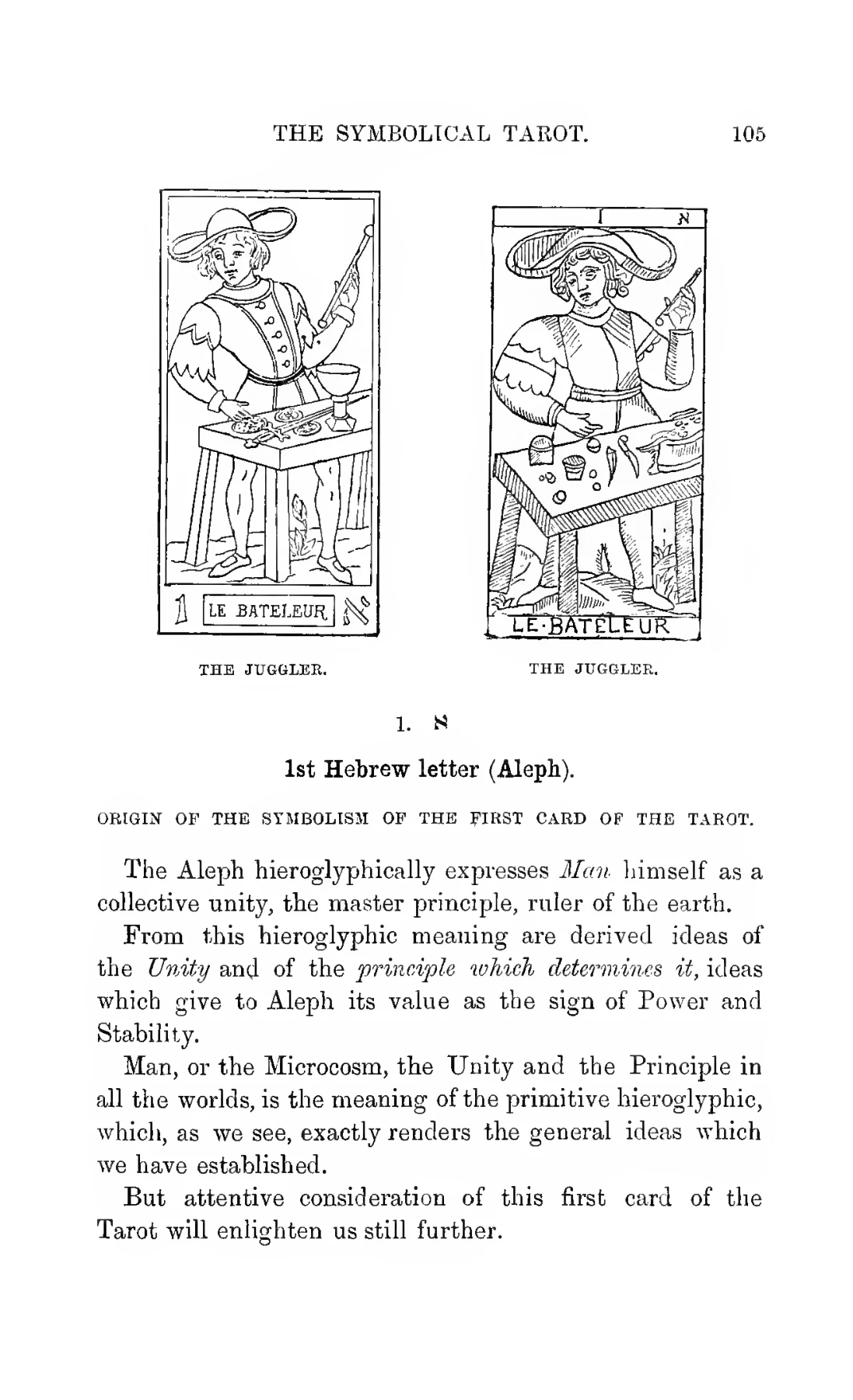 Open the book
Papus · printed page 105 · scan 136
The Juggler and Papus’s opening account of Aleph.
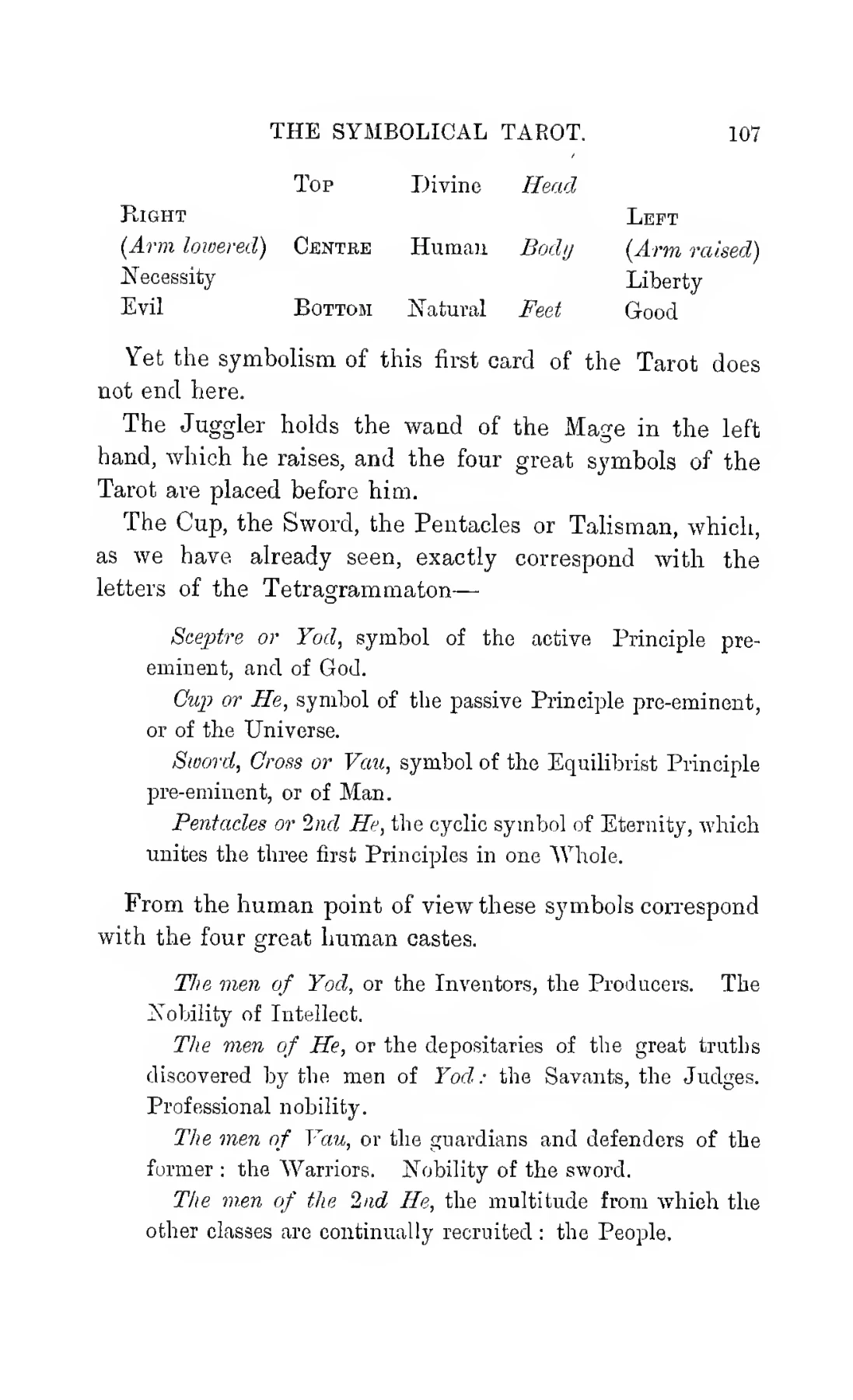 Open the book
Papus · printed page 107 · scan 138
The four objects, their principles, and the relation of above to below.
Enter the nineteenth-century workshop
This English edition presents Papus’s occult synthesis, including claims about ancient Egypt and the transmission of tarot that belong to his theory of the cards. We do not need to adopt those claims as proven history to learn how his symbolic system works. Nor is the Juggler simply a promise that a wish will materialize. In his later divining table it can stand for a male inquirer, a different use from the elaborate philosophical figure studied here. Keep these two uses visible: a symbolic architecture and a practical cartomantic vocabulary.
Build the Juggler’s table
Use four scraps of paper and an outline of a standing figure. This reconstruction tests whether the image’s parts have distinct jobs.
- 01
Set the three levels
Write divine above the head, human beside the body, and natural below the feet. Draw the raised and lowered hands as connections rather than arrows promising control. Explain aloud why a mediator needs both directions; removing either would collapse the relationship the picture expresses.
- 02
Give the objects functions
Place wand, cup, sword, and pentacle on the table. Beside them write initiate, receive, relate, and carry forward. Try describing a small project with those verbs: conceive a reading group, gather its material, bring readers together, then use its first meeting to begin the next.
- 03
Change scale without changing the pattern
Treat the entire first meeting as one initiative within a longer season. Notice that the finished four-part process can now become the first part of another process. That nested relationship is the real lesson of Papus’s repeated pattern, not a claim that every everyday event has an objectively occult structure.
You have reconstructed a relationship among parts, rather than merely attached a fashionable keyword to a picture.
The text beside the teaching.
These selected pages accompany this free lesson. Enlarge a page and compare its details with the teaching.
Papus · printed page 105 · scan 136
The Juggler and Papus’s opening account of Aleph.
What to carry into the next lesson
- Start with the visible arrangement before assigning meanings.
- Four tools carry four functions within a recurring sequence.
- The symbolic explanation and the divining table answer different questions.
Find the four tools on the original image and trace the two arms. Sketch the arrangement without reproducing the decoration.
Can you explain it in your own words?
Try answering first, then open the explanation to compare your reasoning.
01Why can the fourth position begin another sequence?
It completes and carries forward the first three, so that a finished group can act as a new first term at another scale.
02Does Papus give the Juggler only a fortune-telling meaning?
No. He develops divine, human, and natural meanings, then later supplies a separate divining use.
03What should be checked before borrowing an association from another deck?
Whether Papus actually gives it here; his letters, numbering, and suit correspondences can differ.