Explain how consecration, a visible appearance, a truthful answer and permission to depart form different parts of the glass-or-stone encounter.
MS V.b.26, manuscript p. 32 continuing onto p. 35, 'The method of the glass or stone'; transcription PDF pp. 27–29.
Inside this lesson 6 teachings · 2 source pages
The language of this teaching
- Consecration
- The prayer's act of assigning the book and stone a sacred, continuing use.
- Personal appearance
- The demand that the named spirit itself appear, visibly and recognizably.
- License
- Permission ending the visitor's required presence after the inquiry.
Two instruments receive one consecration
The passage begins by joining a written book to a material stone. Its prayer asks that both be blessed, confirmed and consecrated, and that the words written in the book remain effective when subsequently used. The book holds the authorized language; the stone supplies the place where an appearance is expected. This partnership matters because the stone is not described as independently possessing the full authority of the operation. The speaker attempts to establish that authority through the Passion, resurrection and other acts of Christ, followed by the saints and the Church.
The ambition is also durable. The request concerns future occasions and places, not only the moment of preparation. The consecrated objects would become reusable instruments within the manuscript's imagined art. Consequently, the prayer devotes attention to the status of the book itself: written language is a working component, rather than a reminder of something that matters only when spoken.
 OCCULT HALL · INTERPRETIVE ILLUSTRATION
The instrument gives an appearance a place
The bounded surfaces of mirror and stone evoke the passage’s demand for a distinct appearance that can support questioning.
The operator and companions are the intended witnesses
The subsequent demand asks for an appearance visible to the operator's own eyes and to the people standing nearby. This is a particularly important detail of this passage. It does not assign the sight to a separate child visionary while an adult merely interprets the child's report. Its desired result is a shared appearance that the speaker and companions can see plainly.
The requested spirit must also come personally. An obscure impression, a substitute or a report from somewhere else would not satisfy the wording. The repeated emphasis on plain and distinct sight attempts to reduce ambiguity about who has appeared and whether the gathering has actually encountered that being. The stone therefore functions as a bounded site of disclosure: an invisible subject is supposed to become visible in a way that permits identification and subsequent questioning.
Resurrection appearances supply the model of clarity
The prayer compares the desired visibility with Mary Magdalene's encounter in the garden, the disciples' experiences after the resurrection and Christ's appearance to the men of Galilee. These references do more than decorate the text with familiar religious stories. They supply examples of a spiritual or extraordinary event becoming accessible to human sight. The requested encounter is measured against recognized scenes of revelation.
The comparison does not make the spirit identical with Christ. Rather, the speaker borrows the authority and perceptual certainty attributed to those events. This explains why the passage spends so much space remembering Christ's birth, suffering and triumph: sacred history is presented as the foundation of the speaker's demands. Seeing is imagined as something that divine power can make possible, while the human audience remains dependent on that power for an intelligible manifestation.
An appearance must produce a truthful answer
Visibility is only the first success condition. The spirit must answer the questions put to it without deceit, fraud or evasive argument. The manuscript separates these requirements because an impressive appearance could still leave the operator ignorant. A recognizable visitor might speak falsely; a truthful statement might be too obscure to answer the actual question. The demand therefore combines personal presence, clear perception and relevant speech.
This gives the encounter a definite intellectual purpose. The speaker wants to know, see or hear particular things, and asks the visitor to disclose them plainly. The passage does not provide one fixed subject for every consultation. It instead supplies a general framework into which different questions could be inserted. Elsewhere, the collection's spirit offices identify possible subjects, such as natural properties, missing possessions or hidden treasure.
An appearance must do more than become visible
The glass passage specifies several independent conditions for a successful consultation. Each answers a different possible failure.
Choose a part to look closer.
Recognizable presence
The addressed being must appear personally and plainly to the operator and companions, rather than offer a substitute or private impression.
Read all the connections
- Recognizable presence
- The addressed being must appear personally and plainly to the operator and companions, rather than offer a substitute or private impression.
- Relevant speech
- The visitor must answer the intended question truthfully and intelligibly; an impressive appearance cannot make an evasive answer sufficient.
- Intact people and stone
- The protective clauses include mind, soul and body, other creatures and the stone itself, whose damage would compromise the instrument.
- An authorized ending
- The spirit remains until the inquiry is complete, then receives permission to depart; visible arrival alone does not finish the work.
The book supplies authorized words and the stone a proposed site of disclosure; neither replaces the encounter’s other conditions.
The stone itself is included in the demand for protection
The protective clauses name mind, soul and body, but they also expressly forbid the spirit from hurting or cracking the stone. That small material detail reveals an anxiety about the instrument as well as its user. The encounter is imagined as capable of disrupting the very surface through which it is supposed to become legible. A damaged stone would compromise the means of seeing.
The protection extends beyond the speaker to other creatures. The text attempts to contain the encounter's effects through a broad prohibition of injury, while also controlling appearance and speech. These are related but distinct ambitions: a figure could look agreeable and still threaten someone; an answer could be useful while the instrument suffered damage. The accumulation of conditions shows how many possible failures the manuscript imagines around a supposedly successful revelation.
Look at the passage itself.
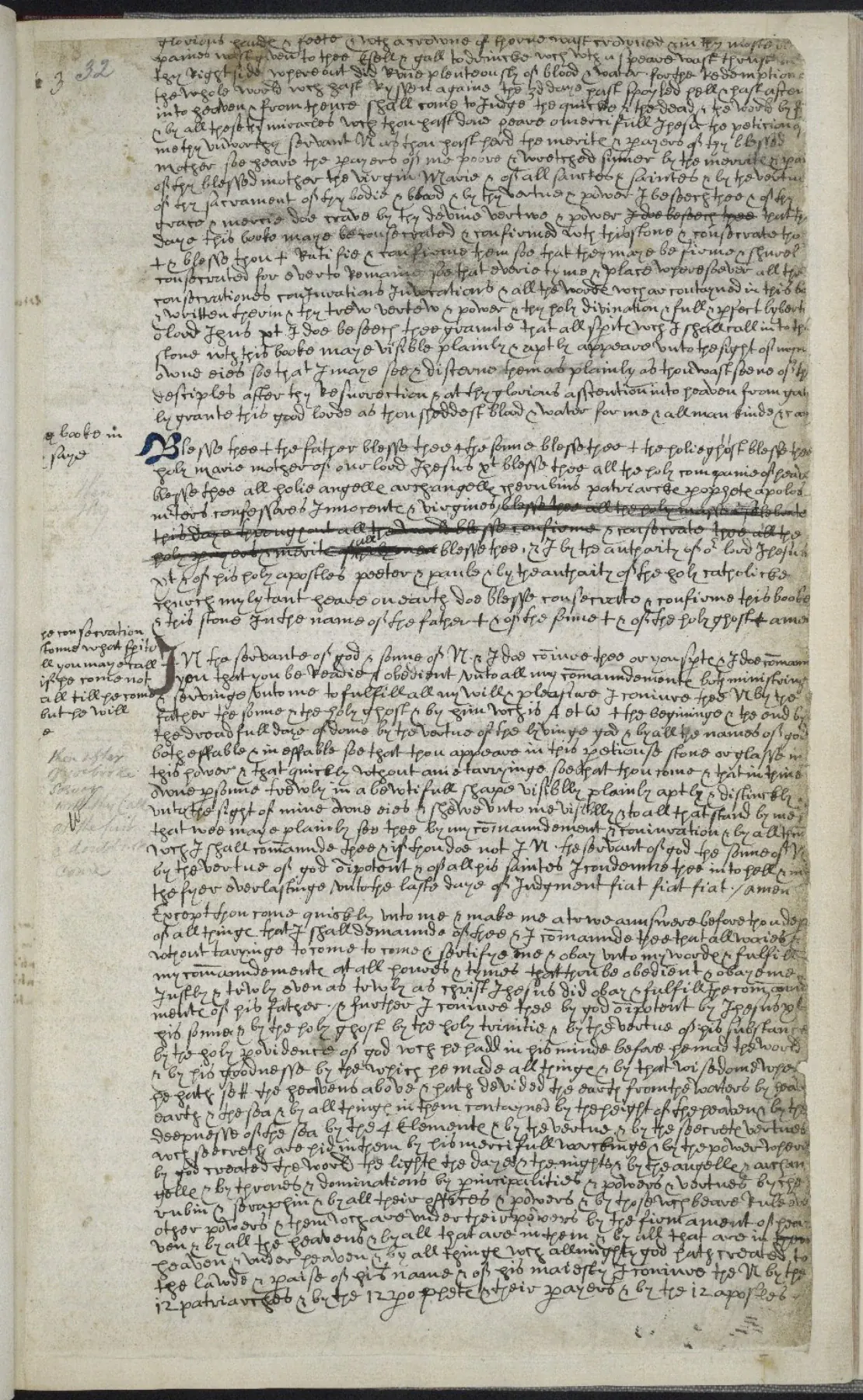 Open the book
Manuscript p.32 — The glass or stone: consecration and clarity
Read the historical manuscript's own wording alongside this lesson's explanation. The numbered page is 32; the viewer's scan number differs because the surviving volume begins at page 15.
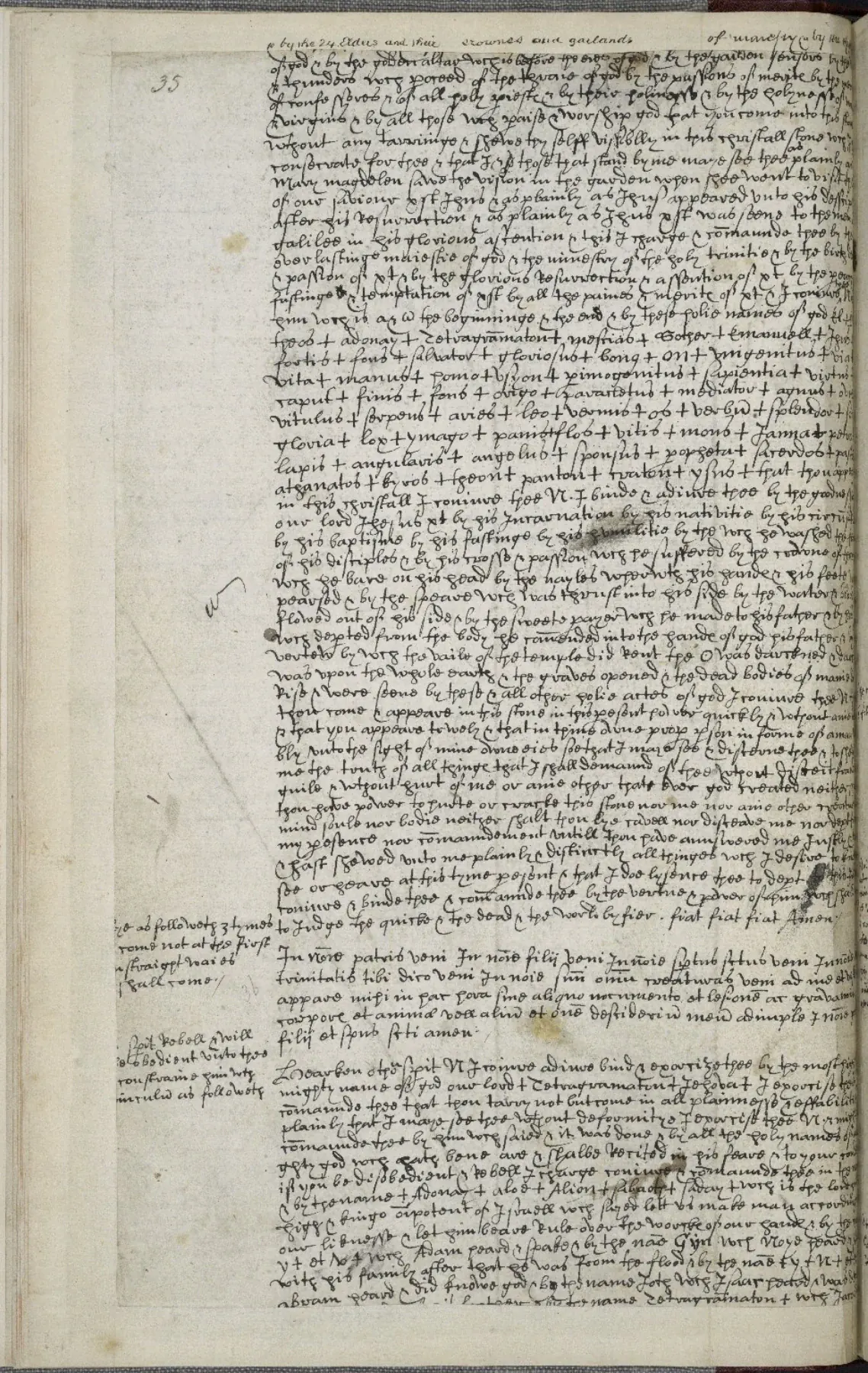 Open the book
Manuscript p.35 — The glass or stone: the continuation and departure
Read the historical manuscript's own wording alongside this lesson's explanation. The numbered page is 35; the viewer's scan number differs because the surviving volume begins at page 15.
Departure completes the controlled encounter
The spirit is not supposed to leave before answering, and the operator explicitly reserves permission for its departure. Arrival and exit are therefore paired. The written demand creates a temporary relationship whose intended end is the completion of an inquiry, followed by a release from presence. That structure explains why a license to depart appears elsewhere as a distinct part of the collection.
Within the passage, authority moves downwards: God creates and governs, sacred history validates the appeal, the speaker claims permission to command, and the spirit is expected to answer. Information moves back towards the human gathering through the stone. Those two movements explain the instrument more precisely than calling it simply magical. It is imagined as a meeting point between claimed divine authorization and the disclosure of concealed knowledge.
What would count as an adequate answer?
Consider the passage's own conditions together, without performing its ceremony. The question is why a visible figure would not, by itself, complete the proposed encounter.
- 01
Presence
The stone shows a recognizable human form to the speaker and companions. This would meet the demand for shared visibility, but it would establish neither the visitor's identity nor the truth of its speech.
- 02
Identity and disclosure
The visitor must be the being addressed and must answer the actual question plainly. An attractive figure giving an irrelevant speech would fail the manuscript's demand just as surely as an absent figure.
- 03
Integrity and completion
The stone and people must remain unharmed. After the relevant answers, permission to leave completes the encounter. Breaking the stone or departing before answering would violate additional conditions even if an appearance had occurred.
The passage defines success through several linked requirements: identifiable presence, intelligible information, freedom from injury and an authorized ending.
The text beside the teaching.
These selected pages accompany this free lesson. Enlarge a page and compare its details with the teaching.
Manuscript p.32 — The glass or stone: consecration and clarity
Read the historical manuscript's own wording alongside this lesson's explanation. The numbered page is 32; the viewer's scan number differs because the surviving volume begins at page 15.
Image license
Folger Shakespeare Library, MS V.b.26 (1) and (2), original manuscript page number as shown. Images reproduced under CC BY-SA 4.0.
Public-domain historical manuscript; image reuse under CC BY-SA 4.0. https://creativecommons.org/licenses/by-sa/4.0/. Historical leaves selected and divided into reading volumes; image data unchanged.
What to carry into the next lesson
- The book's words and the stone's visible surface perform different jobs.
- Biblical appearances provide models of clear revelation.
- A successful encounter requires truthful answers as well as visible presence.
- Protection and permission to depart complete the passage's conditions.
Compare the requests for the operator's own sight, the companions' sight and the stone's preservation. Explain why each adds a condition the others do not supply.
Can you explain it in your own words?
Try answering first, then open the explanation to compare your reasoning.
01Why does the passage ask for both a beautiful visible form and truthful answers?
Appearance makes the visitor perceptible and less frightening; truthfulness makes the encounter informative. Neither requirement guarantees the other.
02Does this particular passage require a separate child seer?
No. It repeatedly asks for the operator and nearby companions to see the spirit directly.
03Why are the book and stone consecrated together?
The book contains the words claimed to authorize the encounter, while the stone provides its proposed visible location.
04What does the prohibition on cracking the stone reveal?
Protection includes the material instrument, not only the bodies and souls of the participants.