Distinguish the surviving manuscript, its catalogue title, and the ritual voice that speaks within its pages.
Clm 849, f.3r and f.156v; complete facsimile scans 5 and 316.
Inside this lesson 5 teachings · 2 source pages
The language of this teaching
- Folio
- A manuscript leaf; recto is its front and verso its back.
- Shelfmark
- The collection identifier of a particular physical manuscript, here Clm 849.
- Ritual voice
- The speaking role constructed by the wording, distinct from a securely identified historical author.
The first surviving sentence is already in motion
Open scan 5, labelled 3r in the manuscript sequence. It does not introduce an author or announce a finished system. The first lines continue an address to named spirits and ask for a knowledgeable teacher. This abrupt entrance is a material fact: the library records that leaves 1 and 2 are missing. A leaf has two sides, so the absent beginning is not simply two missing screen images. The present viewer also includes binding and preliminary images before the first surviving numbered leaf. Reading begins by keeping these three counts separate: the original leaf, its front or back, and the modern scan.
 OCCULT HALL · INTERPRETIVE ILLUSTRATION
The surviving book
The worn binding and surviving leaves make the manuscript itself the starting point of the lesson.
What survives, what is promised
Three kinds of evidence occupy the same book, but they answer different questions.
Choose a part to look closer.
Surviving leaves
The physical manuscript preserves handwriting, diagrams, changes of language, and damaged edges that can be inspected directly in the facsimile.
Read all the connections
- Surviving leaves
- The physical manuscript preserves handwriting, diagrams, changes of language, and damaged edges that can be inspected directly in the facsimile.
- Missing beginning
- The loss of historical leaves one and two prevents us from treating the first surviving conjuration as the original opening.
- Promises in the text
- A promised teacher or appearance records what the passage requests; its presence on paper does not establish that the encounter occurred.
The manuscript is evidence for a written practice and its ambitions, while each claimed result needs a separate kind of evidence.
The speaking 'I' is a role in a text
The page repeatedly places an 'I' opposite an addressed 'you'. That grammatical arrangement makes the writing resemble speech, but it does not identify the historical copyist as a person who performed every action described. A manuscript can preserve instructions copied from another manuscript. Its speaker may be a role supplied for an imagined future operator. The request for a spirit in a master's form gives that role a particular desire: learning without fear. We can reconstruct the relationship that the wording proposes while leaving open who copied it, who read it aloud, and whether anyone claimed to obtain its promised result.
A descriptive title is not a recovered author's title
The library calls the object Liber incantationum, exorcismorum et fascinationum variarum, a book of varied incantations, exorcisms, and enchantments. 'Munich Manual of Necromancy' is a useful modern name for studying it. Neither label restores the lost opening or supplies an author's signature. Its shelfmark, Clm 849, identifies the physical volume within the collection. These different names do different work. The Latin catalogue description tells us what kind of material is present; the modern name makes the volume memorable; the shelfmark permits a precise reference. Treating them as interchangeable would turn a library description into an unsupported claim about original authorship.
The complete object contains more than one textual setting
Now compare scan 316, f.156v, with the opening page. The later page has a visibly different hand and German wording, while the first passage is Latin. This comparison is sufficient to show why the whole surviving codex deserves to remain available beside selected lessons. It does not establish the exact number of compilers, their dates, or their intentions. A change of language is evidence of textual variety, not automatically a new owner. Likewise, a different handwriting can indicate another copying activity without proving a separate tradition. The safest observation is concrete: these pages present different written voices within one preserved object.
Look at the passage itself.
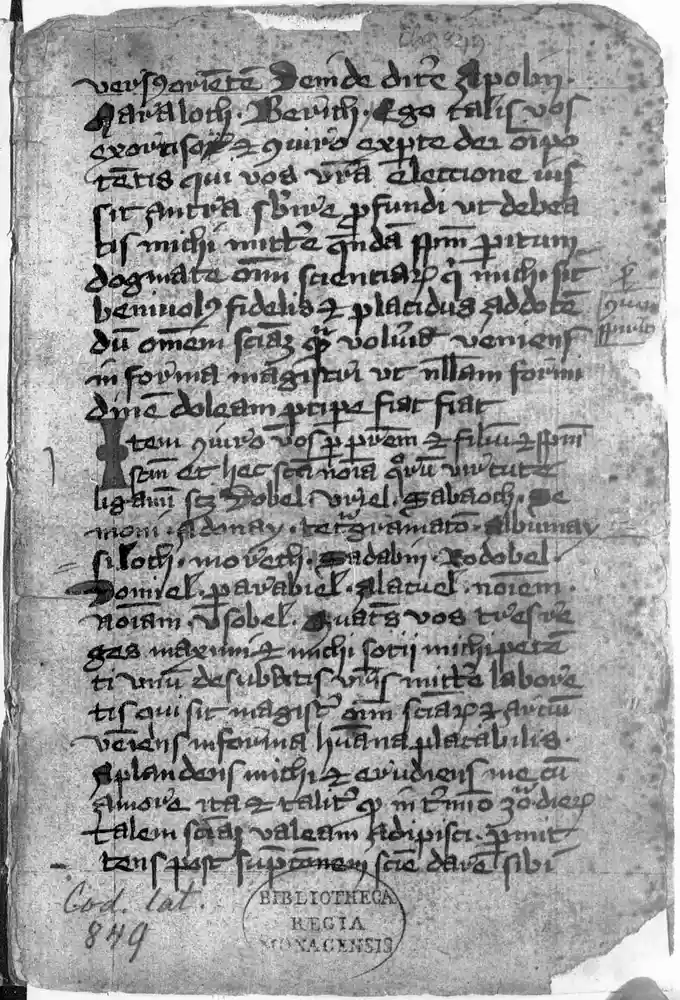 Open the book
Folio 3r — the surviving opening
The passage begins in the middle of an address, with named spirits and a request for a teacher.
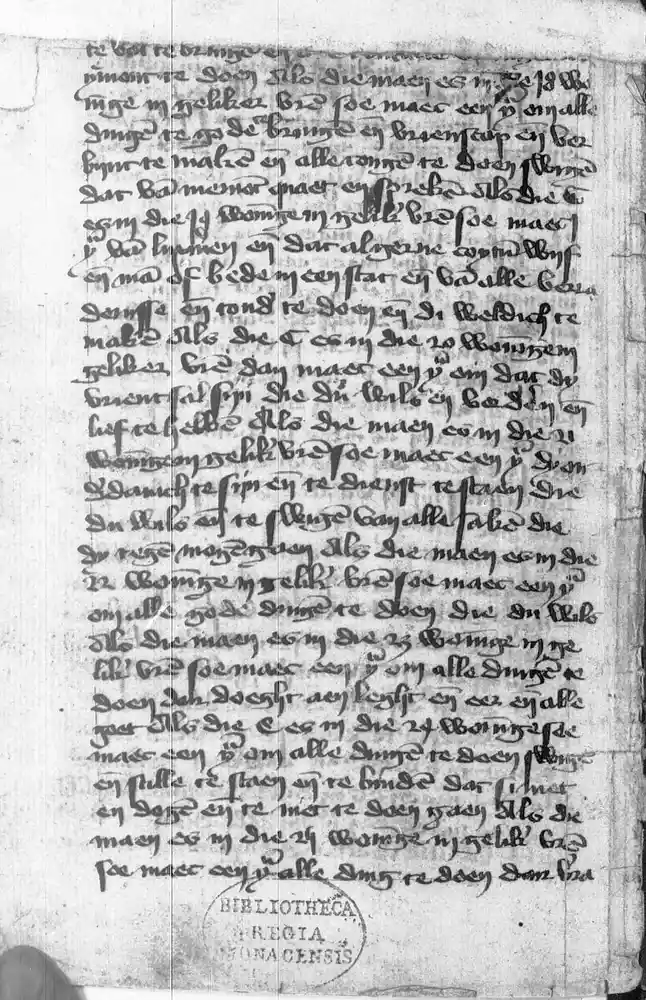 Open the book
Folio 156v — a different written voice
Compare the German wording and handwriting with the Latin opening; the full codex preserves both.
Read promises as promises, then ask what they require
The first page asks for an expert, kindly and faithful teacher who appears in a recognizable form. Those are conditions of an imagined successful encounter. They are not a report of a completed experiment, a modern test, or an explanation of how knowledge was independently checked. This distinction will guide the entire course. A banquet, a vessel vision, or a flying chair can be studied closely as a claim with a structure: someone desires something, addresses an authority, and specifies a result. Historical reading becomes richer when we examine those details rather than converting the manuscript's confident future tense into our own certainty.
Describe one page without filling the gaps
Suppose you are writing a caption for scan 5. Build it from three different kinds of statement, keeping observation and inference visible.
- 01
Begin with what survives
The image shows a handwritten Latin passage on the first surviving numbered leaf, 3r. It begins during an address rather than with a title. These are observations that a second reader can check directly against the image.
- 02
Add what the catalogue establishes
The holding library dates the manuscript to the fifteenth century and records missing leaves 1 and 2. Attribute those facts to the catalogue rather than pretending the visible page contains its own complete date and history.
- 03
Name the proposed relationship
The passage asks for a spirit to teach in a master's form. Describe that as the text's requested encounter. Do not turn it into a claim that the copyist personally met a spirit or acquired supernatural knowledge.
A precise caption can be informative while preserving the difference between surviving evidence, catalogue information, and interpretation.
The text beside the teaching.
These selected pages accompany this free lesson. Enlarge a page and compare its details with the teaching.
Folio 3r — the surviving opening
The passage begins in the middle of an address, with named spirits and a request for a teacher.
What to carry into the next lesson
- The historical beginning is missing even though the complete surviving scan sequence is available.
- Catalogue title, modern title, and shelfmark serve different purposes.
- The manuscript's promised effects must remain attributed to its own voice.
Compare the first and last cited pages. Record one visible difference, one shared material feature, and one question the images cannot answer.
Can you explain it in your own words?
Try answering first, then open the explanation to compare your reasoning.
01Does the first-person voice prove that the copyist performed the experiment?
No. It establishes a speaking role within the text; copying, reading, performance, and claimed success remain separate historical questions.
02Why is scan 5 not called folio 5?
Scans count individual digital images, including preliminary material; the manuscript labels this surviving leaf 3r.
03What can two different hands establish by themselves?
They establish a visible difference in copying, not a complete chronology or identification of the writers.