Read a Goetic entry as a structured profile rather than a single symbolic label.
Goetia, spirits 1–4; compare spirits 5–11 and the catalogue’s concluding observations. The local edition is Mathers and Crowley, 1904, printed pp.13–15.
Inside this lesson 6 teachings · 2 source pages
The language of this teaching
- Office
- An activity or capacity specifically attributed to a spirit.
- Lamen
- A sign or plate worn at the breast, here associated with a spirit’s seal.
- Legion
- A company of subordinate spirits in the catalogue’s account.
A catalogue entry is a compact profile
The Goetia introduces seventy-two spirits through entries that combine several kinds of information. A name identifies the being; a title places it within a hierarchy; an appearance describes how it is expected to become visible; an office states what it can supposedly accomplish; a legion count expresses the company under its command; and a seal supplies a graphic identifier. These categories should not be treated as interchangeable descriptions of a single quality. Bael, the first entry, is a king associated with the East, with sixty-six legions and a power of invisibility. His several forms include cat, toad and human appearances. Nothing in the entry requires us to interpret sixty-six as a numerical spelling of “invisibility,” or his royal title as the name of his animal form. The text builds an identity by adding distinct attributes. Its compactness can conceal this structure, but separating the fields reveals how the catalogue is intended to work.
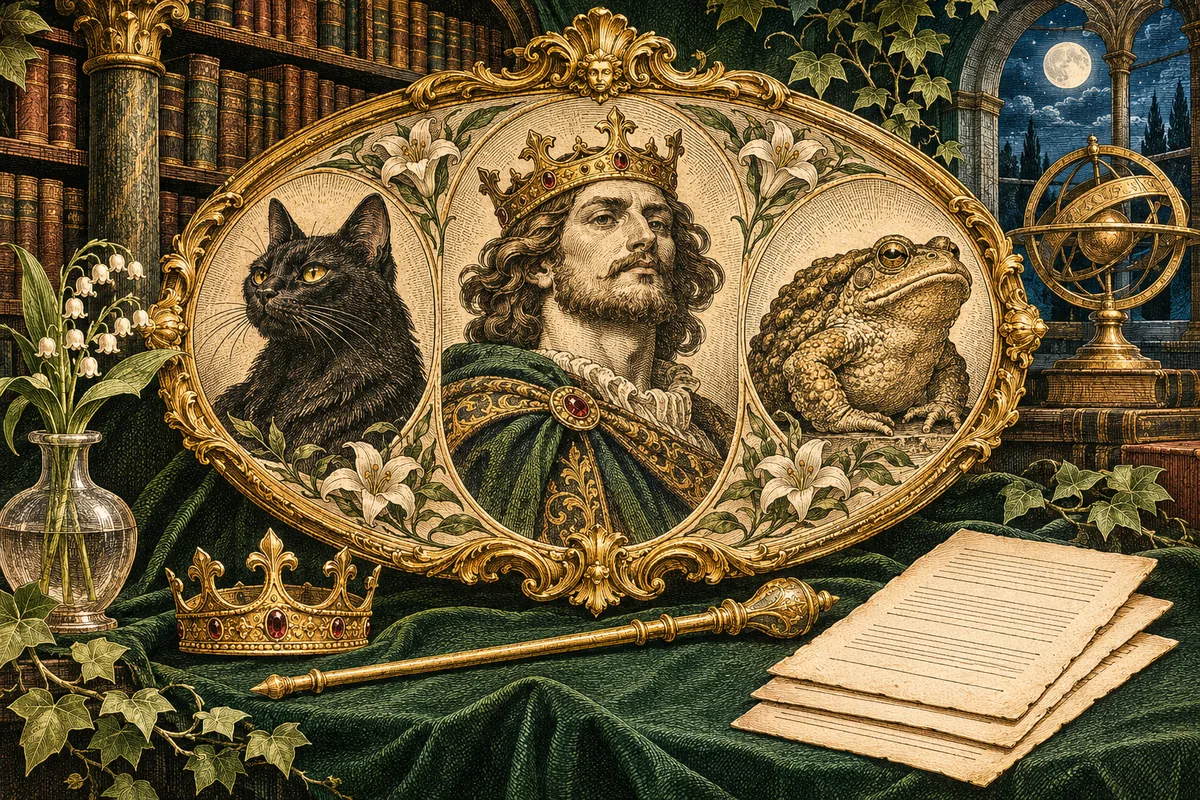 OCCULT HALL · INTERPRETIVE ILLUSTRATION
Read Bael in six separate fields
The cat, crowned human and toad illustrate Bael’s three reported forms; the six-field diagram separates appearance from rank, office, company and seal.
Read Bael in six separate fields
The first Goetic entry builds an identity by combining attributes. No single field substitutes for the others.
Choose a part to look closer.
Name: Bael
The name identifies the entry’s subject. It connects the accompanying title, forms, office, company and seal without making those attributes identical.
Read all the connections
- Name: Bael
- The name identifies the entry’s subject. It connects the accompanying title, forms, office, company and seal without making those attributes identical.
- Rank: king
- The royal title places Bael within the catalogue’s language of authority. It does not describe his animal appearance or name his particular office.
- Forms: cat, toad, man
- The entry describes several possible appearances. These recognizable forms concern manifestation, rather than supplying the abstract design of the accompanying seal.
- Office: invisibility
- Invisibility is the particular capacity assigned here. It should be read from the office statement rather than inferred from the royal title.
- Company: 66 legions
- The number concerns the subordinate company under Bael’s command. It is not presented as a numerical spelling of his name or attributed office.
- Seal: graphic identifier
- The seal connects recognition with the operator’s claimed authority. It serves a different function from the cat, toad or human portrait.
A complete profile joins the fields; a careful comparison keeps them separate.
Agares combines learned and disruptive powers
Agares, the second spirit, is called a duke. He appears as an old man riding a crocodile, with a goshawk on his fist, and the entry emphasizes a mild manner. His offices include teaching languages, bringing back those who have fled, disrupting dignities and causing earthquakes. The same profile therefore combines instruction, movement, status and disturbance. It cannot be reduced to “the language spirit” without losing much of the text's account. Nor does his mild appearance imply that every attributed power is harmless. Appearance and office are separate fields. The old man, mount and hawk make an unusually recognizable portrait, while the offices explain the kinds of service the catalogue assigns to him. Thirty-one legions belong under his government. The entry also remembers an earlier angelic order, the Virtues. This adds a further layer: present rank and remembered celestial origin are not necessarily the same classification, even within a single short description.
Vassago is defined chiefly by hidden information
The third entry names Vassago as a prince with twenty-six legions. It associates his nature with Agares, calls him good-natured, and attributes knowledge of the past and future and the discovery of hidden or lost things. Unlike a lavish visual portrait, this short entry concentrates on disposition and office. The reference to Agares creates a relationship between entries, but it does not give Vassago every separate attribute in Agares's profile. The text still supplies a different rank, legion count and seal. This is an important reading distinction: a comparison can indicate affinity without establishing complete identity. Vassago's office also contains more than one kind of hiddenness. A lost object is concealed by location or lack of knowledge, whereas a future event is concealed by time. The catalogue groups both under a spirit's capacity to disclose what ordinary perception cannot presently reach. Its interest is the removal of uncertainty across several dimensions.
Gamigin joins the classroom to the world of the dead
Gamigin, the fourth spirit, is a marquis with thirty legions. His initial form is a small horse or ass, followed by a human appearance at the operator's request; his voice remains hoarse. The entry assigns him instruction in the liberal sciences and knowledge concerning the souls of people who died in sin. These are strikingly different subjects placed together. The liberal sciences belong to learned education, while the second office concerns a hidden posthumous condition. Their combination shows that the Goetia does not maintain a modern boundary between an educational spirit catalogue and a catalogue of supernatural revelation. Both count as knowledge inaccessible or difficult for an ordinary seeker. The change from animal to human form also has a practical role in the narrative: the encounter is meant to become intelligible. The spirit's recognizable initial manifestation and its subsequent speaking form answer different needs, identification and communication, within the same imagined exchange.
Rank and legion count do not form one simple ladder
Compare these first four entries. Bael is a king with sixty-six legions; Agares a duke with thirty-one; Vassago a prince with twenty-six; Gamigin a marquis with thirty. The numbers do not simply repeat the order of titles in a neat descending sequence. Vassago's princely title does not automatically give him more legions than Gamigin. The book uses aristocratic language to organize authority, but its individual profiles preserve particular counts and combinations. Some later entries even combine titles, such as president and earl. That means the reader should not force every being into a modern organizational chart with exactly one title and a strictly predictable number of subordinates. The legion count expresses the extent of a spirit's commanded company as the catalogue presents it. The office expresses the kind of activity attributed to it. A larger company does not by itself mean a broader range of knowledge or a more suitable office for a particular question.
Look at the passage itself.
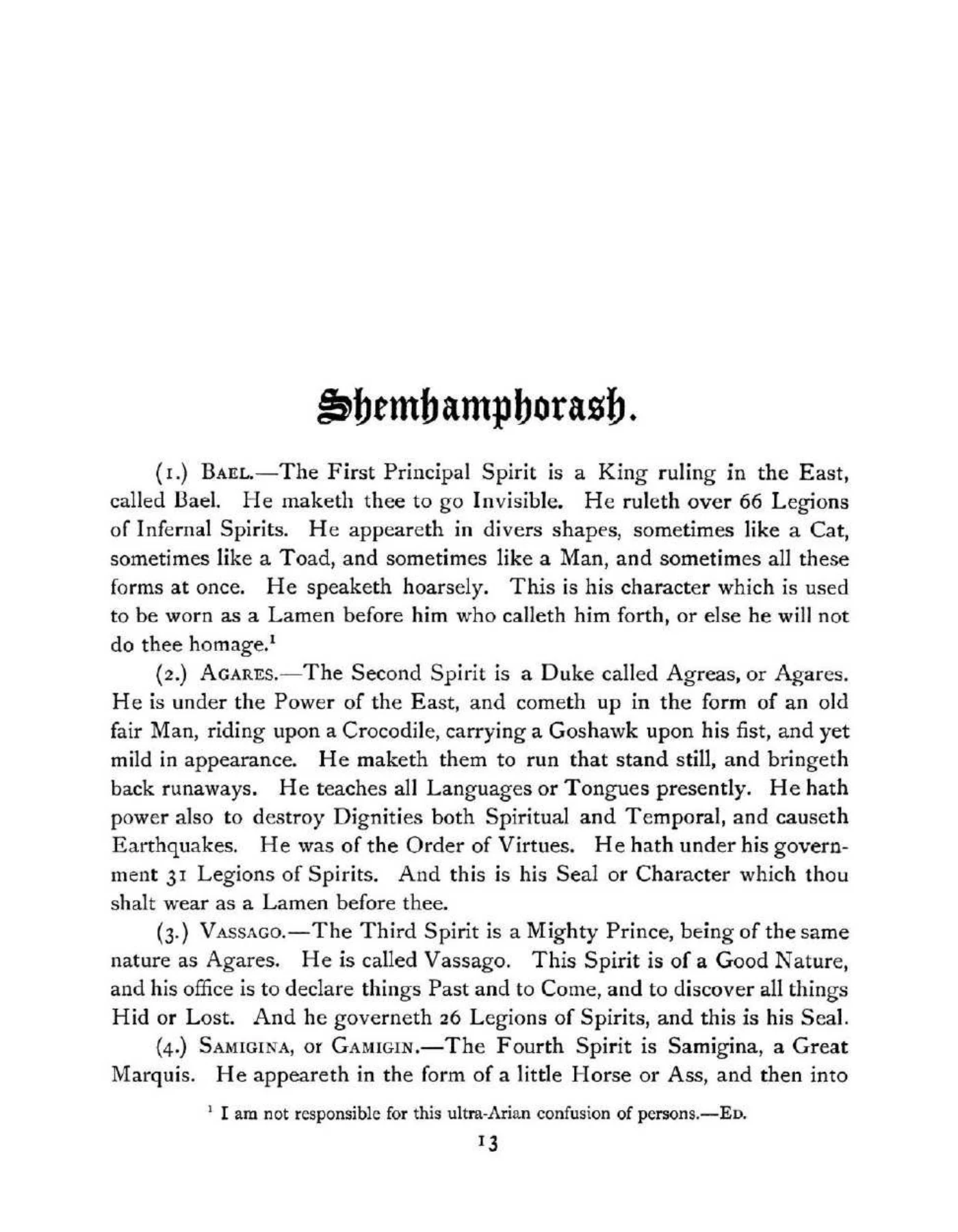 Open the book
Printed p.13 — Bael, Agares, Vassago and Gamigin
The opening entries supply the six profile categories used throughout this lesson.
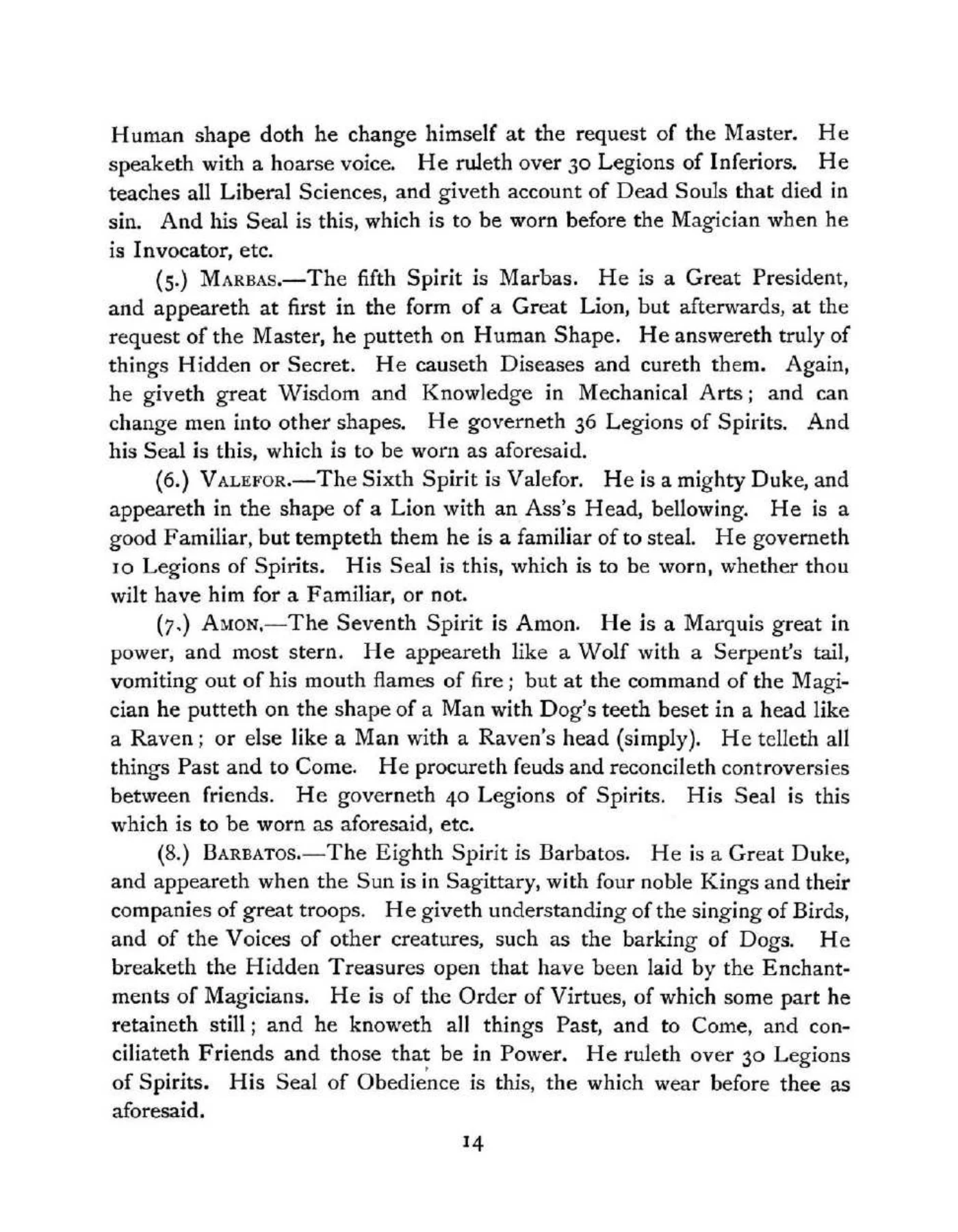 Open the book
Printed p.14 — Gamigin’s offices continue
The page begins with Gamigin’s instruction in liberal sciences and account of the dead; later entries offer comparisons.
The seal connects identification with claimed obedience
The entries repeatedly associate a spirit's seal with the operator's lamen, a sign worn at the breast. In the text's theory, the sign helps establish the relationship in which the named spirit recognizes the operator's claim to obedience. It is therefore part of the encounter's authority, not merely an illustration of the spirit's face. The same being can have an animal portrait, a human speaking form and an abstract seal without contradiction, because the three serve different functions. For a complete study profile, combine name, rank, appearance, office, company and seal, then compare a second entry using exactly the same headings. This reveals both shared structure and meaningful differences. Agares and Vassago share an expressed affinity but differ in rank and office; Vassago and Gamigin both disclose hidden information, but one emphasizes events and lost things while the other includes the dead. The catalogue becomes a map of attributed capabilities rather than a gallery of interchangeable frightening images.
How are Vassago and Gamigin different teachers?
Compare their offices while keeping rank, appearance and legion count in separate fields.
- 01
Vassago
A prince with twenty-six legions; his entry emphasizes past and future events and hidden or lost things.
- 02
Gamigin
A marquis with thirty legions; his entry combines liberal sciences with knowledge of souls who died in sin.
- 03
Interpret the difference
Both concern otherwise inaccessible knowledge, but they do not teach identical subjects or occupy the same rank.
A shared interest in hidden knowledge does not erase differences in subject, rank, company or identifying sign.
The text beside the teaching.
These selected pages accompany this free lesson. Enlarge a page and compare its details with the teaching.
Printed p.13 — Bael, Agares, Vassago and Gamigin
The opening entries supply the six profile categories used throughout this lesson.
What to carry into the next lesson
- A Goetic profile combines name, rank, appearance, office, legion count and seal.
- Similar offices or shared affinities do not make two spirit entries identical.
Compare their offices while keeping rank, appearance and legion count in separate fields.
Can you explain it in your own words?
Try answering first, then open the explanation to compare your reasoning.
01How are Vassago and Gamigin different teachers?
A shared interest in hidden knowledge does not erase differences in subject, rank, company or identifying sign.
02What distinguishes Vassago’s hidden knowledge from Gamigin’s?
Vassago concerns past and future events and hidden or lost things. Gamigin combines liberal sciences with knowledge concerning souls who died in sin.
03Why does a spirit’s legion count not explain its office?
The count describes its subordinate company; the office describes its attributed capability. A larger company does not automatically imply a particular kind of knowledge.