Reconstruct the planetary-hour sequence, explain its weekday pattern, and connect particular planets with the purposes assigned to them.
Book I, chapter II, printed pp. 10–12; compare the preliminary planetary tables, printed pp. 6–7.
Inside this lesson 6 teachings · 2 source pages
The language of this teaching
- Planetary hour
- An interval assigned to one of the seven traditional planets in a repeating sequence.
- Weekday ruler
- The planet governing the first daylight hour and lending its name to the day.
- Planetary virtue
- A quality or field of action attributed to a planet, such as Mercury’s association with learning and writing.
The seven planets form an ordered ladder
The Key’s first substantial lesson in timing is an order of seven: Saturn, Jupiter, Mars, Sun, Venus, Mercury and Moon. Chapter II presents this as a descent from the highest planet to the lowest. The Sun and Moon count as planets within this historical scheme because the term covers the seven wandering heavenly lights. The order matters more than memorizing seven isolated associations. It is the engine that generates the hourly cycle. After the Moon, the sequence returns to Saturn and begins again. Nothing in this rule makes the Sun always first: the starting point depends on the weekday. Once that point is chosen, the same order continues. This lets one compact sequence produce a complete timetable rather than requiring seven unrelated sets of instructions.
 OCCULT HALL · INTERPRETIVE ILLUSTRATION
Seven rulers, twenty-four changing hours
The paired dials distinguish daylight from darkness, the two spans divided separately in this lesson’s planetary clock.
A weekday and an hour answer different questions
Saturday belongs to Saturn, Sunday to the Sun, Monday to the Moon, Tuesday to Mars, Wednesday to Mercury, Thursday to Jupiter and Friday to Venus. The weekday identifies the first hour’s ruler, not the ruler of every hour in that day. The author’s Saturday example therefore runs Saturn, Jupiter, Mars, Sun, Venus, Mercury, Moon, and then Saturn again. The eighth hour repeats the first because seven positions have elapsed. This is why a Mercury hour can occur on Saturday: the larger period and the smaller period have different labels. The text asks the reader to coordinate these labels. A day gives an overall planetary setting, while an hour locates a more particular interval within that setting. Collapsing them into one label destroys the system’s useful distinctions.
Seven rulers, twenty-four changing hours
Read around the ring in this order. The first ruler at sunrise names the weekday; the sequence then keeps going.
Choose a part to look closer.
Saturn
Saturday begins here. After seven hours the sequence returns to Saturn, while the length of each hour follows daylight or darkness.
Read all the connections
- Saturn
- Saturday begins here. After seven hours the sequence returns to Saturn, while the length of each hour follows daylight or darkness.
- Jupiter
- The next place belongs to Jupiter. Its position in this cycle is different from its role as Thursday’s weekday ruler.
- Mars
- Mars follows Jupiter in the hourly order. Moving one place means advancing one seasonal hour, not one whole weekday.
- Sun
- The Sun follows Mars. Counting twenty-four hours from Saturday brings the next sunrise to this position and therefore Sunday.
- Venus
- Venus follows the Sun in the repeating order. Its hours can occur within a weekday named for another planet.
- Mercury
- Mercury follows Venus and precedes the Moon. On Saturday it returns at hours six, thirteen and twenty in the count.
- Moon
- The Moon completes the seven-part sequence before Saturn begins again. Daylight and nighttime continue the same order without restarting.
Seven governs repetition; twelve divides each light or dark span; twenty-four carries the count into the next weekday.
The day changes; the count stays twelve
Compare three example day lengths, then follow the Key's sequence of hourly rulers.
Divide each span by twelve: 16 × 60 ÷ 12 = 80 minutes by day; 8 × 60 ÷ 12 = 40 minutes by night. Both bars use the same clock-time scale.
Hour 1 is assigned to Saturn. Saturn begins the sequence because the day is Saturday.
Key of Solomon, Book I, chapter 2, for the dawn-starting planetary sequence. The bars are a modern mathematical demonstration of seasonal hours, using example day lengths.
The count begins at sunrise
Chapter II explicitly places the beginning of its hourly count at dawn. That statement is essential when comparing the prose with the preliminary tables, which include columns labeled from sunset and midnight. The table is a different presentation of the material and should not silently replace the chapter’s stated starting point. The chapter counts twenty-four hours across day and night, but does not here explain how to divide daylight and darkness into twelve separate seasonal portions. That unequal-hour scheme is historical background often used with planetary hours; Abramelin describes it explicitly when criticizing it. For this lesson, the secure rule supplied by the Key is narrower and sufficient: start the day’s first planetary hour at sunrise, then advance through the repeating seven-planet order.
Why the next weekday follows from the arithmetic
The weekday sequence can be understood rather than merely accepted. Twenty-four divided by seven leaves a remainder of three. Consequently, after a full twenty-four-hour cycle, the next first hour stands three positions farther along the planetary ladder. Begin Saturday with Saturn. The twenty-second hour returns to Saturn, the twenty-third is Jupiter, and the twenty-fourth is Mars. The following first hour is therefore the Sun, which explains Sunday. Starting with the Sun and advancing another twenty-four positions produces the Moon, explaining Monday. This calculation is a worked consequence of the chapter’s rule. It shows why the weekday order differs from the order of the planetary spheres. The familiar week emerges by repeatedly advancing through the same cycle, not by rearranging the planets at random.
Planetary virtues turn a schedule into a purpose
The chapter gives timing a subject. Mercury is connected with eloquence, intelligence, business, science and writing. The Moon is connected with journeys, messages and navigation. Jupiter concerns honors, friendship and riches; Venus also concerns friendship, but adds kindness and agreeable travel. These overlaps are instructive. The categories are not mutually exclusive boxes in which each human concern belongs to exactly one planet. A journey may be considered through movement and navigation, through agreeable company, or through successful communication. The chosen description emphasizes one aspect of the undertaking. The Key’s word virtue means an attributed capacity, not simply moral goodness. A planetary virtue explains what kind of help the text expects from the selected time. The timetable alone cannot supply that explanation.
Look at the passage itself.
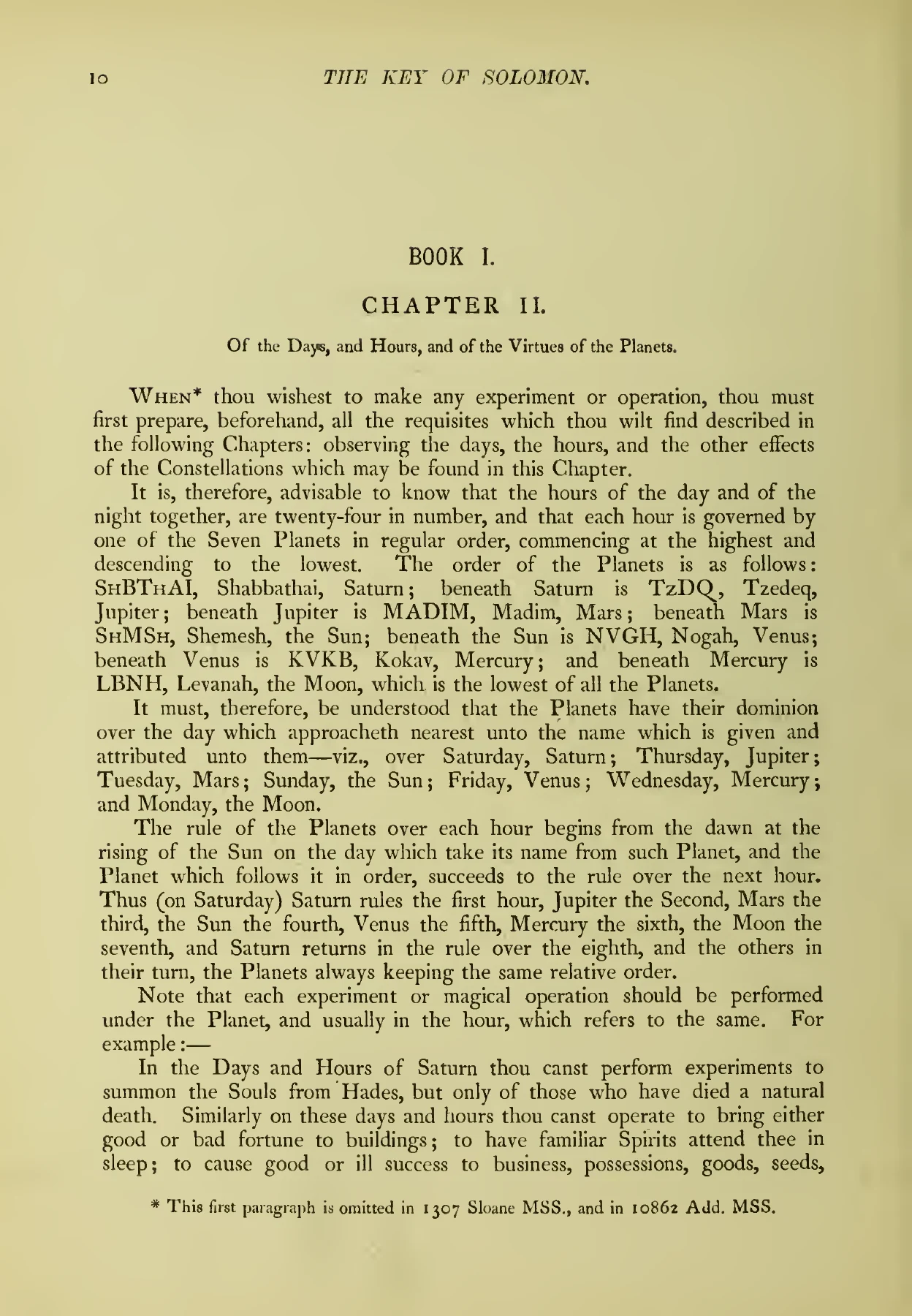 Open the book
Book I.II: dawn and the planetary sequence
The prose establishes the order and demonstrates it with Saturday.
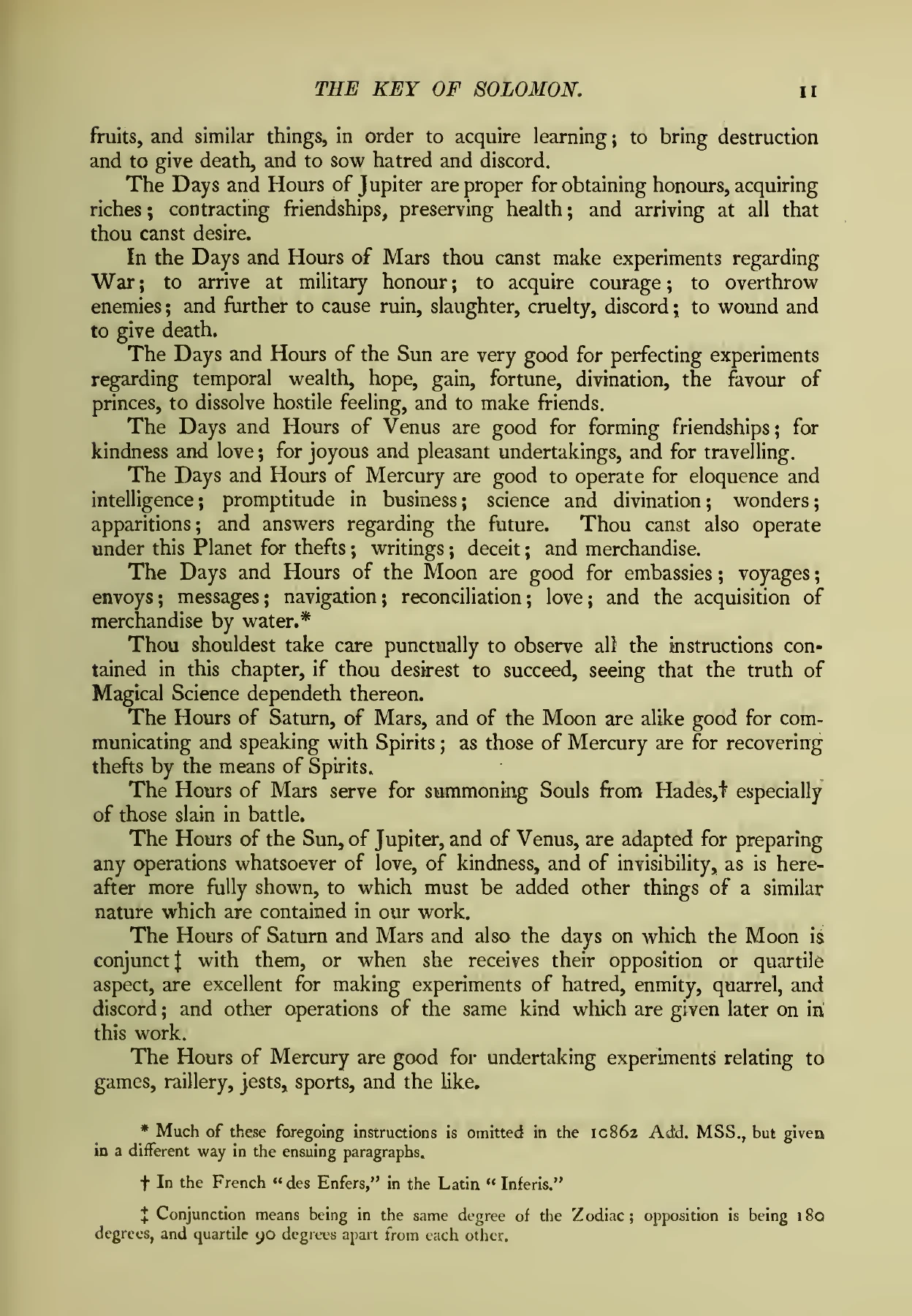 Open the book
Book I.II: planetary virtues
Compare the purposes attributed to Mercury, the Moon, Jupiter and Venus.
Timing remains one condition among several
The Key does not present the calendar as a substitute for the rest of its art. Chapter II repeatedly points ahead to the instruments, preparation and ceremonies explained elsewhere. An appropriate hour is one part of an ordered undertaking. That relationship explains why the circle and pentacle chapters refer back to planetary time without repeating the whole sequence. It also reveals a real disagreement with Abramelin. Abramelin accepts some natural celestial influences but rejects the claim that planetary divisions should govern spiritual communication. The Key gives those divisions a practical role. Understanding both positions means identifying the question each answers: what orders natural time, and what conditions an encounter with spirits? There was no single grimoire doctrine that made all books’ timetables interchangeable.
Follow Saturday into Sunday
Use the dawn sequence on scan 22 and the planetary virtues on scan 23 to solve a problem: where does Mercury occur on Saturday, and why does the following day begin with the Sun?
- 01
Locate Mercury
Write the seven rulers beginning with Saturn. Mercury occupies position six, after Venus and before the Moon. Continuing the cycle places Mercury at hours thirteen and twenty. These positions follow from adding seven each time, not from changing Saturday into a Mercury day. Its connection with writing and learning remains relevant even when its hour falls within another planet’s weekday.
- 02
Cross the day boundary
Continue beyond hour twenty-one, which belongs to the Moon. Hours twenty-two, twenty-three and twenty-four are Saturn, Jupiter and Mars. The next entry is the Sun. That becomes the first hour of the next day and supplies the name Sunday. The transition follows from twenty-four hours passing through a seven-part sequence.
- 03
Explain the desired connection
Suppose the example concerns composing a persuasive letter. Mercury’s association with eloquence and writing explains its relevance more directly than a bare claim that the hour is fortunate. If the letter is carried overseas, the Moon’s associations explain a different aspect: the message’s journey. The text supplies a vocabulary for distinguishing those aims.
The example connects the repeating order, its placement within the week, and the capacity attributed to a planet. A useful explanation accounts for all three.
The text beside the teaching.
These selected pages accompany this free lesson. Enlarge a page and compare its details with the teaching.
Book I.II: dawn and the planetary sequence
The prose establishes the order and demonstrates it with Saturday.
What to carry into the next lesson
- Reconstruct the planetary-hour sequence, explain its weekday pattern, and connect particular planets with the purposes assigned to them.
- Twenty-four hours advance the seven-planet sequence by three positions. From Saturn those positions lead through Jupiter and Mars to the Sun.
Use the dawn sequence on scan 22 and the planetary virtues on scan 23 to solve a problem: where does Mercury occur on Saturday, and why does the following day begin with the Sun?
Can you explain it in your own words?
Try answering first, then open the explanation to compare your reasoning.
01Why does the first hour after Saturday’s twenty-four-hour cycle belong to the Sun?
Twenty-four hours advance the seven-planet sequence by three positions. From Saturn those positions lead through Jupiter and Mars to the Sun.