Identify the different subjects inside Fludd’s Temple of Music and distinguish a teaching diagram from a building plan.
Utriusque cosmi historia, vol. I, tract II, part II, opening and Templi praefigurati descriptio; scans 387, 391, 393–395.
Inside this lesson 5 teachings · 2 source pages
The language of this teaching
- Monochord
- A stringed measuring instrument used to compare musical intervals through divisions of a string.
- Consonance
- A relationship between sounds treated as concordant within a particular musical theory.
- Musica mundana
- World music: the ordered harmony attributed to the cosmos, whether or not it is physically audible.
A doorway into the whole art
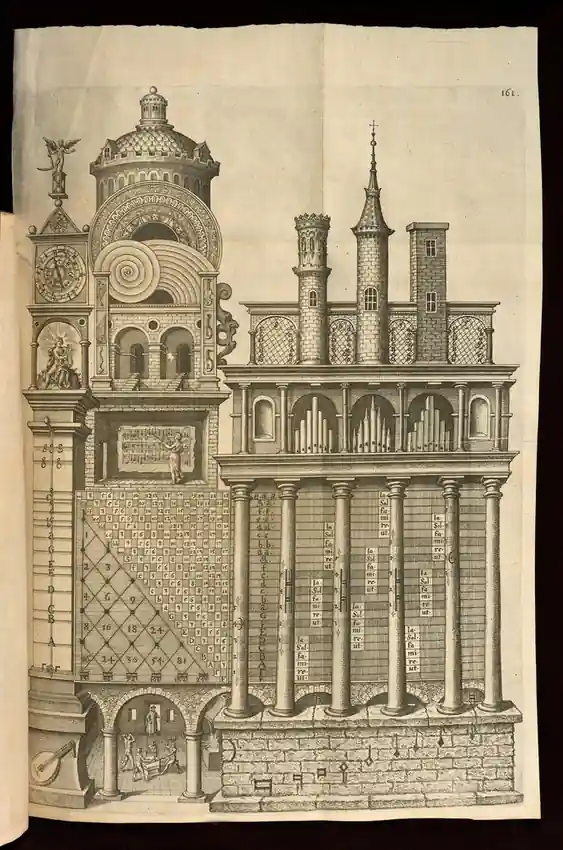
Fludd introduces his Temple of Music inside the technical history of the larger world. The opening announces seven books, so the magnificent building is also a promise about the order of study. Music here includes singing, measured intervals, written durations, combinations of voices and physical instruments. The temple makes these different activities belong together. It offers a place for each subject before asking the reader to master its details. Begin by looking at the folding plate as a map: locate its columns, patterned triangle, galleries and upper structures. Each visible difference prepares a different intellectual task.
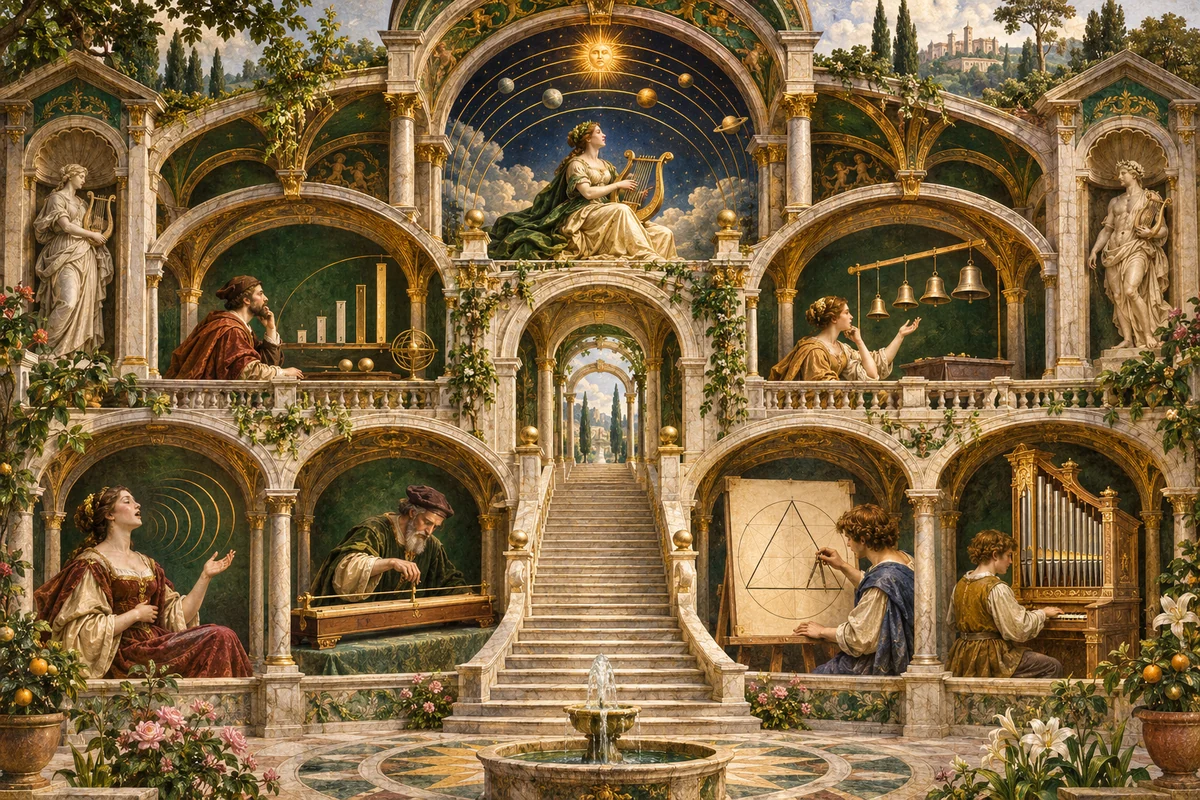 OCCULT HALL · INTERPRETIVE ILLUSTRATION
Enter the Temple of Music
The temple gathers different kinds of musical knowledge into one architecture.
Architecture that helps you remember
A column is especially useful for displaying divisions along one dimension. A triangle can bring many pairs of positions into one field. A row of marked places resembles a musical system in which a singer must find a location. Fludd uses these affordances rather than decorating an otherwise ordinary textbook. The architecture supplies a memory structure: a reader can return mentally to a part of the building when considering its associated subject. This does not mean the entire image is a practical architectural specification. Its success depends on connections between shapes and ideas, not on whether a mason could construct it.
Read one feature before reading the whole building
Imagine that the temple’s marked column catches your eye first. Use it to build a small, checkable route through the book.
Choose a part to look closer.
Observe
Observe the column’s unequal divisions before interpreting them. Its shared vertical axis lets you compare positions and lengths across the image.
Read all the connections
- Observe
- Observe the column’s unequal divisions before interpreting them. Its shared vertical axis lets you compare positions and lengths across the image.
- Connect
- Read the accompanying monochord explanation to identify the column’s musical function: its measured divisions organize the derivation of consonant intervals.
- Extend carefully
- Compare the musical column with the cosmic string. Both order lengths, but their surrounding texts make different claims about those proportions.
A useful reading turns an impressive image into a sequence of questions that the book can answer.
Follow the seven books
The sequence matters. Fludd begins with music’s subject, moves into the musical system, then treats the proportional division of a monochord. Musical time follows, before the triangle of consonances and the discussion of familiar instruments. The seventh book presents his own large instrument. This order lets elementary distinctions support increasingly complicated combinations. Someone who skips straight to the mysterious-looking triangle misses the work performed by pitch positions and interval relationships. Someone interested only in sound-producing devices misses why an instrument is supposed to reveal mathematical order. The course follows these connections while also visiting the cosmic and human applications elsewhere in the complete work.
Several meanings of harmony
Harmony can mean an audible relationship between sounds, an ordered relationship between quantities, or a claimed correspondence among parts of the universe. Fludd moves across these meanings. A modern reader should notice each move instead of treating every use of harmony as a single measurement. Two string lengths can be compared directly; a claim that heaven and earth possess the same relation needs a further argument. Both belong to Fludd’s project, but they ask different questions of the evidence. His temple is useful precisely because it lets us inspect how practical music, mathematics and a philosophical world picture have been assembled.
Look at the passage itself.
 Open the book
The Temple of Music, folding plate
The architectural image arranges musical subjects in a single façade.
 Open the book
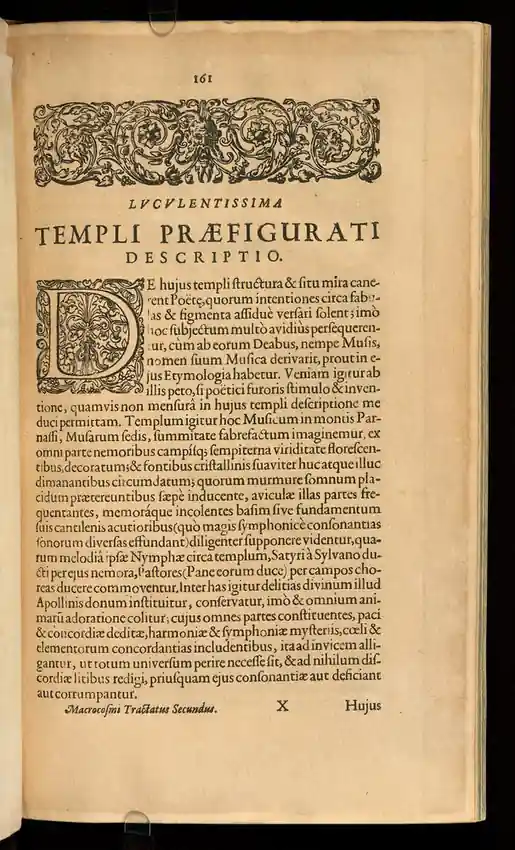
Description of the pictured temple, printed p. 161
Fludd begins explaining how the building’s visible features carry musical meanings.
Make the image work for you
Use the historical plate actively. Choose one feature, describe only what is visible, and then read the passage explaining its purpose. Keep those two descriptions separate until you have checked their connection. A column bearing divisions gives strong evidence of a diagram organized by length. It does not by itself tell you the pitch of a note or the significance of a planetary sphere. The accompanying lessons supply those intermediate steps. Our paintings imagine the atmosphere of this intellectual world, while the facsimile preserves what Fludd’s reader actually encountered. Returning to both makes the walkthrough more than a sequence of attractive pictures.
Hear the proportion.
Choose an interval, then listen to its two tones. The bridge marks the length of string that would produce the higher tone.
Half the string gives twice the frequency. The octave makes one of the clearest connections between a simple proportion and a musical interval.
Reference: 220 Hz · Comparison: 440 HzThis modern sound demonstration explains a musical relationship. Its pure tones are not a recording of Fludd’s instrument. His cosmic interpretation belongs to the historical text; it does not establish supernatural effects.
Read one feature before reading the whole building
Imagine that the temple’s marked column catches your eye first. Use it to build a small, checkable route through the book.
- 01
Observe
Describe a tall support divided into unequal marked lengths. This is a report about the image, before deciding what the divisions mean. Its vertical arrangement invites comparison between positions along a common axis.
- 02
Connect
Turn to the book on the column and the monochord. Now the shape gains a defined musical job: representing divisions from which consonances can be derived. The connection comes from the accompanying text, not a guess about occult symbolism.
- 03
Extend carefully
Compare the column with the cosmic string later in the course. Both use ordered length, but one explains musical intervals while the other organizes a philosophical cosmos. Record the shared device and the different claim it supports.
A useful reading turns an impressive image into a sequence of questions that the book can answer.
The text beside the teaching.
These selected pages accompany this free lesson. Enlarge a page and compare its details with the teaching.
The Temple of Music, folding plate
The architectural image arranges musical subjects in a single façade.
What to carry into the next lesson
- The temple is a teaching structure for several related musical arts.
- Read an image together with the passage that assigns its parts meaning.
- Audible intervals and cosmic correspondences require different kinds of evidence.
Notice that the column and the large patterned triangle ask the eye to perform different comparisons.
Can you explain it in your own words?
Try answering first, then open the explanation to compare your reasoning.
01What is gained by beginning with the temple rather than an isolated mystical symbol?
The temple places each symbol within a course of study, showing what a reader must learn before using it.
02Why does the temple contain several different shapes?
Different spatial arrangements help Fludd present different subjects: linear division, combinations, notation and instruments.
03Does the temple prove that the cosmos obeys musical ratios?
No. It organizes a body of teaching. A cosmic application requires its own argument beyond the architectural metaphor.