Robert Fludd: Worlds, Arts & Hidden Harmonies
Fifty-five studies of number, nature and the human world
 AN OCCULT HALL ILLUSTRATION
Enter its world.
Fludd connects number, craft, nature and sacred history. A sounding string becomes a measuring tool and a picture of the cosmos; geometry becomes an art of seeing; the human body becomes a smaller world. Begin with the music studies, then choose a section to explore the mathematical arts, macrocosm, microcosm, sacred philosophy or experiments in the other reading parts.
The reader preserves all 2,473 historical scans of the two bound volumes, arranged into thirteen manageable reading parts. The set is catalogued as 1617–1623 and also binds the 1626 Philosophia sacra / Meteorologia cosmica. This is the complete digitized witness, with its blank leaves, foldouts, repeated views and supplements; it is not a complete English translation. Our fifty-five lessons are original English explanations of selected material.
- Fifty-five substantial lessons with worked examples and verified source pages
- Hear simple interval ratios and understand their relationship to string lengths
- Complete composite facsimile: 2,473 scans in thirteen reading parts
Fifty-five harmonies
One free introduction · 54 member lessons
Why this number?
55 lessons form our expanded editorial path through this collection. The course count is a modern study arrangement, not the number of chapters, beings or stages stated by the historical authors.
Your way through.
Follow the teachings step by step, work through concrete examples, and connect each explanation with its cited passage.
Choose a subject below. Open a section to see its lessons; the source links inside each reading take you to the relevant volume and page.
01First readings · music and the connected worlds12 lessons · 168 min of study
Enter the Temple of Music
Identify the different subjects inside Fludd’s Temple of Music and distinguish a teaching diagram from a building plan.
14 min · Free introduction
A string stretched across the world
Explain how Fludd maps musical relations onto the cosmos without confusing the diagram with measured astronomical sound.
14 min · Member lesson
When numbers become consonance
Reduce equivalent ratios and explain why proportional relationships matter more than the size of the numbers used.
14 min · Member lesson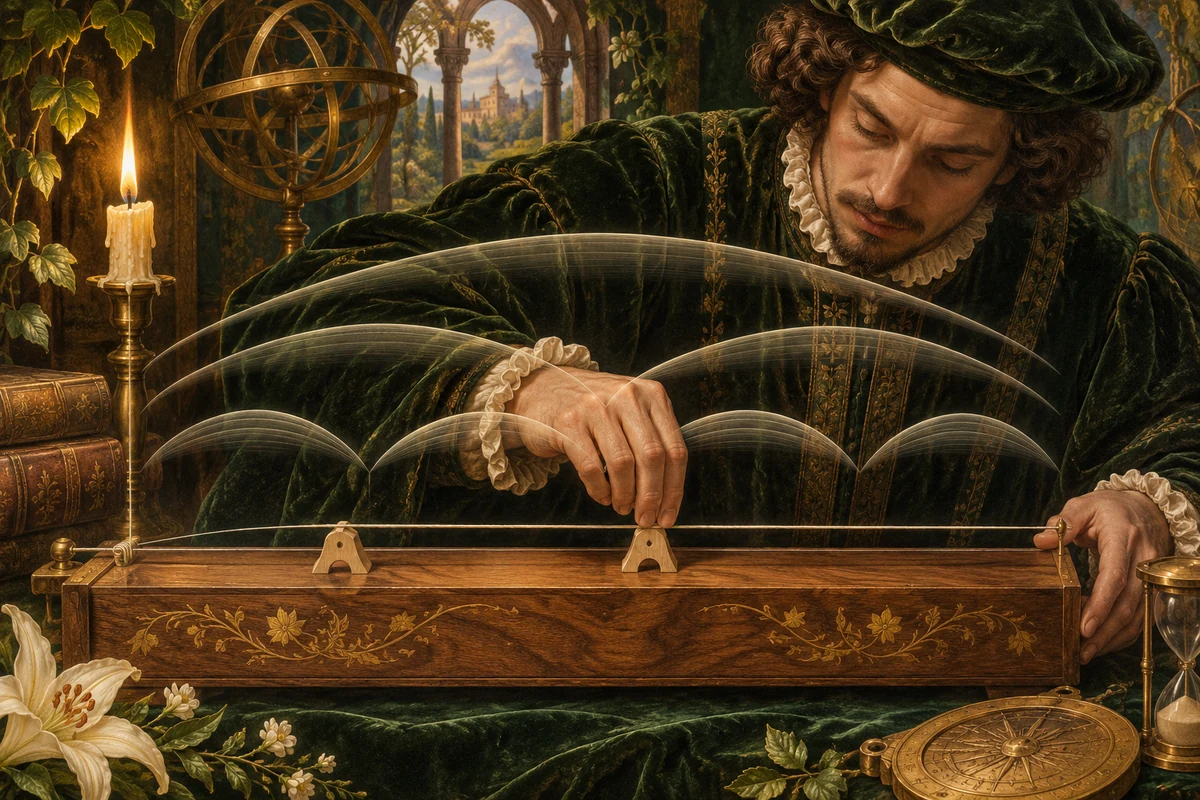
One string, two octaves
Relate whole, half and quarter string lengths to successive octaves while keeping the physical conditions explicit.
14 min · Member lesson
The fifth and fourth complete an octave
Calculate a fifth followed by a fourth and explain the inverse relationship between frequency and comparable string length.
14 min · Member lesson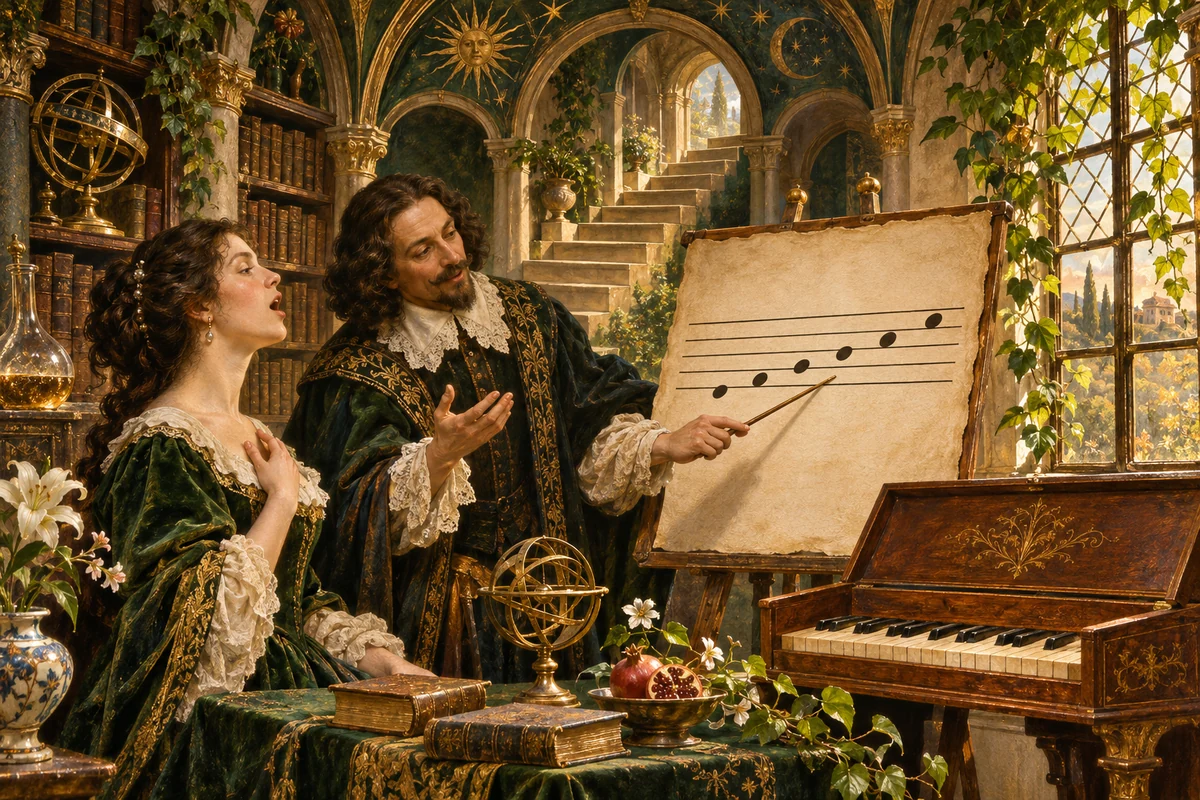
Finding your place in the musical system
Distinguish letter names, singing syllables and interval relationships in Fludd’s musical system.
14 min · Member lesson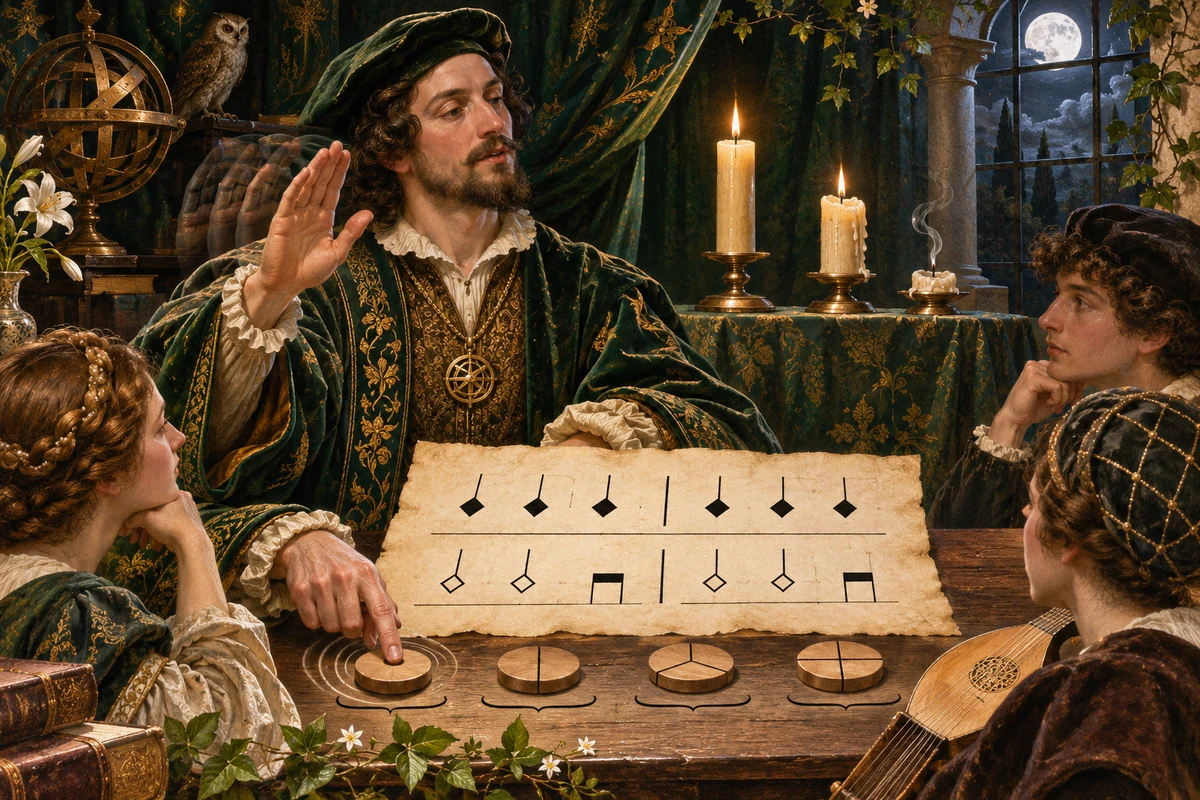
How signs organize musical time
Explain how note forms and contextual rules organize duration without assuming modern time signatures or fixed seconds.
14 min · Member lesson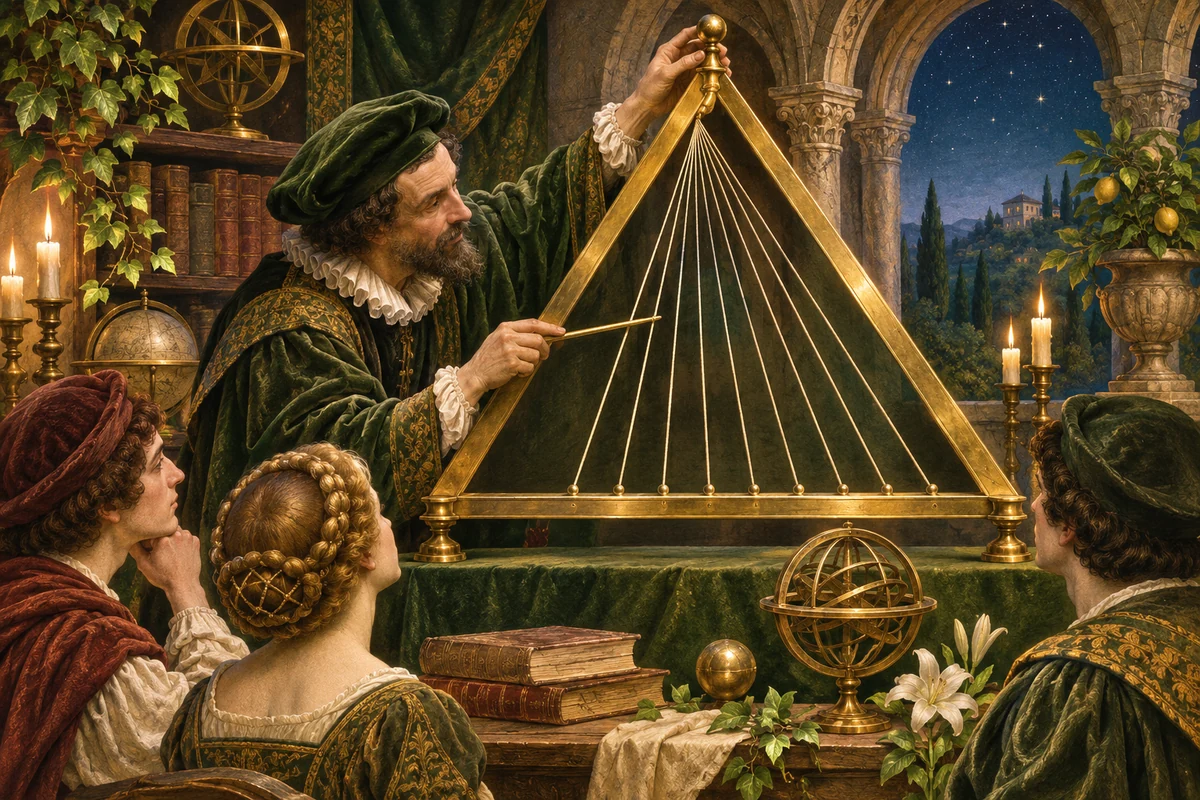
The triangle of consonances
Read Fludd’s triangular table as a framework for relationships between voices, rather than as an autonomous magical sign.
14 min · Member lesson
One theory, different instruments
Distinguish pitch relationships from the mechanisms and tone qualities of different instruments.
14 min · Member lesson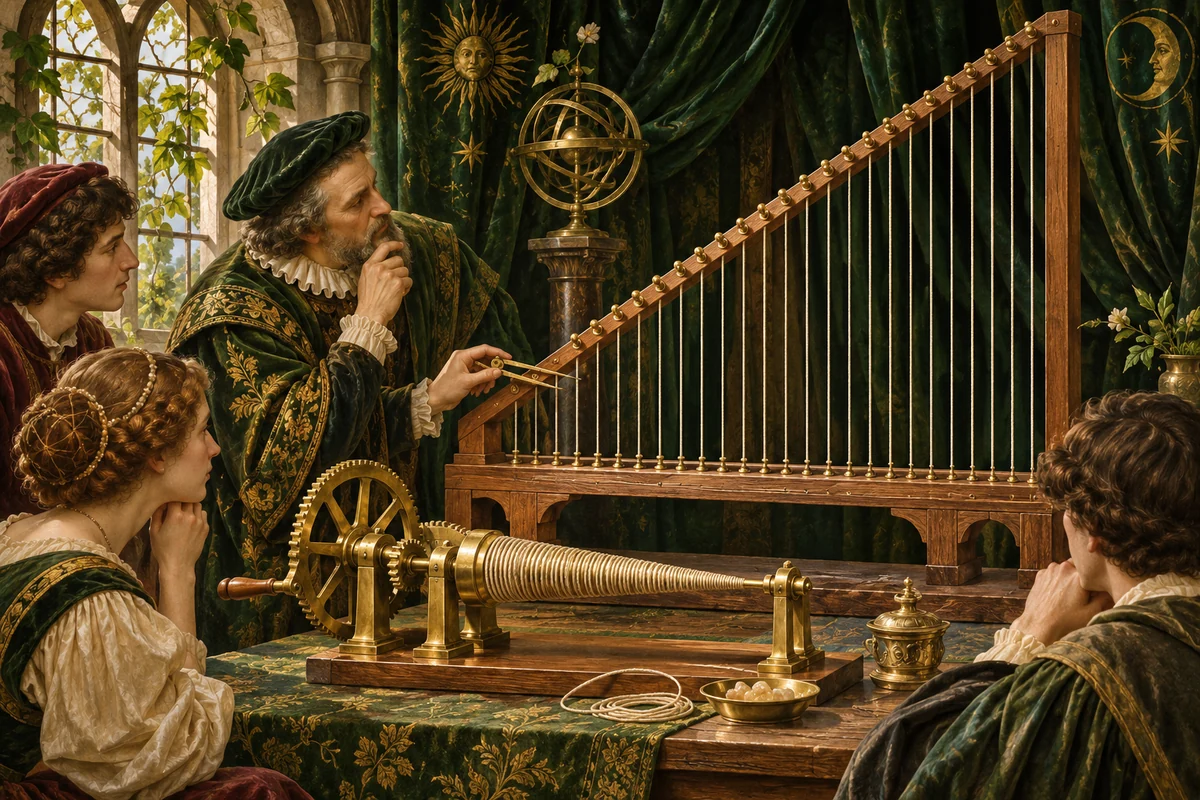
The great instrument
Explain the relation between the great instrument’s geometry, strings and mechanisms while distinguishing design from demonstrated performance.
14 min · Member lesson
The human being as a little world
Explain how Fludd relates the human body to the larger world and distinguish geometric proportion from physiological claims.
14 min · Member lesson
When two harmonies disagree
Use Fludd’s replies to Kepler to distinguish a shared interest in cosmic harmony from agreement about its explanation.
14 min · Member lesson02First principles of the world5 lessons · 60 min of study
Nature, the Creator and the artisan
Distinguish Fludd’s levels of nature and explain where an artisan acts within them.
12 min · Member lesson
Darkness before form
Explain Fludd’s distinction between primordial darkness and the privation of an existing form.
12 min · Member lesson
Three regions of the cosmos
Distinguish the three regions inside the macrocosm from the archetypal, cosmic, and human senses of world.
12 min · Member lesson
Angelic orders and messengers
Read the angelic hierarchy as a classification of offices and distinguish angel from the wider philosophical language of spirits.
12 min · Member lesson
Elements into living forms
Explain why elemental ingredients alone do not complete Fludd’s account of a mixed or living body.
12 min · Member lesson03Number and calculation4 lessons · 56 min of study

Number in things and in the mind
Distinguish Fludd’s physical, mental and mathematical senses of number, then explain why unity has a special status in his arithmetic.
14 min · Member lesson
The written art of calculation
Explain Fludd’s layout for written addition, carry out one of his listed sums and distinguish an operation from a check on its result.
14 min · Member lesson
Cossic signs and unknowns
Read the purpose of Fludd’s cossic characters and use a modern notation to distinguish coefficients, powers and arithmetic operations.
14 min · Member lesson
Numbers in memory places
Explain the conversion from ordinary memory places to Fludd’s arithmetic arrangement, and distinguish a place, its image and the result stored there.
14 min · Member lesson04The practice of music5 lessons · 60 min of study
Three kinds of music
Distinguish worldly, human, and instrumental music without treating every use of harmony as audible sound.
12 min · Member lesson
Pythagoras at the forge
Reconstruct the proportional lesson in the Pythagorean story while distinguishing its historical narrative from valid acoustic measurement.
12 min · Member lesson
The two forms of B
Explain the different interval positions of soft and hard B and distinguish hexachordal movement from modern key signatures.
12 min · Member lesson
Building voices above a bass
Explain how a bass, interval choices, and shared durations cooperate in Fludd’s method for constructing several parts.
12 min · Member lesson
Reading the fingerboard
Read tablature as a coordinate system of strings and stopping positions, and explain why tuning remains necessary.
12 min · Member lesson05Geometry, sight and painting5 lessons · 60 min of study

Triangles and the invisible line
Identify the physical and visual sides of a surveying triangle and explain why similar triangles permit indirect measurement.
12 min · Member lesson
Measuring a tower
Apply proportional scaling and the instrument-height correction in Fludd’s example of altimetry.
12 min · Member lesson
The eye as a chamber
Identify the roles assigned to the eye’s three humors and separate an anatomical description from an older theory of visual reception.
12 min · Member lesson
The returning ray
Explain the source’s distinction between direct luminosity and reflected light, and use surface regularity to interpret its mirror diagram.
12 min · Member lesson
Geometry under the painting
Explain how Fludd uses geometrical construction to organize a picture without reducing artistic judgment to a rigid formula.
12 min · Member lesson06Machines, time and the cosmos3 lessons · 36 min of study
The balance and the long arm
Explain the relationship between weight and lever arm in the steelyard and distinguish mechanical advantage from the creation of energy.
12 min · Member lesson
Writing time with shadow
Explain the difference between equal angular divisions and their projection onto a shadow scale.
12 min · Member lesson
Circles of heaven and earth
Distinguish celestial reference circles from their terrestrial projections and identify which depend on the observer.
12 min · Member lesson07Stars and geomancy4 lessons · 48 min of study
Dividing the zodiac
Explain the twelvefold division of the zodiac and distinguish a geometrical sign from the qualities later assigned to it.
12 min · Member lesson
Planetary temperaments
Explain how Fludd connects planetary position, qualities, and interpretive character without treating those connections as modern astronomical facts.
12 min · Member lesson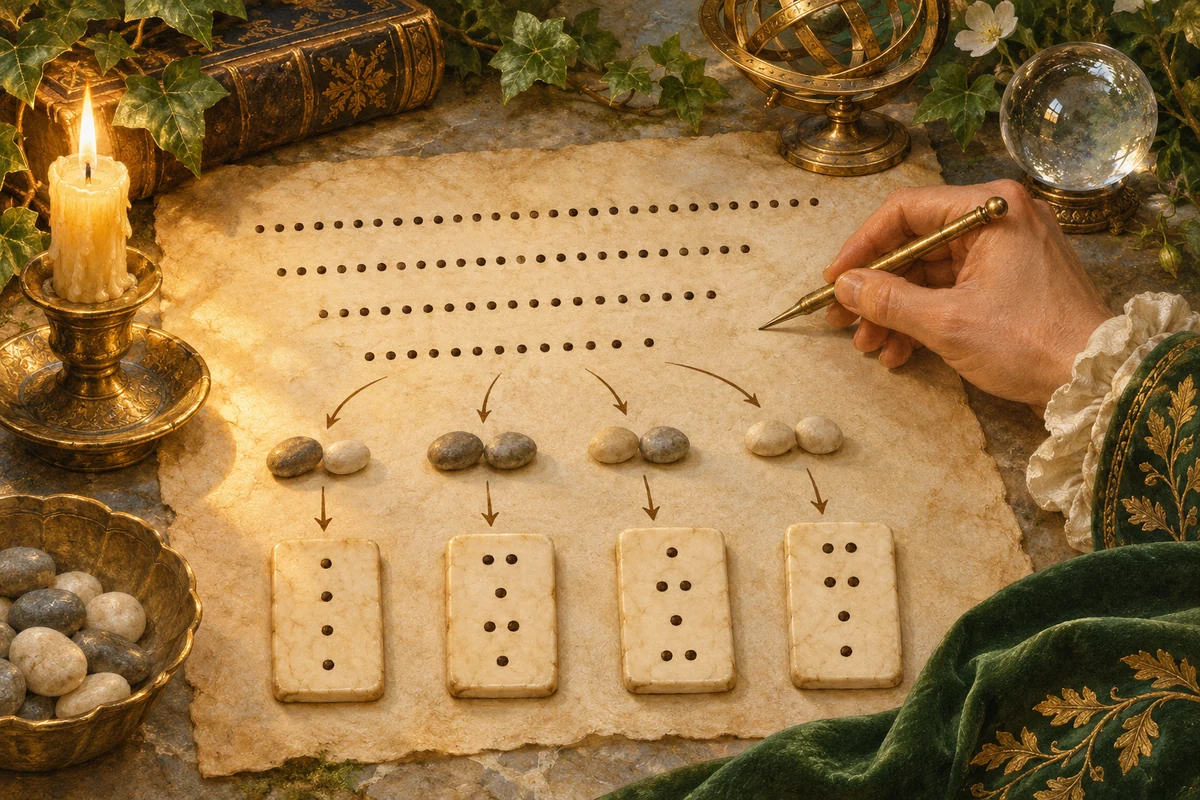
From dots to four mothers
Reduce rows by parity and assemble four mother figures while explaining the author’s rules for the initial question.
12 min · Member lesson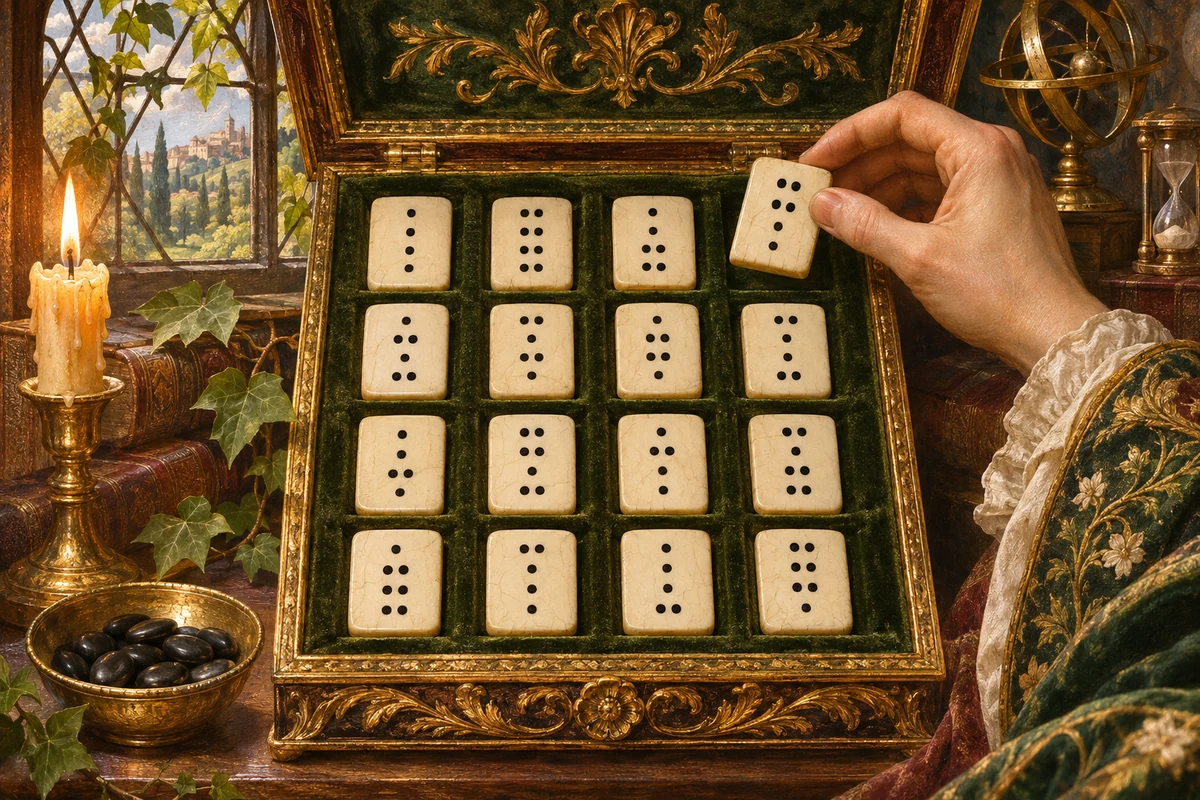
The sixteen earth figures
Derive the number of geomantic figures and distinguish a pattern’s structure from its name and correspondence.
12 min · Member lesson08The inner and outer human4 lessons · 48 min of study
Unity and divine number
Explain Fludd’s analogies of unity and distinguish an ascending path of inquiry from a descending order of exposition.
12 min · Member lesson
Knowing the inner human
Reconstruct the ascent from sensation through imagination and reason to intellect in the opening of the inner microcosm.
12 min · Member lesson
Creation and generation
Explain the author’s local definition of creation and why he distinguishes it from generation rather than equating it automatically with making from nothing.
12 min · Member lesson
Three kinds of vision
Distinguish Fludd’s three kinds of vision and analyze his optical examples without treating vivid experience as automatic proof.
12 min · Member lesson09The arts of the soul4 lessons · 48 min of study

Prophecy and the gathered mind
Explain the two analogies by which Fludd describes inspiration and concentration, while distinguishing his claims from evidence of predictive ability.
12 min · Member lesson
The remembered theater
Explain how familiar locations, suitable images, and ordered retrieval cooperate in the source’s art of memory.
12 min · Member lesson
Reading the hand as a map
Describe the source’s hand terminology and distinguish anatomical location from the predictive and physiological claims attached to it.
12 min · Member lesson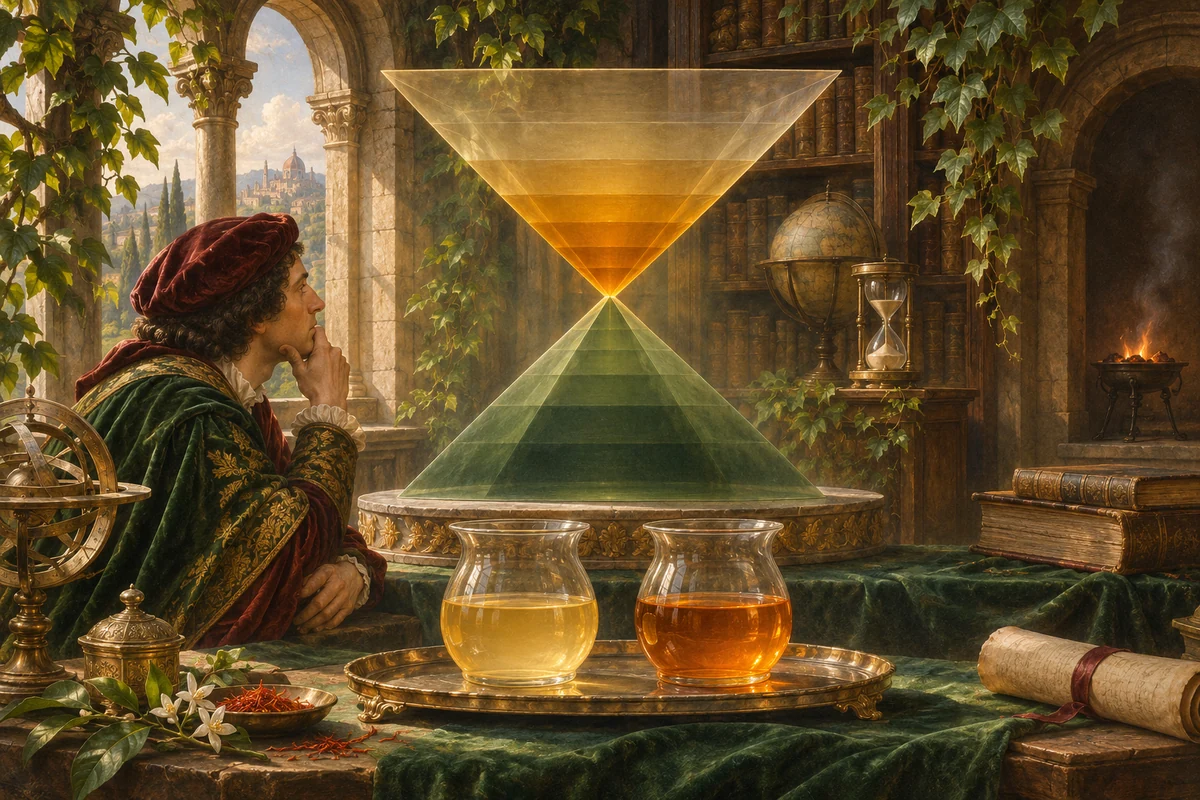
The opposed pyramids
Interpret the opposed pyramids as gradients of material density and formal power, distinguishing intensity from spatial extent.
12 min · Member lesson10Letters and the higher world2 lessons · 24 min of study

Letters at the beginning
Distinguish ordinary translation from Fludd’s Christian Cabalistic interpretation of Hebrew letters and their attributed creative functions.
12 min · Member lesson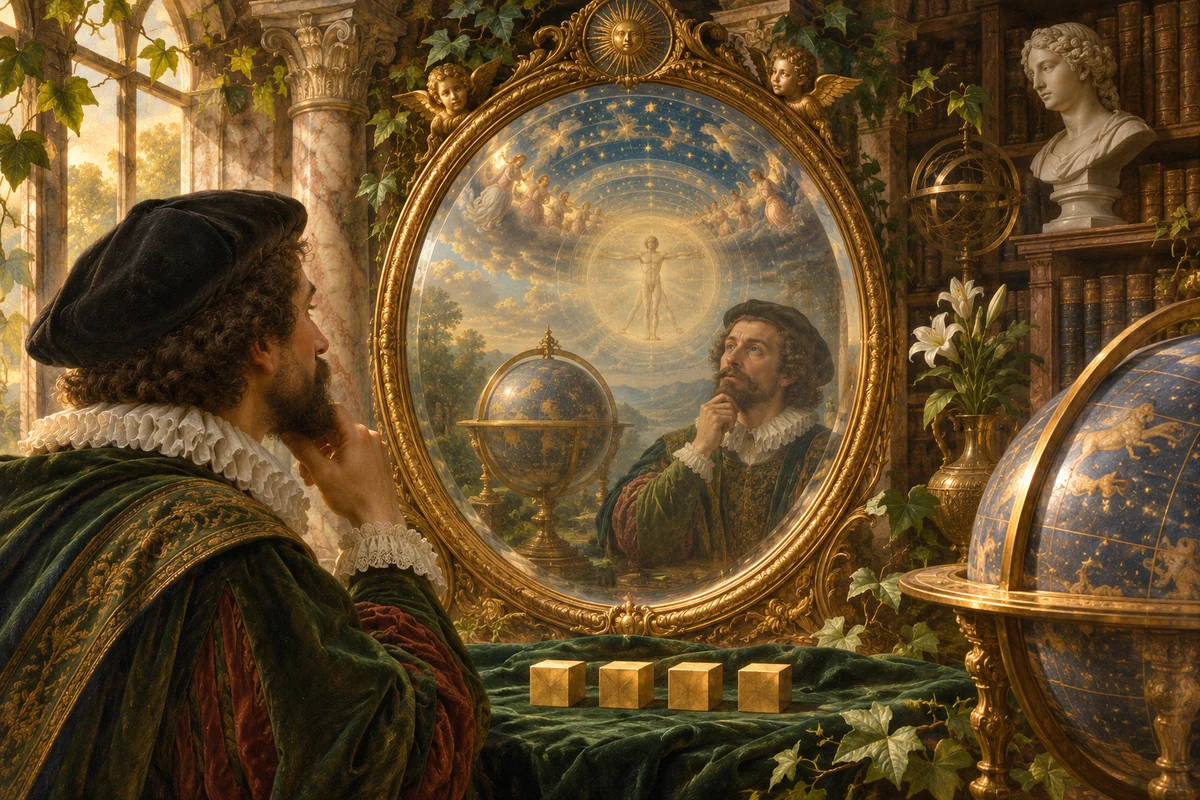
The name and the two worlds
Explain why Fludd distinguishes the divine name’s ideal letters from ink marks and uses the name to connect the great and small worlds.
12 min · Member lesson11The anatomical theater2 lessons · 24 min of study
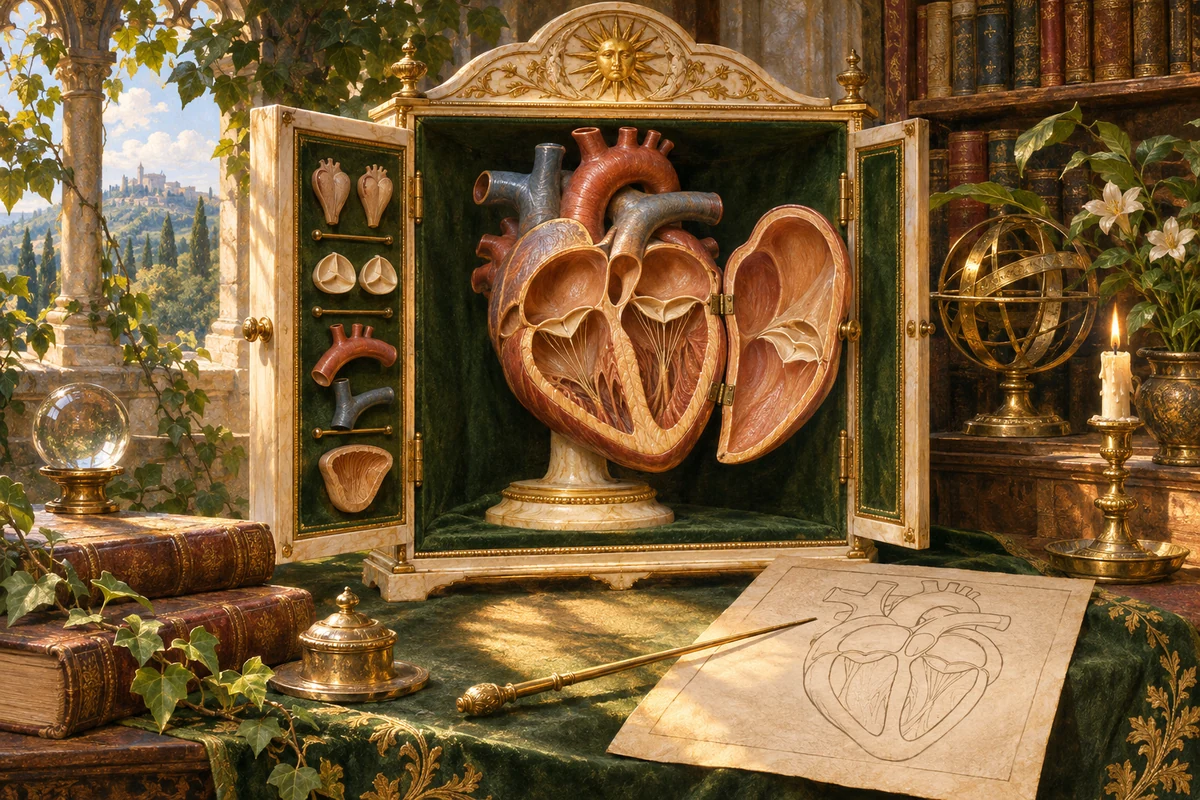
The heart and vital heat
Read the heart’s labeled structures alongside the historical functions Fludd assigns to them, keeping the two kinds of claim distinct.
12 min · Member lesson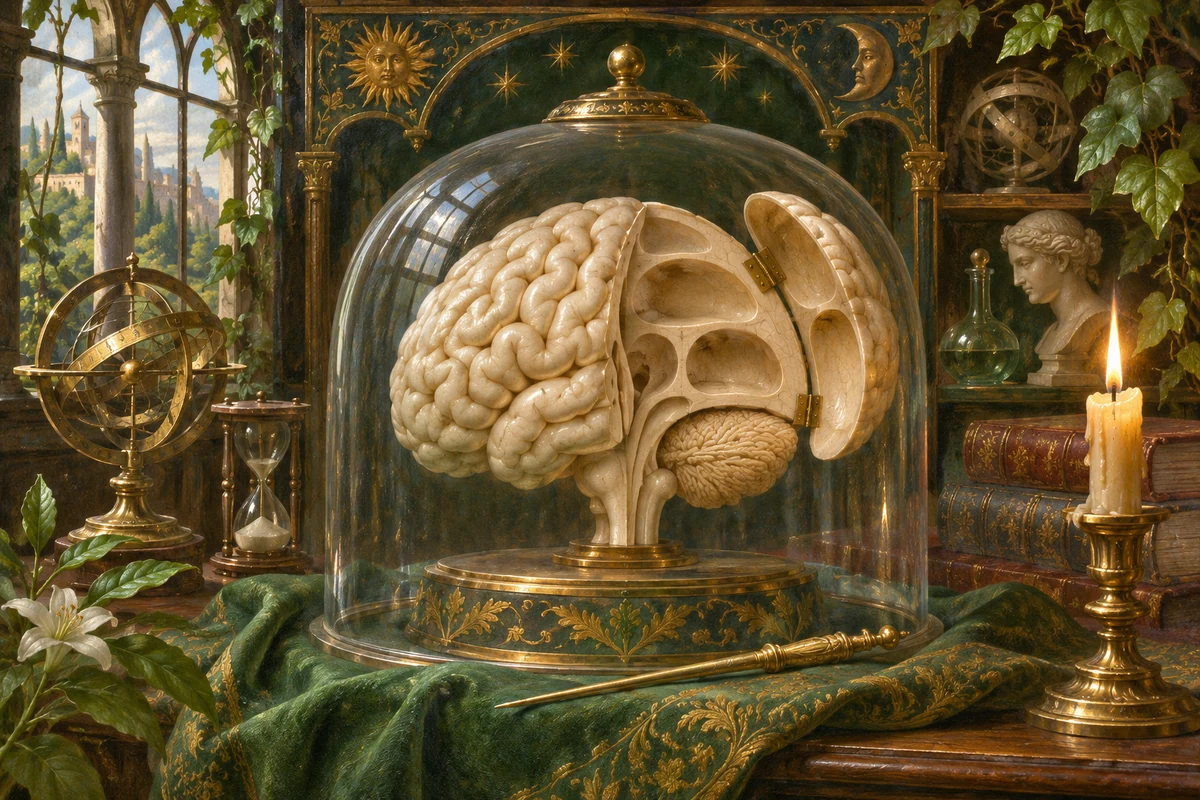
The brain and its chambers
Explain the source’s organization of the brain and distinguish its structural observations from its historical theory of sensation and movement.
12 min · Member lesson12The argument over harmony1 lesson · 12 min of study
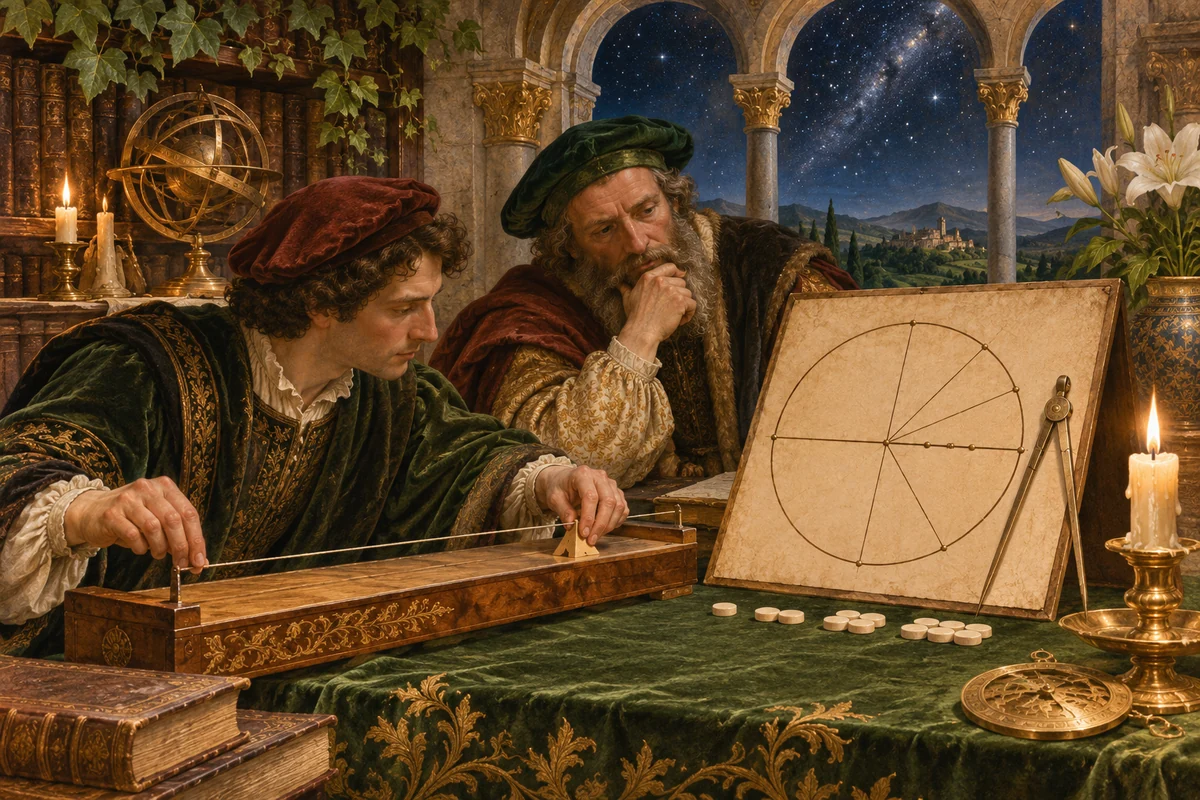
13Sacred philosophy and weather3 lessons · 36 min of study

Reading the weather wheel
Read the meteorological chart as a layered historical model and distinguish its observations, classifications, and providential interpretation.
12 min · Member lesson
Clouds, rain and hidden causes
Explain the historical disagreement over rain and dew and identify the different work performed by observation, definition, and scriptural authority.
12 min · Member lesson
The rainbow and its causes
Analyze the rainbow through material, formal, efficient, and final causes while distinguishing Fludd’s observations from his theological conclusion.
12 min · Member lesson14The universal experiment1 lesson · 12 min of study

The source beside you.
Members can explore the complete edition. Begin with the free introduction and its selected source pages.
The complete book awaits.
Robert Fludd: Worlds, Arts & Hidden Harmonies
The complete historical editions and page-turning readers belong to the member library. Free introductions include the source excerpts used in their teaching.
Books & dates
Fludd — Volume I — The history of the larger worldRobert Fludd · 1617–1626
Fludd — Volume I — Universal arithmeticRobert Fludd · 1617–1626
Fludd — Volume I — The Temple of MusicRobert Fludd · 1617–1626
Fludd — Volume I — Geometry, optics, painting and warfareRobert Fludd · 1617–1626
Fludd — Volume I — Motion, time and cosmographyRobert Fludd · 1617–1626
Fludd — Volume I — Astrology, geomancy and closing matterRobert Fludd · 1617–1626
Fludd — Volume II — The human worldRobert Fludd · 1617–1626
Fludd — Volume II — The arts of the microcosmRobert Fludd · 1617–1626
Fludd — Volume II — The higher world, portions I–IIRobert Fludd · 1617–1626
Fludd — Volume II — Anatomy, portion IIIRobert Fludd · 1617–1626
Fludd — Volume II — The world monochord and the reply to KeplerRobert Fludd · 1617–1626
Fludd — Volume II — Sacred philosophy and cosmic meteorologyRobert Fludd · 1617–1626
Fludd — Volume II — The meteorological experiment and closing matterRobert Fludd · 1617–1626
Guided readings and teaching diagrams are original Occult Hall commentary. Imagined scenes are modern illustrations, separate from the historical source pages.
The Tarot of the Bohemians
Twenty-six studies through the complete tarot pack