Explain how seer, questioner and recorder contribute different parts of an angelic conference.
Mysteriorum Libri Quinque I, actions of 10–14 March 1582; De Heptarchia Mystica 3, f.39v; comparison with the later action of 20 June 1584, Casaubon 1659 printed pp.168–170.
Inside this lesson 6 teachings · 1 source page
The language of this teaching
- Seer
- The participant reporting the visionary sight or voice.
- Action
- A dated session or spiritual conference in Dee’s records.
- Receptacle
- The stone understood as the place in which the encounter becomes perceptible.
The conversation depends on two human roles
In the early actions, Edward Kelley appears under the name Edward Talbot. He reports figures, gestures, voices and writing perceived through the visionary encounter, while John Dee puts questions and records the proceedings. These are connected but distinct roles. A vision becomes part of the written record through a chain: something is reported by the seer, a question may be asked about it, an answer is reported, and Dee commits the exchange to writing. The resulting page therefore contains more than a single speaker's uninterrupted message. The distinction explains why Dee can ask about an image that Kelley says he sees, or request the meaning of letters that have just been reported. Their partnership combines perception, inquiry and notation. Within their own understanding, the angels provide instruction, but the human participants still have work to do in receiving, questioning and arranging it. The record preserves that work rather than presenting knowledge as one instantaneous revelation.
 OCCULT HALL · INTERPRETIVE ILLUSTRATION
A vision enters the written record
The observing and writing roles evoke how perception, questioning and documentation contribute differently to Dee’s conferences.
Dee brings questions from his existing studies
On 10 March 1582, Dee asks about the Book of Soyga. This is a specific learned object already important to him, not a subject invented by the vision at that moment. The exchange refers the matter to Michael, showing that even among the interlocutors the record distinguishes capacities and authority. One reported angel does not automatically answer every question. The episode introduces a recurring structure in Dee's work: a human intellectual difficulty is carried into the conversation, and the answer is placed within a hierarchy of spiritual knowledge. The questioner's interests therefore shape the inquiry without being presented as its ultimate source of truth. Dee seeks an explanation from an authority he considers greater than his own. This makes the sessions resemble a highly unusual classroom, with clarification, referral and deferred instruction. They concern the meaning of particular books and signs, as well as broad hopes for knowledge of creation and divine government.
A vision becomes a record through three roles
Distinguish the reported encounter from the questions and writing that give it an interpretation.
Choose a part to look closer.
Perception · Kelley
Kelley, initially called Talbot, reports figures, speech and gestures. His account establishes what is being presented in the visionary encounter.
Read all the connections
- Perception · Kelley
- Kelley, initially called Talbot, reports figures, speech and gestures. His account establishes what is being presented in the visionary encounter.
- Inquiry · Dee
- Dee asks about identity, authority and meaning. His questions seek reasons to accept a visitor’s claimed commission as a teacher.
- Record · the written exchange
- The written account preserves perception and examination together. Later readers can follow the questions and corrections through which an interpretation emerged.
A reported appearance does not explain itself: perception, evaluation and recording perform different work.
An appearance must also establish its identity
The March actions include a troubling figure associated with the name Lundrumguffa and its expulsion. The record thus does not treat every reported appearance as an equally reliable teacher. Identity and authority have to be established within Dee's Christian framework. A later, particularly clear example occurs on 20 June 1584, when a visitor eventually identifies itself as Ave. Dee asks who it is, whether it is sent by God and how its message agrees with the religious claims already accepted in the conversations. This is not a modern laboratory test; it is a theological examination intended to distinguish a true messenger from deception. The important structural point is that seeing or hearing comes before interpretation, and neither automatically settles trust. Dee's questions concern the speaker's identity, the source of its commission and consistency with divine justice and mercy. The later example makes explicit a problem already present in the opening sessions: revelation requires discrimination between possible interlocutors.
The stone is one part of a furnished setting
De Heptarchia Mystica describes the stone in relation to a square table, cloths and the Sigillum Dei. A principal seal occupies the middle, and four further seals are associated with the table's feet. The stone stands above the principal seal with cloth intervening. The objects have different roles. The stone is the visionary receptacle; the table provides its prepared support and setting; the seal carries the sacred arrangement of names; the cloth mediates the physical arrangement and participates in the ceremonial furnishings. They are not five versions of the same magical object. The record also describes changes and further instructions about the table over time. This is why a single finished picture can conceal the system's development. The teaching to retain is functional: an appearance is expected within a deliberately furnished sacred space, and the central instrument is understood through its relation to the objects and authorities around it.
Descriptions and explanations arrive in separate stages
A reported image may precede an explanation of its meaning. Kelley can describe a crown, rod, table or company before Dee receives an account of what that feature signifies. The distinction is visible in the later four-castles vision: Kelley first reports a procession, and Ave subsequently explains its government. This separates the observation as recorded from the interpretation attributed to the angel. It also makes questions indispensable. If a figure carries a rod, the rod's mere presence does not explain whether it represents measurement, office or something else; the ensuing instruction supplies the claimed meaning. Dee's method often preserves both stages. That gives the reader a more exact understanding than collecting isolated images or assuming every object has a universal symbolic definition. In this record, a particular interpretation belongs to a particular exchange. The conversation teaches by moving from a visible or audible detail to a named office, relationship or doctrine, with the questioner helping make those transitions explicit.
Look at the passage itself.
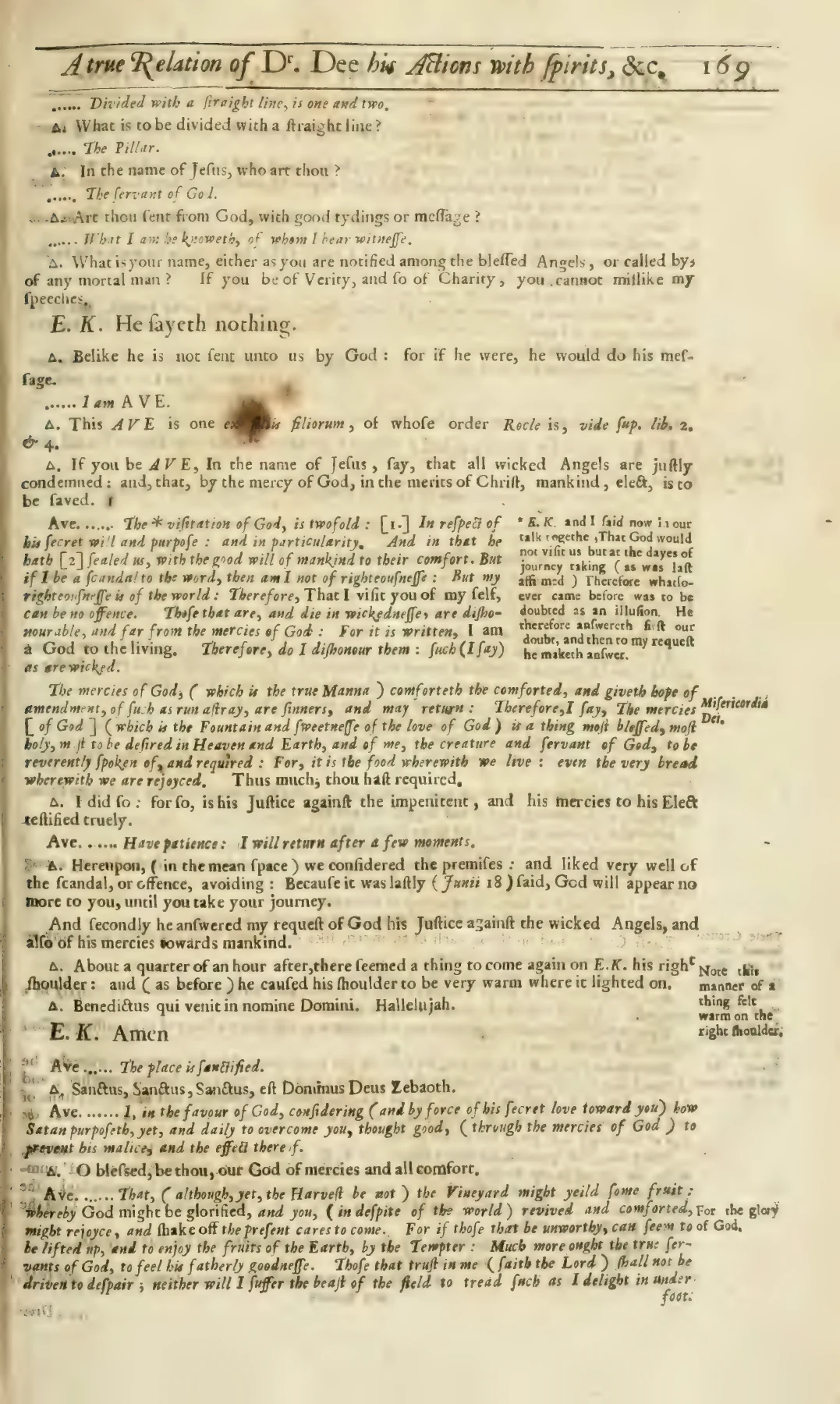 Open the book
Printed p.169 — Dee questions Ave, 20 June 1584
A later comparison for the lesson: Dee asks the visitor’s identity and tests its claimed religious authority. This is not a facsimile of the 1582 actions.
The written record becomes a working memory
Once an answer has been received, it can be compared with earlier answers, incorporated into a table or returned to when a contradiction appears. Writing is therefore part of the system's operation, not merely a diary kept after the interesting events. Names with similar forms, changing titles and instructions delivered across several sessions require a durable record. Dee's later Heptarchia gathers passages into a more organized handbook, grouping furniture, appearances, prayers and offices. That rearrangement changes the reader's route through the material while drawing on the earlier conversations. The diary asks what happened in sequence; the handbook asks how related teachings belong together. Both reveal the same underlying division of labor: the seer reports, the questioner seeks clarification, and the recorder makes the result available for comparison and later use. The apparent intricacy of Dee's diagrams and lists grows out of this repeated movement from encounter to question to written arrangement, rather than from one complete system delivered all at once.
Why does Dee ask questions about a vision Kelley reports?
Separate the roles in the later Ave exchange, then apply the distinction to the early actions.
- 01
Perception
Kelley reports the presence or speech of a visitor. That report establishes what is being presented in the encounter.
- 02
Inquiry
Dee asks the visitor’s identity and commission, seeking a reason to accept it as a teacher.
- 03
Record
The written exchange preserves both the reported appearance and the examination, so a later reader can see how an interpretation was reached.
Perception, evaluation and recording are different stages. Dee’s questioning makes the claimed meaning and authority explicit rather than treating an appearance as its own explanation.
The text beside the teaching.
These selected pages accompany this free lesson. Enlarge a page and compare its details with the teaching.
Printed p.169 — Dee questions Ave, 20 June 1584
A later comparison for the lesson: Dee asks the visitor’s identity and tests its claimed religious authority. This is not a facsimile of the 1582 actions.
What to carry into the next lesson
- Kelley’s reported perception, Dee’s questions and the written record perform different roles.
- Images can be reported before their offices and meanings are explained.
Separate the roles in the later Ave exchange, then apply the distinction to the early actions.
Can you explain it in your own words?
Try answering first, then open the explanation to compare your reasoning.
01Why does Dee ask questions about a vision Kelley reports?
Perception, evaluation and recording are different stages. Dee’s questioning makes the claimed meaning and authority explicit rather than treating an appearance as its own explanation.
02What did Dee’s Soyga question contribute to the early conversation?
It brought an existing scholarly problem into the conference, showing that the questioning helped shape the subjects of the instruction.
03Why does Ave’s self-identification not end Dee’s examination on 20 June 1584?
Dee also asks about the visitor’s commission and consistency with divine justice and mercy. A name alone does not establish authority within his framework.