Explain how the opening image places the manuscript’s promised power beneath a higher authority.
Clavis Inferni, MS.2000; photographed source spreads 6.
Inside this lesson 5 teachings · 1 source page
The language of this teaching
- Frontispiece
- An image positioned near a book’s opening that frames how its contents should be understood.
- Iconography
- The study of recognizable visual attributes and the meanings they acquire in a particular context.
- Attributed authority
- A named figure presented as the source or guarantor of a text, without automatically establishing physical authorship.
Begin with the whole opening
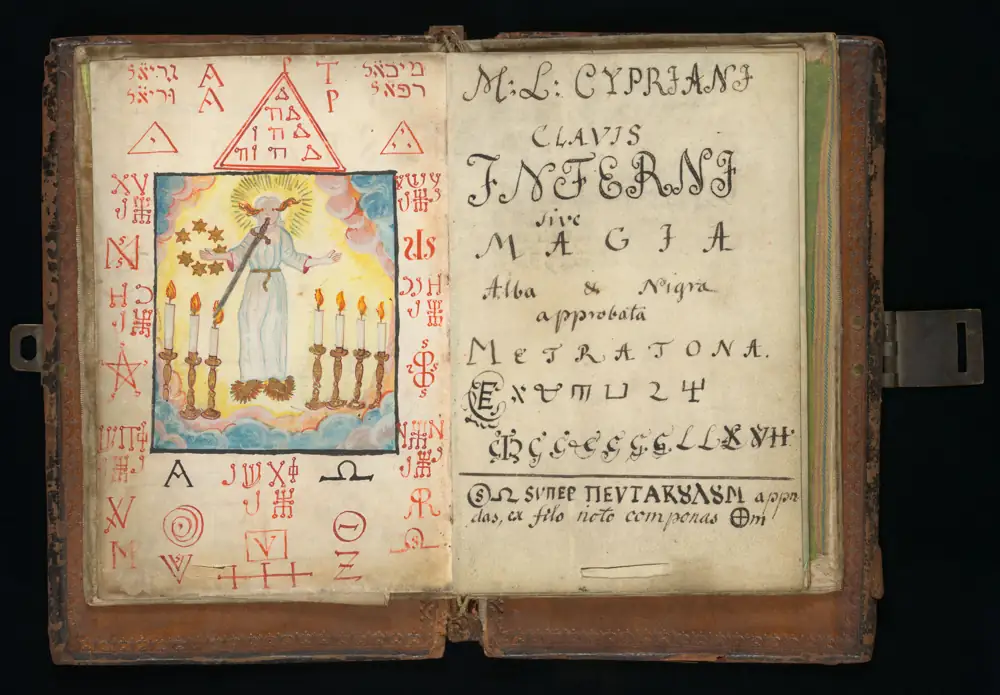
The opening puts an illuminated figure opposite the title Clavis Inferni, the Key of Hell. The title announces white and black magic together, yet the facing image is filled with light, stars and lamps. That arrangement is the first teaching of the book. Its infernal subject does not mean its imagined operator worships whatever is summoned. Instead, the manuscript presents access to dangerous powers as something governed from above. Reading the two pages together reveals that claim more clearly than reading the dark title by itself, detached from its carefully chosen companion image.
 OCCULT HALL · INTERPRETIVE ILLUSTRATION
A key beneath seven lights
The seven lights connect the book’s dark title with its image of superior sacred authority.
Seven lights and a speaking figure
Look closely at the robed figure. Seven candlesticks stand around it, a cluster of stars appears beside the raised hand, and a sword projects from the mouth. Those features recall the visionary figure in the opening chapter of Revelation. The sword belongs to the mouth rather than a fighting hand: speech is pictured as powerful judgment. The lamps make the figure a center of ordered light. The manuscript thus introduces a model of authoritative utterance before the reader reaches its written addresses and commands. This is an iconographic connection, not evidence that the manuscript itself dates from biblical antiquity.
Authority at the opening
Read the frontispiece and title as an arrangement of authority.
Choose a part to look closer.
Radiant figure
Lamps, clustered stars and the sword at the mouth establish a visual model of radiant authority and powerful sacred speech.
Read all the connections
- Radiant figure
- Lamps, clustered stars and the sword at the mouth establish a visual model of radiant authority and powerful sacred speech.
- Named warrant
- Cyprianus and Metatron lend the title an attributed lineage and superior approval; those written claims differ from independently established authorship.
- Material witness
- The surviving handwriting is catalogued late eighteenth century, so the earlier date written within belongs to the manuscript’s claimed history.
Read the title and its facing image together.
A title can contain several warrants
The facing title invokes Cyprianus and Metatron while displaying an elaborate date and unusual characters. These elements do different work. An attributed name offers a learned or sacred pedigree; the approving heavenly name supplies a further warrant; the impressive date suggests inherited knowledge. None functions as a modern signature proving who physically wrote the manuscript. The surviving object is catalogued as late eighteenth century on the evidence of its handwriting, despite the earlier date written inside. Its claimed lineage and its material date are therefore separate pieces of information, both worth preserving when introducing the book.
The book is itself a crafted object
Colour, gold, careful borders and the compact binding make this more than a loose list of formulas. They turn the manuscript into a possession that could be handled, opened and contemplated. The frontispiece offers an image of order before the dense writing begins. Its frame also surrounds the figure with additional signs, extending sacred authority into the margins. We should distinguish the visible care invested in the object from its promises of efficacy. A beautifully made manuscript can show how seriously somebody valued a tradition without proving that every promised result occurred.
Look at the passage itself.
 Open the book
Frontispiece and Clavis Inferni title
Read the complete source photographed opening alongside this lesson. Explain how the opening image places the manuscript’s promised power beneath a higher authority.
Read authority as a relationship
The useful question is not simply whether the scene feels holy or frightening. Ask who authorizes whom. The radiant figure occupies the opening; the book names the powers it claims to transmit; the reader later assumes a speaking role within that arrangement. This creates a hierarchy rather than a free-standing collection of symbols. As the course proceeds, keep returning to that relationship. A circle, a command and a dismissal each make better sense when connected to the opening’s higher authority. The frontispiece is therefore part of the manuscript’s argument, not a decorative pause before its real contents.
Read the opening as an argument
Use the reproduced opening to build a short explanation from visible features rather than from the atmosphere of its title.
- 01
Identify the evidence
List the lamps, the stars and the sword at the mouth. These are specific observations that another reader can check. Keep them separate from your first emotional impression of a book called the Key of Hell.
- 02
Connect the facing pages
Place the title’s promise of access beside the frontispiece’s image of superior power. Explain how their juxtaposition makes the promised command appear dependent on a higher source, rather than independent of it.
- 03
State the limit
Finish by distinguishing the manuscript’s claim from the date and authorship of the surviving object. The image establishes a theological framework inside the book; it does not establish that the book’s attribution or promises are historically true.
A strong reading explains why these pages belong together while leaving the manuscript’s claims visible as claims.
The text beside the teaching.
These selected pages accompany this free lesson. Enlarge a page and compare its details with the teaching.
Frontispiece and Clavis Inferni title
Read the complete source photographed opening alongside this lesson. Explain how the opening image places the manuscript’s promised power beneath a higher authority.
What to carry into the next lesson
- Read the title and its facing image together.
- Sacred imagery frames the book’s claimed infernal authority.
- An attribution is different from verified authorship.
Follow the figure’s attributes before reading the border. Notice how the lamps and the mouth direct attention toward ordered light and authoritative speech.
Can you explain it in your own words?
Try answering first, then open the explanation to compare your reasoning.
01What changes when the opening image is read beside the title?
The title’s promise becomes a claim to command under superior authority, rather than a simple celebration of infernal power.
02Why does the sword emerging from the mouth matter?
It presents speech as an instrument of authority, anticipating the manuscript’s later verbal commands.
03Does the written date settle the manuscript’s age?
No. The catalogue dates its handwriting to the late eighteenth century; the earlier internal date is part of the object’s claimed history.