Distinguish astronomical calculation from Ptolemy’s conditional art of judging effects.
Book I, chapters I–III; pp. 1–18.
Inside this lesson 5 teachings · 3 source pages
The language of this teaching
- Ambient
- The surrounding environment through which celestial conditions supposedly affect earthly things.
- Prognostication
- An inference about future conditions or events.
- Cooperating cause
- An additional condition contributing to an outcome.
Two studies under the same sky
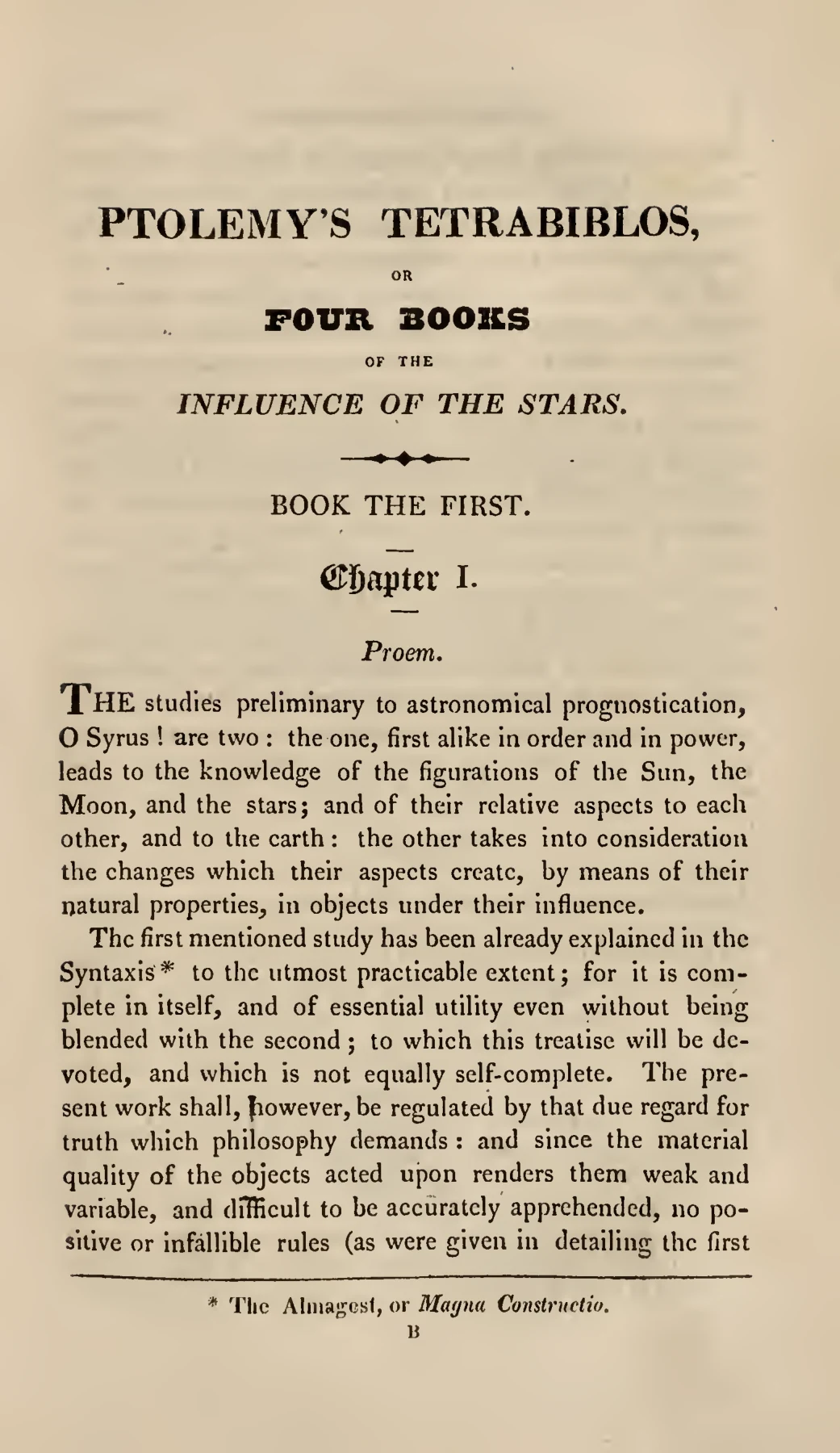
On the first page Ptolemy separates two enterprises. One describes positions and configurations of the Sun, Moon, and stars in relation to one another and to Earth. The other investigates changes allegedly produced by those configurations in earthly things. The first can be studied without accepting the second. That distinction is the doorway into this book.
Astronomy supplies a structured sky: a planet occupies a position, an angle separates two bodies, a cycle returns. Interpretation adds a causal claim about what those arrangements mean. A chart can therefore be calculated correctly while its interpretation remains mistaken. Ptolemy gives the second study less certainty because earthly material is variable and difficult to apprehend.
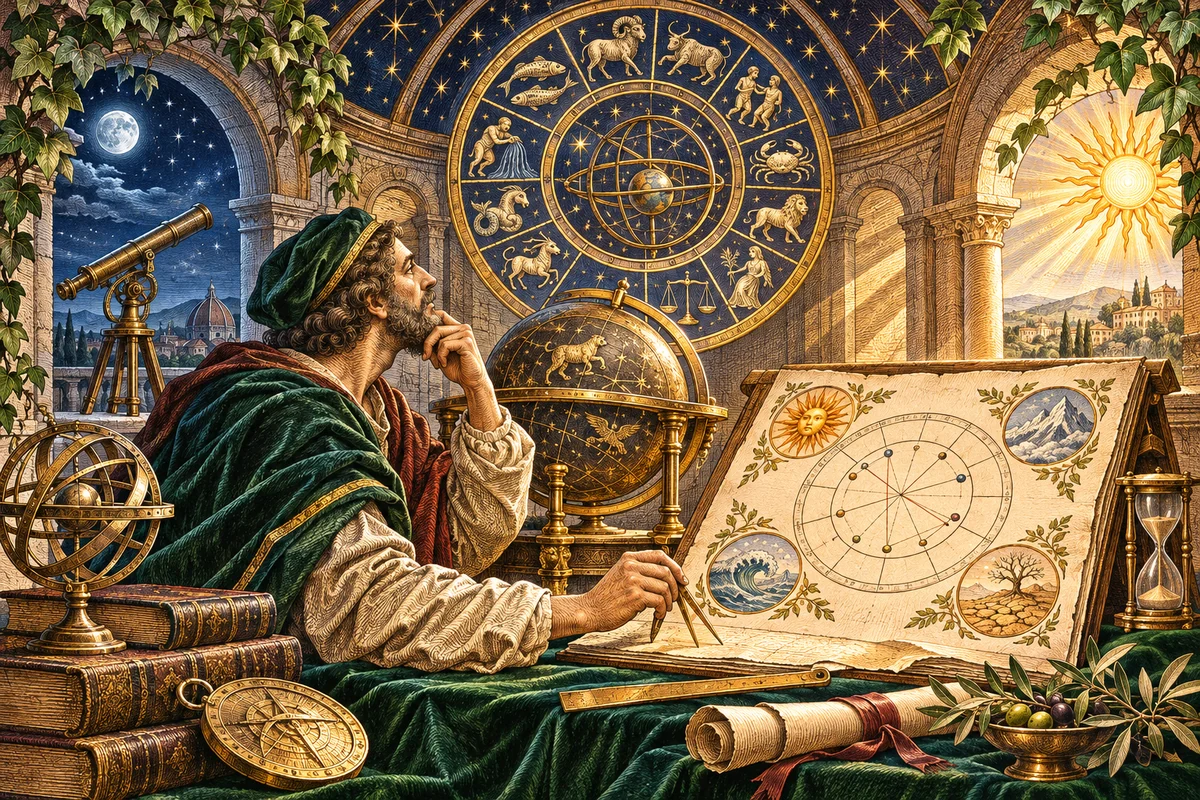 OCCULT HALL · INTERPRETIVE ILLUSTRATION
Two kinds of foreknowledge
An original interpretive painting inspired by this lesson.
The ambient and cooperating causes
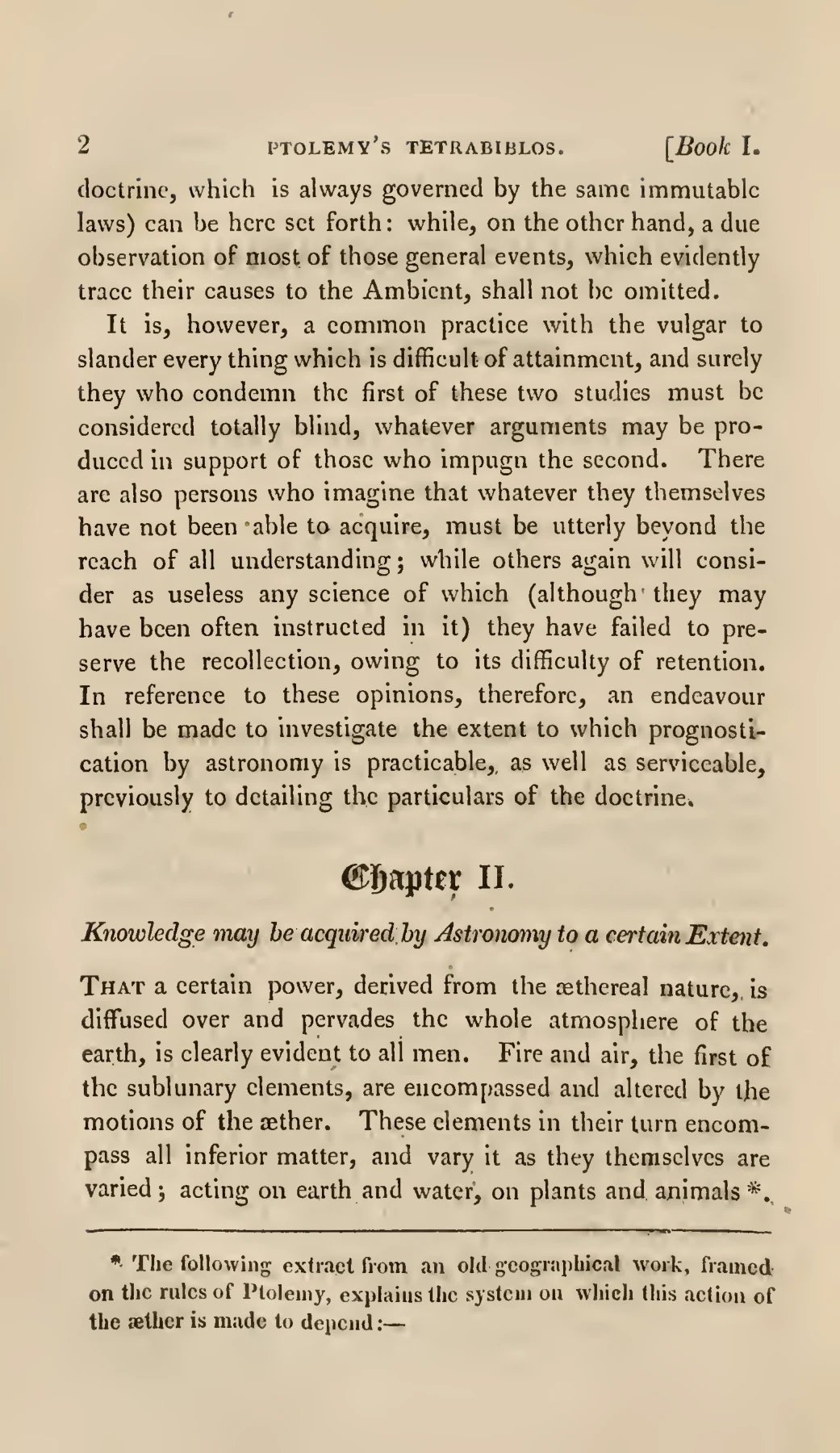
His bridge between sky and Earth is the ambient: the surrounding atmospheric and celestial environment. Seasonal changes provide his most accessible model. Heat, moisture, growth, and decay vary with the year; he extends that reasoning to other configurations. The familiar effect of sunlight, however, does not establish every further astrological claim.
Read page 11 closely. The interpreter must also consider country, nurture, education, and other circumstances. The same celestial arrangement does not erase every difference in the material receiving it. This is a theory of interacting conditions, rather than a rule that one star mechanically produces one identical event in everyone.
From a calculated sky to a conditional judgment
Distinguish astronomical calculation from Ptolemy’s conditional art of judging effects.
Choose a part to look closer.
Position
The first study calculates where celestial bodies stand and how their configurations relate to one another and to Earth.
Read all the connections
- Position
- The first study calculates where celestial bodies stand and how their configurations relate to one another and to Earth.
- Proposed cause
- The second study adds an account of how those configurations supposedly act through the surrounding environment upon earthly things.
- Receiving conditions
- Nature, place, upbringing, and other circumstances qualify the judgment; an accurate position alone does not establish an accurate prediction.
Calculation and prediction are separate claims.
What usefulness means
Ptolemy next asks why uncertain foreknowledge would be useful. He argues that anticipation can prepare a person emotionally and sometimes allow a response to circumstances. He distinguishes causes that overwhelm an individual from conditions that may be modified. His confidence belongs to the historical source; our task is to understand the structure of that confidence.
Keep three columns while reading: what is observed, what is inferred, and what is claimed as useful. This prevents seasonal warmth, a theory of planetary influence, and a promise about human affairs from collapsing into one kind of evidence. Every new rule in later lessons should be located somewhere in that chain.
A useful margin notation
Try three margin signs on the opening pages: O for an observation, M for a proposed mechanism, and J for a judgment about an earthly result. A statement about the Sun’s seasonal heat may receive O; the extension of that action through a general celestial medium receives M; a conclusion about an individual fortune receives J. Some sentences contain more than one layer. Split them before labeling. This exercise trains attention to the actual steps of the argument, rather than judging an entire page as either factual or mystical. It also gives you a precise way to explain where agreement ends and uncertainty begins.
Look at the passage itself.
 Open the book
Two preliminary studies · printed p. 1
Compare the studies and their different certainty.
 Open the book
The reach of knowledge · printed p. 2
Watch the move from position to supposed effect.
The opening is a contract with the reader
The first page does something more demanding than announce a subject. It tells the reader what kind of certainty to expect. The astronomical study is described as complete in itself, while the second study must allow for variability in the objects acted upon. This means the book’s later technical detail should be read under the qualification already established at the beginning. A detailed rule does not cancel the opening limitation.
To test your understanding, rewrite an absolute sentence in the form the introduction requires. Instead of this configuration always produces this result, write that the author associates the configuration with a tendency whose manifestation depends on the receiving subject and cooperating conditions. That wording does not validate the association; it states the claim more faithfully. Then ask whether the passage actually names those conditions or leaves them unspecified. The distinction between an explicit condition and a condition supplied by a modern reader matters. It prevents us from making the theory more careful than the surviving text, just as it prevents us from making it more absolute.
Separate three claims
An imaginary reader says a correct planetary table proves a prediction about a harvest.
- 01
Identify the calculation
The table may correctly locate a planet on a date. That is a claim about celestial position.
- 02
Find the missing bridge
The harvest prediction also requires an account of weather, soil, crop, and any alleged planetary effect. Correct position alone does not supply it.
- 03
Apply the distinction
Mark the first statement calculation and the second conditional interpretation. Ask which cooperating circumstances have been omitted.
You have reconstructed the opening’s logic without accepting every subsequent rule.
The text beside the teaching.
These selected pages accompany this free lesson. Enlarge a page and compare its details with the teaching.
Two preliminary studies · printed p. 1
Compare the studies and their different certainty.
What to carry into the next lesson
- Calculation and prediction are separate claims.
- The ambient connects celestial theory with terrestrial conditions.
- Distinguish observation, inference, and promise.
Notice the contrast between stable celestial configurations and variable earthly material on the first page.
Can you explain it in your own words?
Try answering first, then open the explanation to compare your reasoning.
01Does an accurately calculated chart prove its judgments?
No. Ptolemy distinguishes calculation from interpretation and treats the latter as more conditional.
02Why is earthly judgment less certain?
Its receiving material and circumstances vary, unlike a simple calculation of configuration.
03What accompanies celestial interpretation in this account?
The subject’s nature and circumstances, including country, nurture, and education.