Ptolemy’s Tetrabiblos
Sixteen gates into the architecture of classical astrology
 AN OCCULT HALL ILLUSTRATION
Enter its world.
The Tetrabiblos builds an art of celestial interpretation from heat, cold, moisture, dryness, position, and relation. These sixteen lessons follow that architecture through all four books. They teach what this influential historical system says and how its reasoning works; they do not treat its predictions as established facts.
This edition contains the complete numbered text of Ashmand’s 1822 volume, including notes and appendices. The surviving copy lacks the separate folded planisphere plate mentioned in its catalogue. Its in-text diagram and tables remain available. Sixteen is our guided lesson count, not the original chapter count.
- Sixteen lessons through all four books
- Original English pages with every lesson
- Qualities, aspects, dignities, eclipses, and life cycles
Sixteen celestial gates
One free introduction · 15 member lessons
Why this number?
16 lessons form our expanded editorial path through this collection. The course count is a modern study arrangement, not the number of chapters, beings or stages stated by the historical authors.
Your way through.
Follow the teachings step by step, work through concrete examples, and connect each explanation with its cited passage.
Two kinds of foreknowledge
Distinguish astronomical calculation from Ptolemy’s conditional art of judging effects.
12 min · Free introduction
Seven lights, four qualities
Explain planetary qualities and why changing conditions modify judgment.
12 min · Member lesson
The year inside a day
Distinguish seasonal sign classes from the four angles of the local sky.
12 min · Member lesson
The geometry of a glance
Reconstruct principal aspect angles and distinguish geometry from interpretation.
12 min · Member lesson
Planetary homes and honors
Distinguish domicile, triplicity, and exaltation and explain their separate rationales.
12 min · Member lesson
Dividing the zodiac finely
Explain terms or bounds and distinguish lengths from cumulative endpoints.
12 min · Member lesson
From a birth to a whole country
Reconstruct the distinction between universal and particular judgment and critically read geographical correspondences.
12 min · Member lesson
An eclipse is a sequence of questions
Explain the four branches of Ptolemy’s eclipse judgment without treating the interpretation as a forecast.
12 min · Member lesson
The uncertain beginning
Explain why conception, birth, and the recorded ascending degree are distinct issues.
12 min · Member lesson
Reading several testimonies together
Distinguish the source’s body and mind inquiries and trace how multiple testimonies are combined.
12 min · Member lesson
Different questions need different witnesses
Identify how Book IV changes its witnesses for different kinds of worldly affairs.
12 min · Member lesson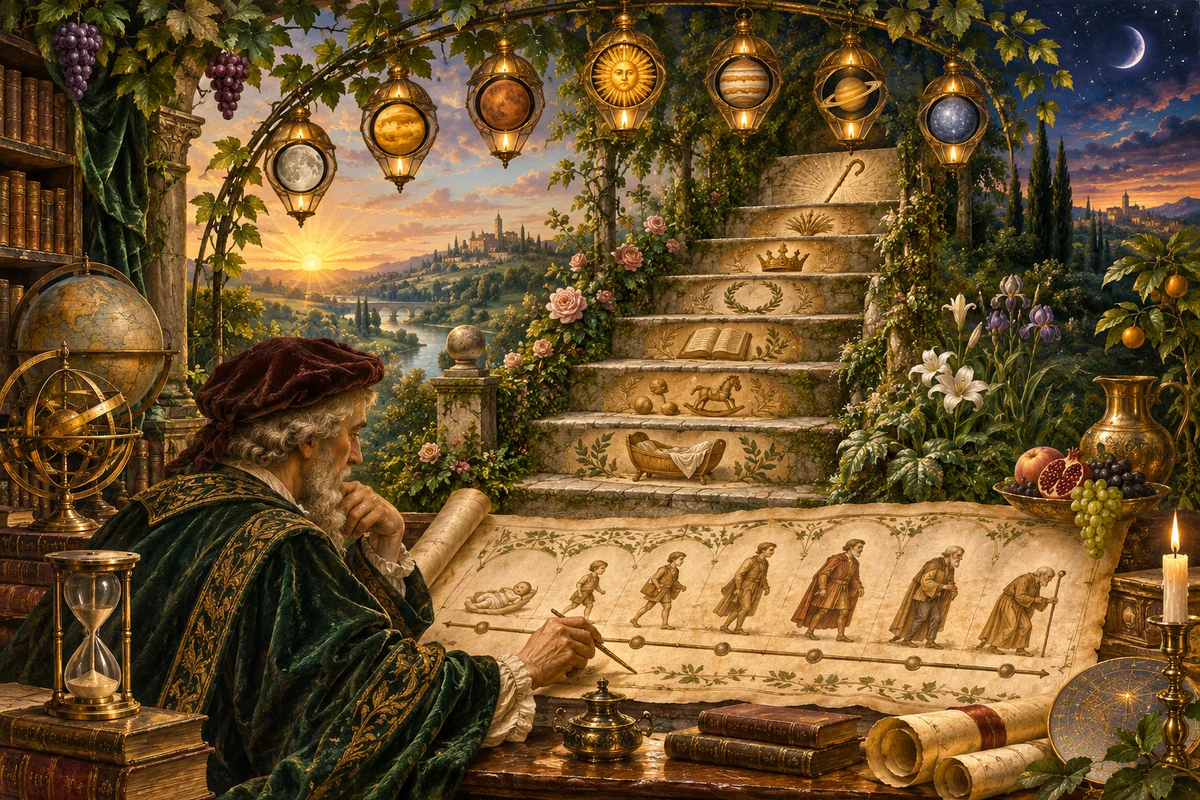
Seven ages under one sky
Reconstruct the seven planetary ages and distinguish them from individual timing rules.
12 min · Member lesson
Day and night as a balance
Explain why Ptolemy assigns some planets to compatible conditions and others to conditions that moderate their excess.
11 min · Member lesson
Fixed stars as mixtures
Read the fixed-star catalogue as a set of planetary analogies, preserving local differences within a constellation and the wording of this edition.
11 min · Member lesson
Weather at three scales
Explain the hierarchy of seasonal, monthly, and shorter atmospheric judgments while distinguishing Ptolemy’s claims from modern weather forecasting.
11 min · Member lesson
Friendship as a comparison of nativities
Read the distinction between enduring relationships and temporary encounters, and identify the different motives assigned to the chart’s principal places.
11 min · Member lessonThe source beside you.
Members can explore the complete edition. Begin with the free introduction and its selected source pages.
The complete book awaits.
Ptolemy’s Tetrabiblos
The complete historical editions and page-turning readers belong to the member library. Free introductions include the source excerpts used in their teaching.
Books & dates
Ptolemy’s TetrabiblosPtolemy · J. M. Ashmand translation · 1822
Guided readings and teaching diagrams are original Occult Hall commentary. Imagined scenes are modern illustrations, separate from the historical source pages.
The Triumphant Chariot of Antimony
Eleven chambers of matter, fire and Hermetic interpretation