Connect each governor with its planetary sphere and attributed offices, and explain how the work distinguishes a natural process from a miraculous intervention.
Arbatel, aphorisms 15–17, especially the seven governor descriptions and the general precepts following them.
Inside this lesson 6 teachings · 4 source pages
The language of this teaching
- Olympic governor
- One of seven named spiritual rulers associated with the seven traditional planetary spheres.
- Province
- A jurisdiction assigned to a governor within the work’s numerical account of spiritual government.
- Ophiel
- The governor associated with Mercury, whose attributed offices include teaching arts.
Seven names organize seven fields of action
Aphorisms 16–17 name Aratron, Bethor, Phaleg, Och, Hagith, Ophiel and Phul, associated respectively with Saturn, Jupiter, Mars, the Sun, Venus, Mercury and the Moon. These are spiritual governors, not simply alternative spellings of the visible planets. The planet identifies a field of correspondences; the governor is an agent said to administer that field. The distinction matters when the text says a governor acts naturally or of free will. A regular natural process and a personal response to a request are different modes of action. Both are placed within a created order and remain subject to divine permission. The catalogue consequently describes offices as well as marvels. To understand an entry, connect its personal name, celestial sphere and particular activities.
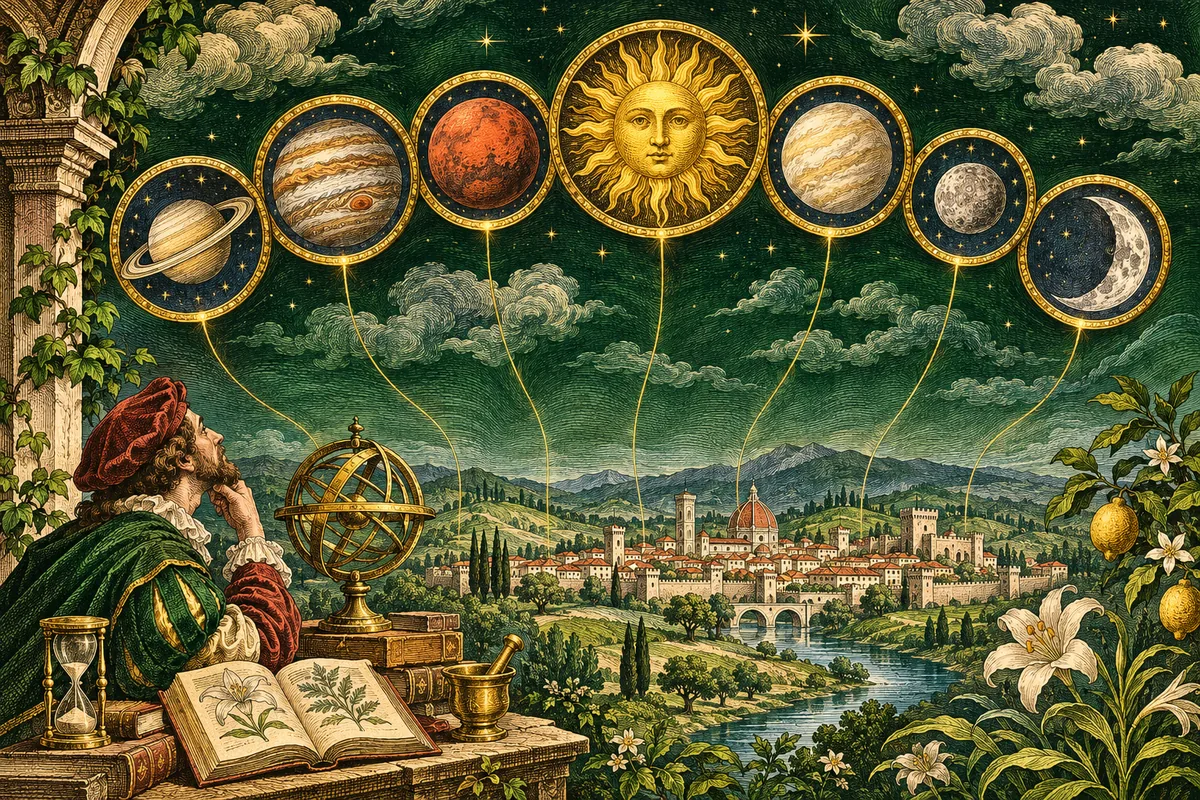 OCCULT HALL · INTERPRETIVE ILLUSTRATION
Seven planets, seven different offices
Seven celestial medallions connected to an earthly landscape evoke the planetary governments; the diagram names each governor and its particular offices.
Aratron’s Saturnian powers include transformation
Aratron’s description begins with the claim that an animal or plant can be changed into stone while preserving its outward appearance. This separates visible form from material constitution: something could look the same yet be different in substance. The same entry associates Aratron with converting treasure into coal and coal into treasure, teaching alchemy, magic and physic, and providing familiars with definite powers. These are not merely a list of desirable outcomes. They concern transformation, hidden material potential and specialized service. The familiar’s definite power also limits its office; receiving a helper does not mean receiving every possible capacity. Within the catalogue, Saturn’s governor becomes a teacher and administrator of material changes whose effects may be concealed beneath an unchanged appearance.
Bethor and Phaleg distinguish kinds of eminence
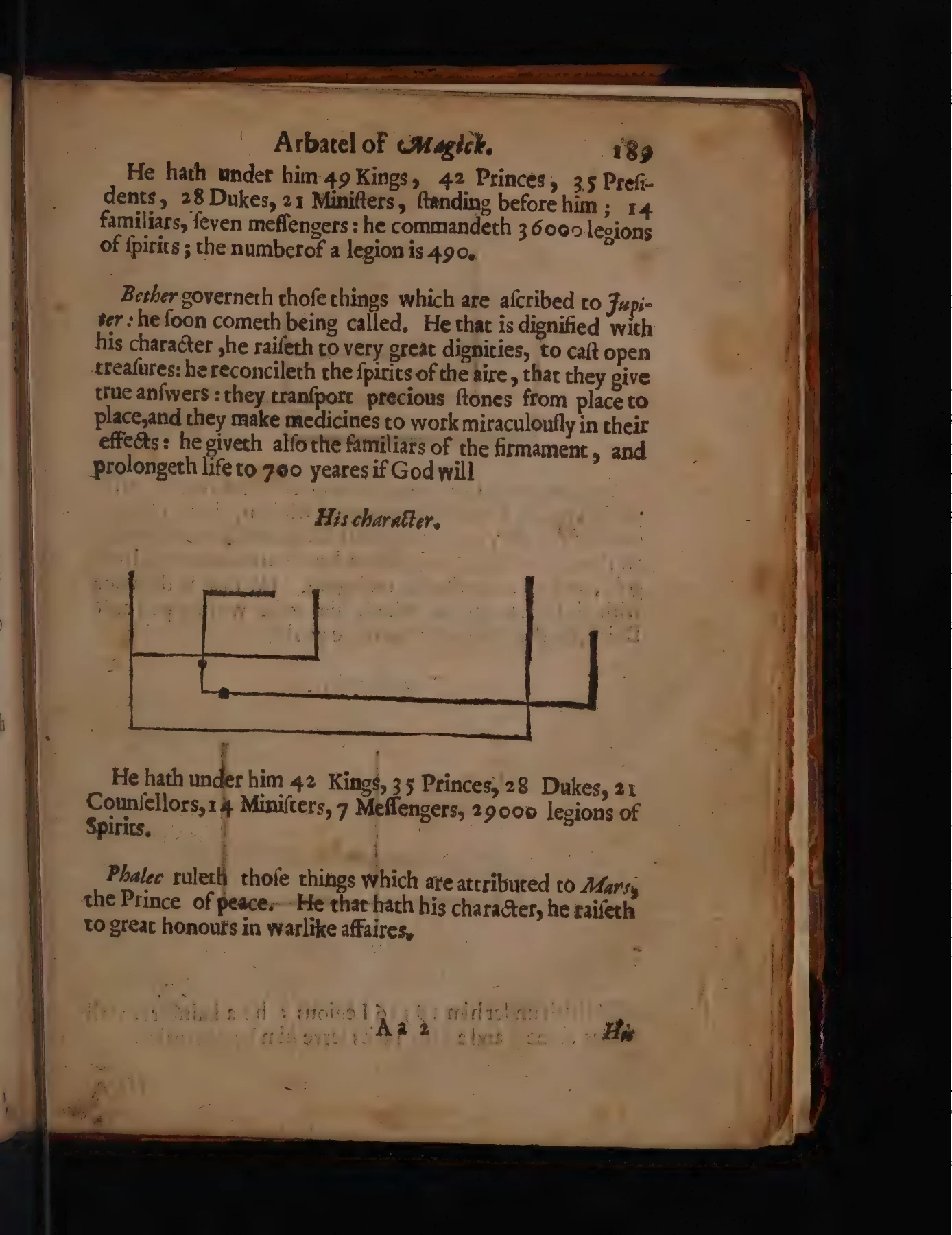
Bethor, Jupiter’s governor, is credited with elevating people to dignities, revealing treasures and reconciling aerial spirits so that they give truthful answers. His entry therefore joins social elevation with access to resources and reliable information. Phaleg, the governor associated with Mars, is called a prince of peace while also granting honors in military affairs. That combination is striking but should not be erased. The text can imagine authority in war serving an ordered peace, rather than defining Mars only through uncontrolled violence. Both governors concern eminence, but the emphasis differs: Bethor’s office includes dignity and mediation, while Phaleg’s short description concentrates on military honor. Their shared ability to raise someone’s standing does not make their spheres identical.
Seven planets, seven different offices
Read the governors by the particular kinds of assistance attributed to them.
Choose a part to look closer.
Aratron · Saturn
Aratron's transformations can alter material while preserving appearance; his teaching of alchemy, magic and physic concerns hidden capacities within substances.
Read all the connections
- Aratron · Saturn
- Aratron's transformations can alter material while preserving appearance; his teaching of alchemy, magic and physic concerns hidden capacities within substances.
- Bethor · Jupiter
- Bethor joins elevation to dignities with treasure and the reconciliation of aerial spirits, combining social standing, resources and truthful answers.
- Phaleg · Mars
- Phaleg grants honours in military affairs and is called a prince of peace, bringing martial eminence into an account of ordered authority.
- Och · Sun
- Och's office combines wisdom, gold, precious stones and exceptional standing; the same gold may form through nature, chemical art or claimed immediate magic.
- Hagith · Venus
- Hagith concerns beauty and adornment while exchanging copper and gold, linking attractive appearance with transformation between materials of different value.
- Ophiel · Mercury
- Ophiel teaches arts and provides familiars, making instruction and continuing assistance central to the office assigned to Mercury in this catalogue.
- Phul · Moon
- Phul's lunar office concerns silver and spirits of water appearing visibly in bodies, joining a material association with a particular manner of assistance.
The subjects can overlap without becoming interchangeable: gold, for example, enters different governors' descriptions through different offices.
Och and Hagith connect value with visible form
Och’s solar entry combines wisdom, gold, precious stones and exceptional status. Hagith’s Venusian entry emphasizes beauty and adornment, while also claiming the power to change copper into gold and gold into copper. The material contrast teaches something about the catalogue’s organization. A metal can matter as a valuable substance, as something beautiful, or as a material assigned to a planetary sphere. Several offices can therefore touch the same object from different directions. The general precepts make Och the clearest example: gold is said to form slowly in mountains, more quickly through chemical art, and immediately by magic. The promised endpoint remains gold; what changes is the mode and speed of its production within the author’s theory.
Ophiel teaches arts; Phul governs lunar things
Ophiel is assigned to Mercury and is said to teach all arts, provide familiars and grant an extraordinary alchemical transformation. The broad teaching office gives a direct explanation of why a student might be interested in this governor. Phul’s lunar description instead emphasizes silver and spirits of water that serve in visible bodily form. These examples show that the entries combine subject matter with the manner of assistance. Teaching communicates an art; a familiar provides continuing service; a visible water spirit supplies a particular kind of presence. The catalogue’s remarkable claims should be understood as attributed offices, not blended into one generic promise of power. Mercury’s educational association and the Moon’s watery and silver associations give each description its distinctive center.
Look at the passage itself.
 Open the book
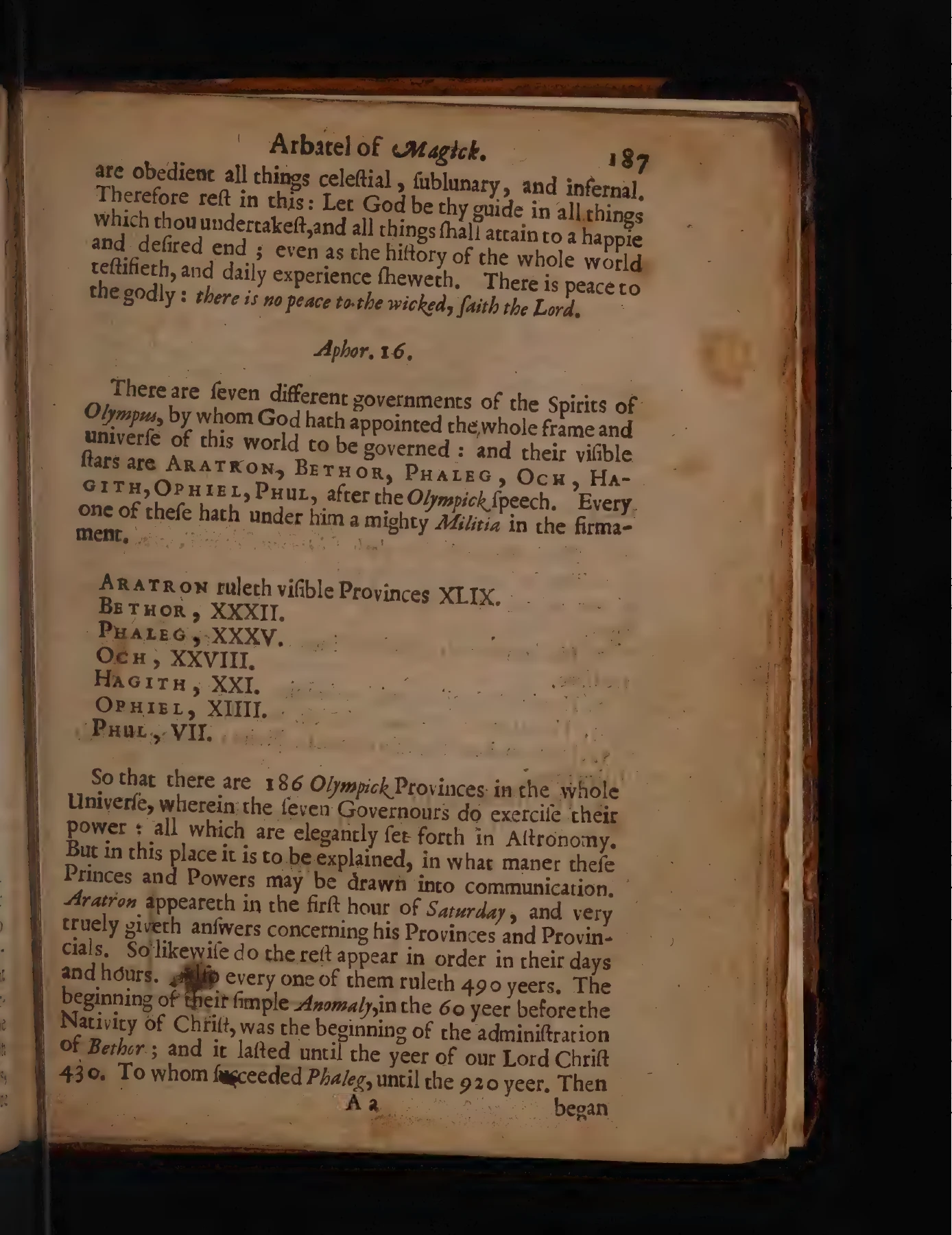
Aphorism 16: seven governments
The printed province numbers preserve Bethor 32 and the total 186; compare the proposed correction carefully.
 Open the book
Aphorism 17: Bethor and Phaleg
The descriptions distinguish Jupiterian dignity from Mars-related honor.
Numbers make the government proportioned
Aphorism 16 assigns provinces in a sequence based on seven. Aratron receives 49, followed by Bethor’s printed 32, then Phaleg 35, Och 28, Hagith 21, Ophiel 14 and Phul 7. Turner prints a total of 186. Replacing Bethor’s 32 with 42 restores a regular descent by seven and produces 196; this is a correction, not what the displayed 1655 page literally says. The distinction lets us understand both the surviving reading and the apparent intended pattern. Aphorism 17 also distributes subordinate ranks under some governors. Those ranks are another organization, not simply a restatement of the province count. Provinces describe jurisdictions; kings, princes and ministers describe the company administering them. Number gives the imagined government scale and proportion.
Understand Och’s three speeds of making gold
On local PDF scan 16, the general precepts compare natural, chemical and magical production of gold. Use that one example to understand a principle applied to the governors.
- 01
Keep the endpoint fixed
In all three descriptions the desired material is gold. The natural example places its formation in mountains over a long period. The chemical example assigns a shorter process to art. The magical example claims an immediate result. The contrast concerns the way a capacity acts, rather than three unrelated substances.
- 02
Distinguish regular action from response
The first general precept says governors act naturally in a regular manner or otherwise according to their will, unless God prevents it. The natural process belongs to the ongoing order of the world. The exceptional result belongs to the text’s account of a governor acting in response to a particular undertaking.
- 03
Connect the example back to office
Och is solar and gold belongs to his description. His role gives the comparison a particular subject. Ophiel’s teaching of arts or Phul’s visible water spirits would require different examples. The general principle is shared, but it acts through the office assigned to each governor.
The catalogue offers a theory of different modes of efficacy: the same created field can be approached through nature, art or the extraordinary agency the work attributes to a governor.
The text beside the teaching.
These selected pages accompany this free lesson. Enlarge a page and compare its details with the teaching.
Aphorism 16: seven governments
The printed province numbers preserve Bethor 32 and the total 186; compare the proposed correction carefully.
What to carry into the next lesson
- Connect each governor with its planetary sphere and attributed offices, and explain how the work distinguishes a natural process from a miraculous intervention.
- The endpoint remains gold, while the manner and speed of production change: long natural formation, shorter chemical art and the immediate result claimed for magic.
On local PDF scan 16, the general precepts compare natural, chemical and magical production of gold. Use that one example to understand a principle applied to the governors.
Can you explain it in your own words?
Try answering first, then open the explanation to compare your reasoning.
01What changes between Och’s natural, chemical and magical production of gold?
The endpoint remains gold, while the manner and speed of production change: long natural formation, shorter chemical art and the immediate result claimed for magic.