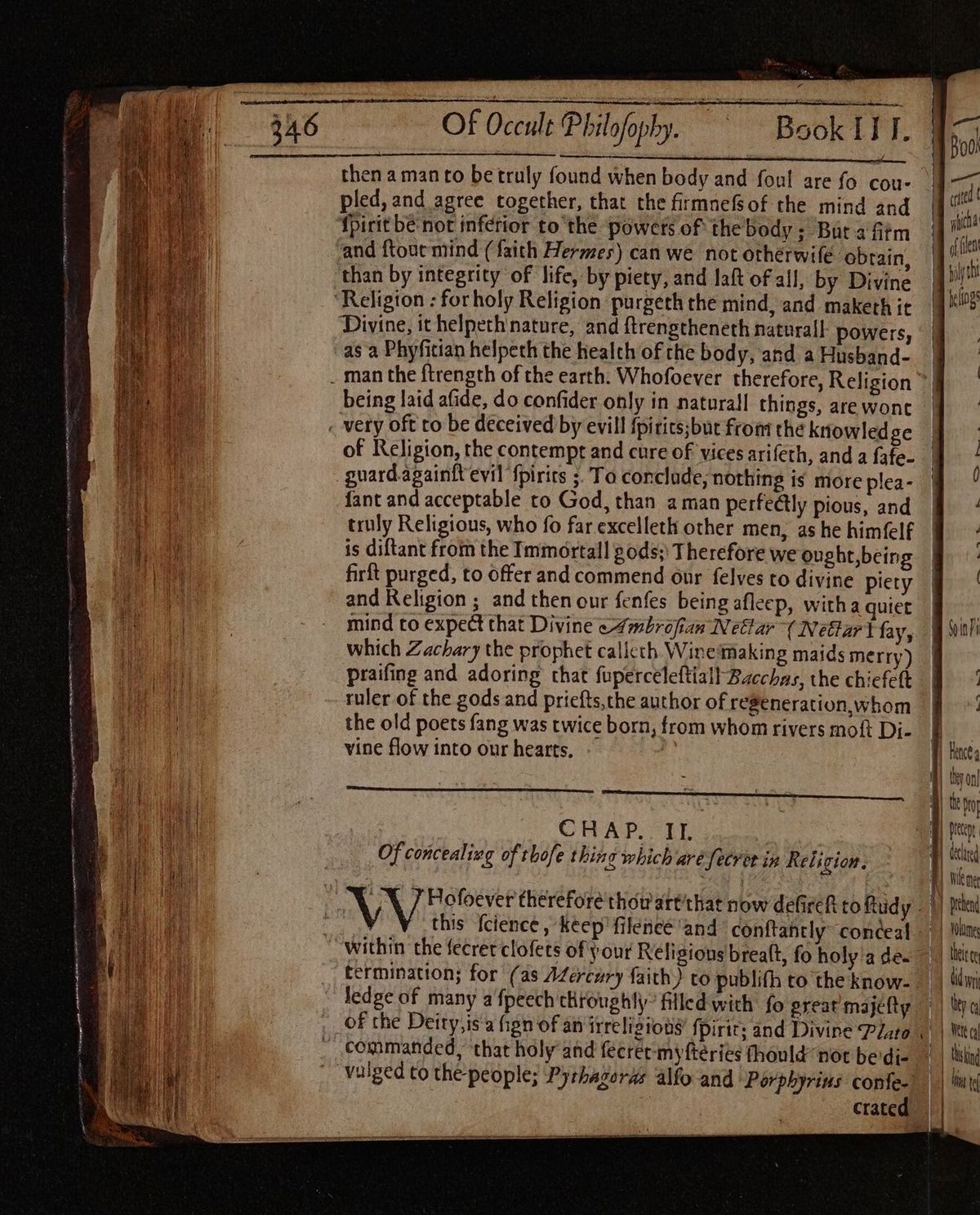
From the 1651 edition
Find the comparison between a physician tending the body and a husbandman tending the earth. It explains the work Agrippa gives to religion.
Why does Agrippa compare religion’s work on the reader to the work of a physician and a farmer?
Find what each worker tends
Start about a third of the way down page 346, above the heading for chapter II. A husbandman is a farmer. Agrippa gives you two occupations in one comparison. A physician tends a living body. A farmer tends ground that has its own power to bring things forth. In each case, the worker assists something capable of acting and growing.
Now put the sentence back in its place. Agrippa has been talking about the relation of mind and body. He wants a reader whose firmness of mind can match the powers of the body. What cultivates that capacity? His answer is religion. The example gives you a precise image for preparation. A person’s way of life can, in his view, improve the condition in which that person comes to know divine things.
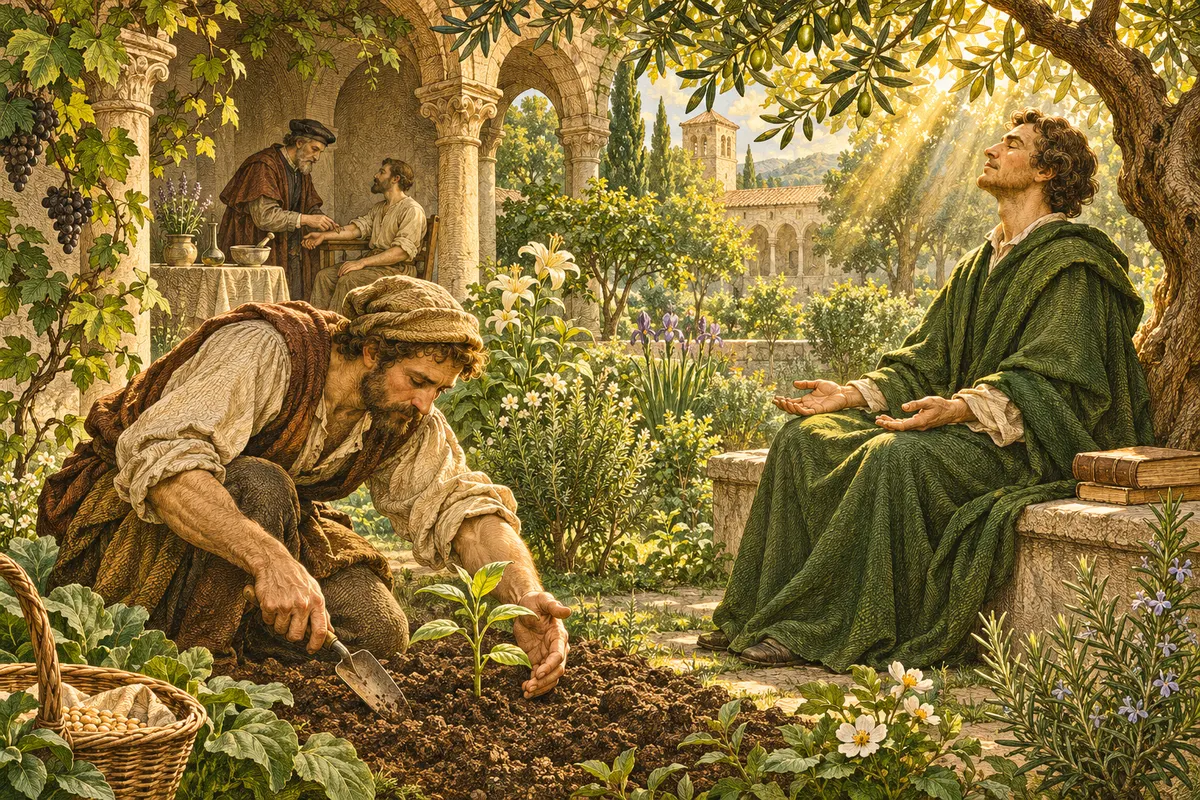 OCCULT HALL · INTERPRETIVE ILLUSTRATION
PICTURE THE TEACHING Preparing the ground, awaiting the gift
Farmer, physician, and attentive reader illustrate Agrippa's analogy of preparing living capacities without commanding their source.
“a Husbandman the strength of the earth”
1651 editionPage 346 Look for the qualities he asks the reader to cultivate
Move a few lines upward. Agrippa invokes Hermes in support of the claim that a firm mind comes through integrity and piety. Integrity asks how a person lives. Piety concerns the person’s duties and reverence toward God. These are requirements on the reader that could never be satisfied simply by copying a diagram accurately or memorizing a list of divine names.
Read the next consequence. Agrippa worries that someone attending only to natural things may be deceived by evil spirits. In his Christian account, religion helps a person recognize and correct vices and supplies protection against such deception. That belief explains why he puts an argument about character at the entrance to a book that will discuss angels and ceremonies.
SEE THE CONNECTION · AN ILLUSTRATED TEACHING Preparation makes a recipient ready; it does not command the gift
Agrippa's farmer and physician prepare conditions for activity whose source is not simply their own technique.
✦Conduct → offering → expectation✦Choose a part to look closer.
Cultivate integrity and piety
The reader's conduct prepares the mind, as a farmer tends soil or a physician assists a body already capable of living activity.
Read all the connections
- Cultivate integrity and piety
- The reader's conduct prepares the mind, as a farmer tends soil or a physician assists a body already capable of living activity.
- Offer and commend the self
- Agrippa's next verbs place the prepared person in a relation of dedication, requiring more than copying diagrams or memorizing sacred words.
- Wait with a quiet mind
- The person awaits what Agrippa regards as a divine gift, so disciplined preparation does not amount to control over its source.
The final posture of expectation changes how the preceding work should be understood.
“by integrity of life, by piety”
1651 editionPage 346 Identify who is expected to act last
Just before the next chapter, follow the verbs. The reader offers and commends the self, waits with a quiet mind, then praises and adores. Pay attention to “expect.” Here it means to await. After all the active preparation, the person must become capable of receiving something whose source is divine.
Return to the farmer. Working the ground matters, but the farmer’s activity alone does not produce the life of the crop. In Agrippa’s analogy, disciplined conduct prepares the reader and God remains the source of what the reader hopes to receive. A technique that guaranteed a result on command would sit uneasily with that final posture of waiting.
ON THE ORIGINAL PAGE Look at the passage itself.
Open the book 01Agrippa · printed page 346
Find the comparison between a physician tending the body and a husbandman tending the earth. It explains the work Agrippa gives to religion.
“with a quiet mind to expect”
1651 editionPage 346
Reading exercise
On page 346 find one phrase about conduct, one about danger, and one about waiting. Arrange them as a sequence. In your own words, explain what the reader does, what problem Agrippa thinks this addresses, and what the reader must await.
Test your reading
Someone copies every ceremonial word correctly but assumes the words give their speaker complete control. Which two parts of this page would Agrippa use to challenge that assumption?
Check your answer
He would point first to integrity and piety, which concern the speaker’s whole life. Then he would point to the quiet expectation of a gift. Correct copying supplies neither that preparation nor authority over the source of the gift.