Explain why Saunders begins a book about hands with planets and the zodiac, and distinguish the observed hand from its proposed cosmic meaning.
Richard Saunders, Physiognomie and Chiromancie (London, 1653), p. 1, p. 2, p. 3.
Inside this lesson 5 teachings · 3 source pages
The language of this teaching
- Chiromancy
- The historical art of interpreting the hand’s visible signs as indications of disposition and events.
- Planetary mount
- A named region, usually a raised area, associated with one of the seven traditional planets.
- Correspondence
- A proposed relationship joining a part of the small human world to a power or structure of the larger cosmos.
Begin where Saunders begins
The first page does not begin with a prediction about love or money. Saunders begins with seven wandering stars: Saturn, Jupiter, Mars, the Sun, Venus, Mercury and the Moon. In the astronomy and astrology of his book, the Sun and Moon belong to this sevenfold group. He says these celestial powers govern lower bodies, particularly human hands. This is the premise that makes his later diagrams intelligible. A planet’s name on a finger is therefore a claim about correspondence and influence, not an anatomical label discovered by dissection. Before reading a mark, the reader has to learn the cosmic map that assigns it a place.
 OCCULT HALL · INTERPRETIVE ILLUSTRATION
The hand as a little cosmos
Original teaching illustration inspired by Richard Saunders’s 1653 hand diagrams.
A year folded into the palm
Saunders next introduces the zodiac as an imagined circle divided into twelve signs and 360 degrees. The Sun’s progress supplies his account of seasons, generation and decay. On the second printed page he arranges the signs into spring, summer, autumn and winter, three signs to a season. This sequence matters because his hand will carry several calendars at once: seven planetary places and twelve zodiacal divisions. He is not simply decorating a hand with stars. He wants the hand to summarize changes that occur in the larger world, so that a local feature can be connected to a season, a power and a proposed event.
Seven items are not seven identical creases
Printed page 2 lists seven lines or parts, but the list is mixed. It includes the Table line, middle natural line, line of Life, hepatic or stomach line, a sister of the vital line, the percussion and the wrist. The percussion is a region along the striking edge of the hand, rather than an ordinary crease. Saunders immediately adds that only four lines are principal. This distinction prevents a common reading error: counting visible creases and trying to force every palm into seven identical lines. His categories describe a system of important structures and places; they do not promise seven equally obvious grooves on every hand.
From cosmos to hand
Follow the three stages in Saunders’s first hand diagram.
Choose a part to look closer.
Visible place
Begin with the thumb-base region, a mount, the center of the palm or a named crease. Record what the engraving actually places there.
Read all the connections
- Visible place
- Begin with the thumb-base region, a mount, the center of the palm or a named crease. Record what the engraving actually places there.
- Assigned power
- Saunders assigns Venus to the thumb region and Mars to the central plain. These names connect local anatomy to his seven planetary powers.
- Attributed subject
- Venus supplies love and marriage; Mars supplies strength and conflict. A further mark and rule would be needed for a specific historical prediction.
Description, correspondence and prediction are three different operations.
A map gives a sign its subject
The first engraved hand on printed page 3 turns the opening theory into a visible arrangement. The roots of the fingers carry planetary mounts; the center includes a triangle and a table or quadrangle. The explanation below assigns different subjects to different places. Mercury’s mount concerns arts and actions, Venus’s area concerns love and marriage, and Mars’s area concerns strength and conflict. These assignments are Saunders’s interpretive conventions. They explain why the same shape can mean different things in different locations. To read his page accurately, record the location first and the shape second; a floating star or cross without its setting loses much of the book’s meaning.
Look at the passage itself.
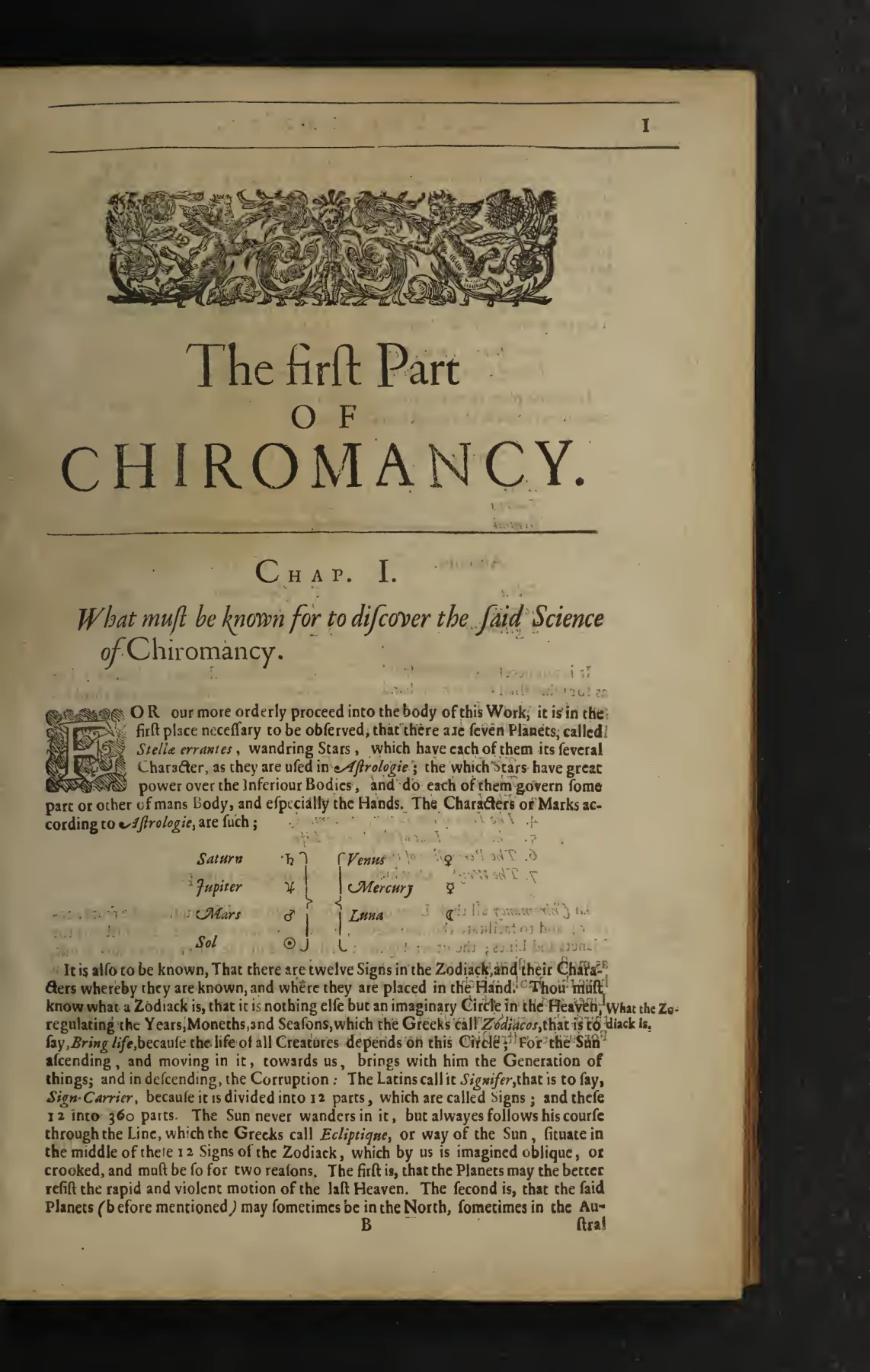 Open the book
Printed page 1 · scan 35
Seven planets and the zodiac form the opening premise.
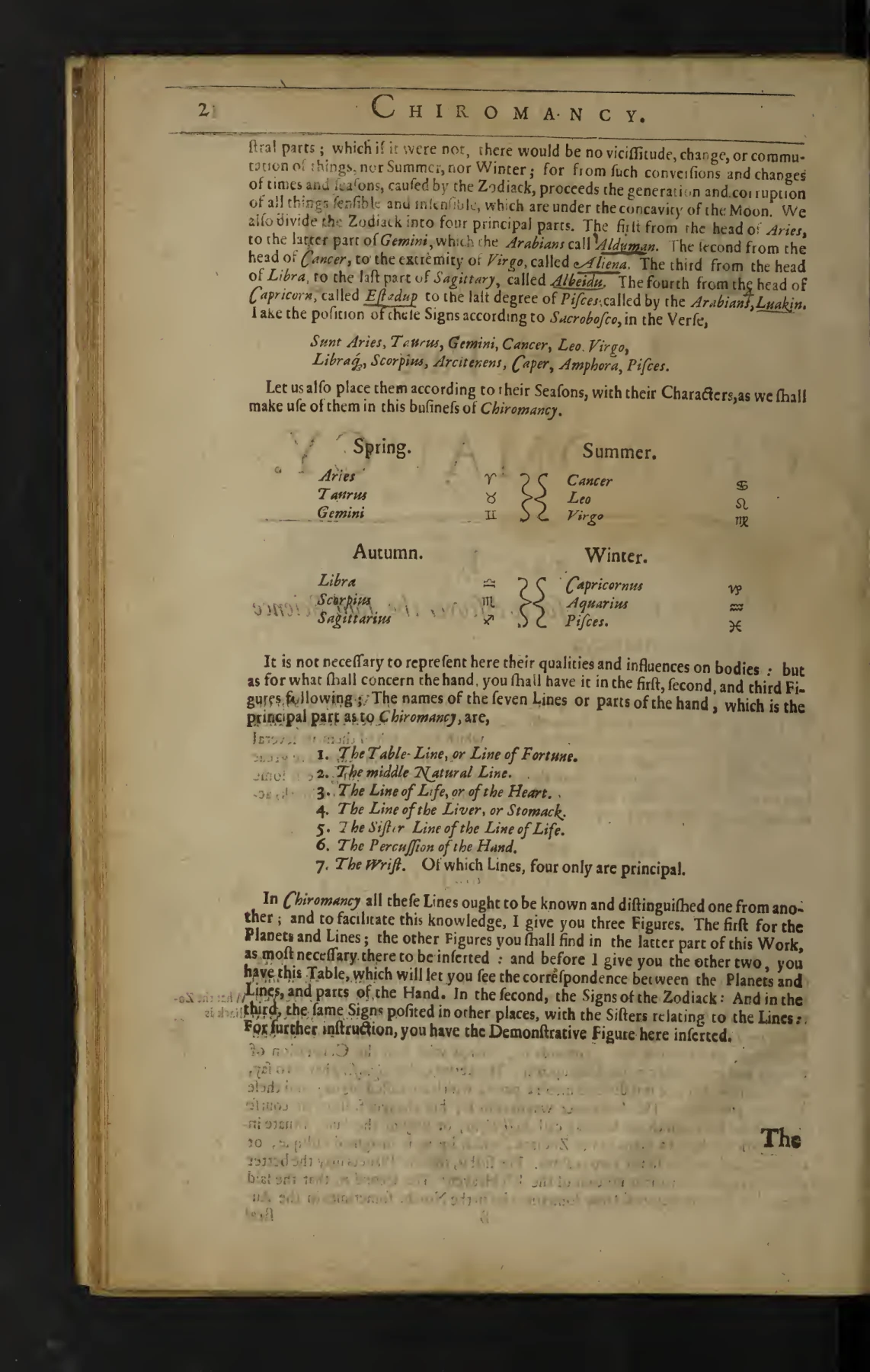 Open the book
Printed page 2 · scan 36
The seasons and mixed list of seven lines or parts.
Read the correspondence in three stages
A useful way through this unfamiliar system is to separate three operations. First describe what the plate actually shows: a line, branch, raised area or engraved symbol. Next identify the planetary or zodiacal territory Saunders assigns to it. Only then summarize the conclusion he draws. The first operation is visual description, the second uses his symbolic map, and the third is his divinatory claim. Keeping those stages separate lets you understand the magic he believed the hand contained without treating it as a proven account of a person’s future. Our course follows seven chosen routes through his substantial book; Saunders did not divide the original into these seven lessons.
Follow one place through the system
Use the engraving on printed page 3 as a map. The exercise concerns its organization rather than a living person’s fortune.
- 01
Locate
Find the fleshy area at the base of the thumb. Describe its position in ordinary words before reading any symbol. Its boundary is important because the thumb region and central palm belong to different divisions.
- 02
Name
Consult the explanation below the plate: the thumb’s mount belongs to Venus. Write that as an attribution made by Saunders. Do not confuse the planet’s name with the name of a crease running around the region.
- 03
Connect
Saunders connects that region to love and marriage. Your finished note should therefore have three separate entries: thumb-base region, Venus, and the subjects of love or marriage. It describes how his system produces a field of meaning without making a personal prediction.
The hand becomes readable through a chain of placement, planetary name and assigned subject. That chain will support every more detailed lesson.
The text beside the teaching.
These selected pages accompany this free lesson. Enlarge a page and compare its details with the teaching.
Printed page 1 · scan 35
Seven planets and the zodiac form the opening premise.
What to carry into the next lesson
- Saunders starts from celestial influence, then maps it onto the hand.
- His seven principal items include regions as well as lines.
- Location, planetary attribution and prediction are distinct stages.
Notice how much of the engraved hand is labeled by location before any individual mark is interpreted.
Can you explain it in your own words?
Try answering first, then open the explanation to compare your reasoning.
01What information would be lost if the Venus label were detached from the thumb region?
The label would no longer identify the location that gives nearby marks their subject. A planetary name alone is not a complete interpretation.
02Why does the opening discuss the zodiac?
Saunders wants the hand to reflect the larger cosmos, including seasonal and celestial divisions.
03Why is it misleading to look for exactly seven major creases?
His list includes the percussion and wrist, and he explicitly distinguishes four principal lines.