Explain how hourly and daily government work together.
Lucidarium I–II, IV, IX–XI and XXIIa; MS 334, manuscript pp.1–4, 6–8 and 17.
Inside this lesson 6 teachings · 4 source pages
The language of this teaching
- Hourly governor
- The angel assigned to a particular hour on a particular weekday.
- Daily company
- The group assigned to the weekday as a whole.
Two questions hidden in a single hour
The Lucidarium begins by giving hours names. Its first daylight hour is Yayry, also written Yayn in the later example. That name describes a position within the day. A second list answers a different question: which angel governs that position today? Sunday's first hour has Raphael; Monday's has Gabriel. The first hour can therefore retain its own name while its governor changes. This is the foundation of the book's system of time. The operator is imagined as addressing an ordered creation whose parts have both identities and administrators. Saying only “the first hour” would omit the weekday's heavenly government; saying only “Raphael” would omit the particular time. The text brings those two facts together without collapsing them. A useful modern comparison is a room with a fixed number and a changing occupant: the two labels belong to the same situation, but provide different information about it.
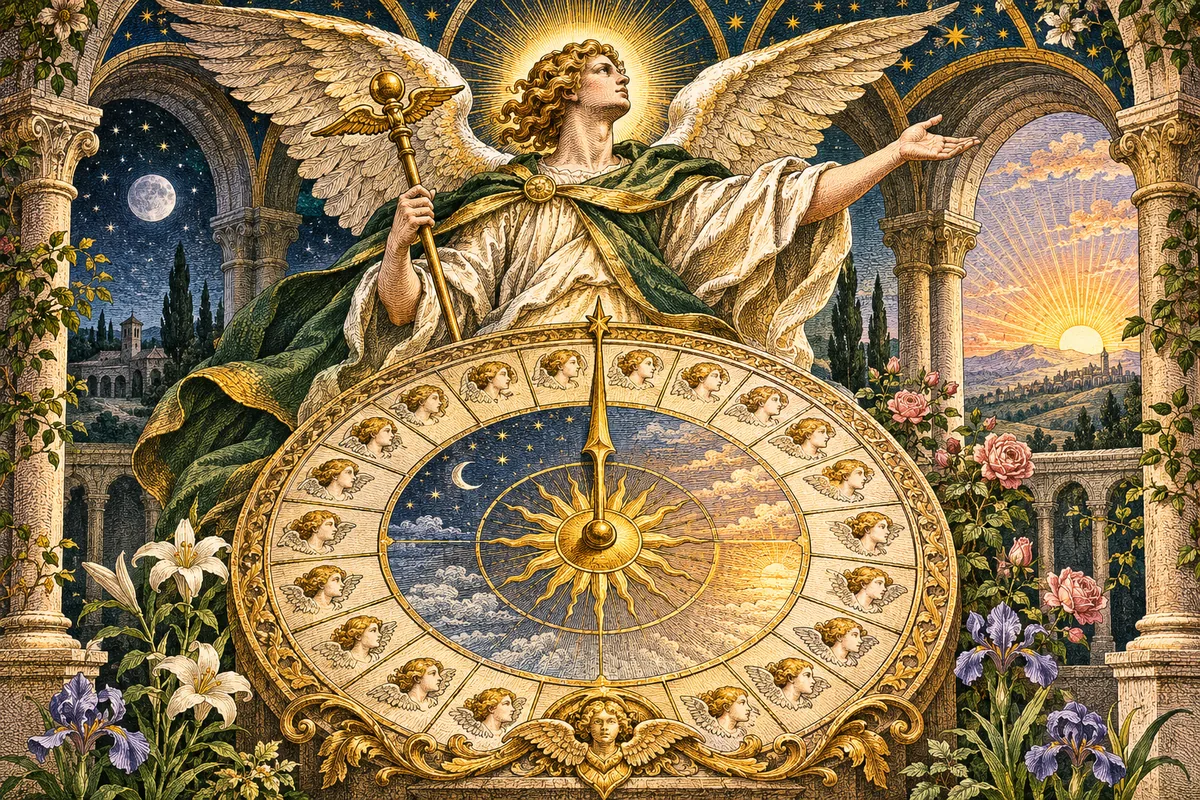 OCCULT HALL · INTERPRETIVE ILLUSTRATION
An hour beneath angelic government
The messenger and changing light introduce the lesson’s distinction between an hour, its governor and the wider occasion.
The sequence turns a week into a pattern
Sunday's first governor is Raphael, followed in the next hour by Anael. The sequence moves through the planetary governors rather than repeating the day's angel every hour. Across the system, the seven principal angels are Cafriel, Satquiel, Samael, Raphael, Anael, Michael and Gabriel, associated respectively with Saturn, Jupiter, Mars, Sun, Venus, Mercury and Moon. Following this cycle explains why an hourly table is necessary even after the weekday is known. A solar day can contain an hour governed by Venus or Mercury. The day supplies a broad affiliation; the hour supplies a more immediate one. The text's instruction about Sunday mentions the first and eighth hours, showing the return after seven places. Counting forward seven positions brings a governor back. This repeated cycle gives the book a calculable structure: its apparently dense angelic lists encode a recurrence, not a different arbitrary association for every possible hour.
Daily angels are another layer of government
Section IV assigns a group to each weekday. Sunday has Raphael, Dardiel and Huratael; Monday has Gabriel, Michael and Samael. The daily group is not simply the first three entries in a person's chosen hour. It belongs to the day as a whole. Raphael therefore appears twice in the Sunday example for two intelligible reasons: he is the first hour's governor and also a member of the day's company. This repetition is functional. It links two scales of government, much as one officeholder may participate in both a local task and a wider council. Wednesday's group, Michael, Miel and Saraphiel, likewise belongs to the daily layer. If the chosen hour changes, the hourly entry can change while the daily group remains. The book's long addresses become clearer once each name is placed in its proper column: hour, hourly governor, weekday company, and then the seasonal identities added later.
One occasion, several identities
Follow the first daylight hour on a spring Sunday through the manuscript’s separate lists.
Choose a part to look closer.
Yayry · the hour
Yayry names the first daylight position. Moving to Monday keeps that position even though its assigned heavenly governor changes.
Read all the connections
- Yayry · the hour
- Yayry names the first daylight position. Moving to Monday keeps that position even though its assigned heavenly governor changes.
- Raphael · hourly government
- Raphael governs Sunday’s first hour; Gabriel governs Monday’s first. An hour’s position and its governing angel answer different questions.
- The daily company
- Raphael, Dardiel and Huratael belong to Sunday as a whole. Their weekday assignment remains distinct from successive hourly governors.
- Taluy · the season
- Spring contributes Taluy and its seasonal names. The same seasonal layer can accompany several weekdays and their different angelic companies.
Change only the layer affected by the occasion: an hour, a weekday and a season are different scales.
Planetary time is not simply a modern clock face
The book distinguishes the hours of daylight from the hours of night, so its first daylight hour is anchored in the day's natural division. This matters when imagining the calendar the compiler inhabited. A modern label such as “nine o'clock” alone does not provide the full ceremonial identity supplied by these tables. The scheme asks where a moment stands within day or night, which weekday contains it, and what heavenly ruler belongs to that position. Its purpose is correspondence, not merely measuring elapsed minutes. The day of the week also participates in a sacred narrative: the seven daily addresses recall acts of creation. Sunday's address recalls the world's beginning; Monday's emphasizes the waters; Saturday's remembers divine rest. Planetary administration and the scriptural week are thus placed together. The compiler is not treating astronomy and biblical time as rival explanations, but as complementary ways of describing one divinely governed world.
The day's prayer places its governor within a heaven
In the daily addresses, Raphael belongs to Sunday's solar work in the fourth heaven, while Gabriel belongs to Monday's lunar work in the first. Mercury occupies the second heaven, Venus the third, Mars the fifth, Jupiter the sixth and Saturn the seventh. This order differs from the weekday sequence because it describes the arrangement of celestial spheres. Sunday followed by Monday is a calendar succession; Moon through Saturn is a cosmological arrangement. The text coordinates both. Sunday's address also names the angelic company serving Salamia, then singles out Raphael as the day's governor. These distinctions show a layered model of authority: the divine creator, the celestial host, its leading figure, and the angel addressed for the occasion. The prayer's repeated divine names establish the source of the command. The named planet identifies the relevant celestial province, while the weekday and hour locate the action within its changing schedule.
Look at the passage itself.
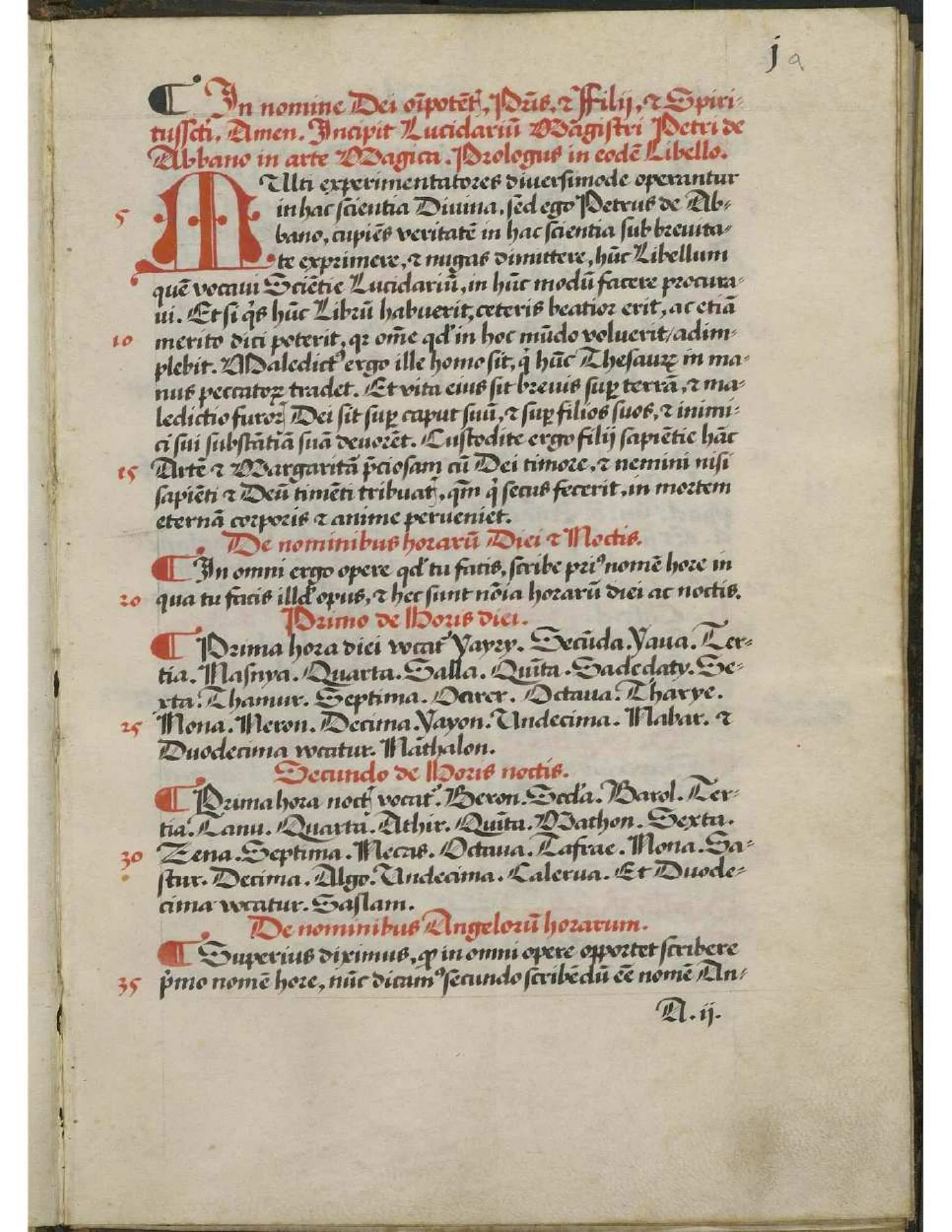 Open the book
Manuscript p.1 — names of the hours
The opening hour list supplies the distinction between an hour and its governor.
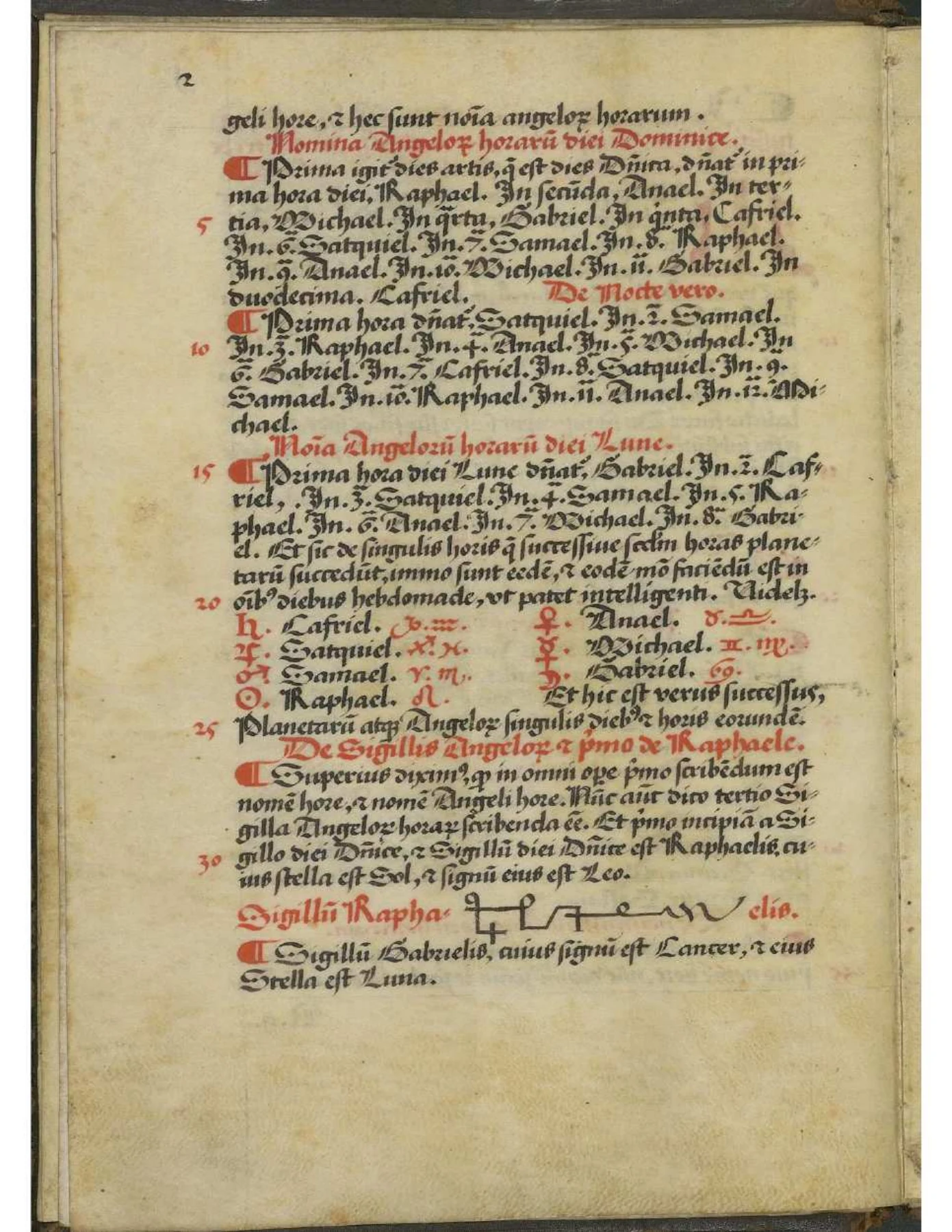 Open the book
Manuscript p.2 — hourly governors
Compare the weekday assignments and the beginning of the seal section.
Reconstructing the Sunday example
Section XXIIa demonstrates how these lists cooperate. For its solar example, the first hour contributes Yayry or Yayn; the hourly governor contributes Raphael and his seal; the weekday contributes Raphael, Dardiel and Huratayel. The text then asks which season applies. In spring, Taluy is added, together with Caracassa, Core, Amatiel and Commissores and their seasonal head Spugliguel. Earth's spring name is Amaday, the Sun's Abraym and the Moon's Agusita. Finally, the solar aerial court contributes Varcam and his ministers Tus, Andas and Cinabas. The completed address is therefore a description of a whole occasion. Moving from Sunday to Monday would require replacing the daily and relevant hourly entries; moving from spring to summer would require replacing seasonal entries. A change in one coordinate does not automatically change every coordinate. That selective substitution is what makes the lists a reusable system rather than one fixed prayer for one isolated event.
What changes between two occasions?
Compare a first-hour Sunday in spring with a first-hour Monday in spring as a paper exercise.
- 01
Keep the position
Yayry still identifies the first daylight hour. Spring still supplies Taluy and the spring names of earth, Sun and Moon.
- 02
Change the government
The first hourly governor changes from Raphael to Gabriel, and the daily company changes from Raphael, Dardiel and Huratael to Gabriel, Michael and Samael.
- 03
Keep the categories separate
The lunar day does not erase the spring season. Each list contributes the information appropriate to its own scale.
The system is coordinated substitution: several identities describe one moment, and only the identities affected by a change should change.
The text beside the teaching.
These selected pages accompany this free lesson. Enlarge a page and compare its details with the teaching.
Manuscript p.1 — names of the hours
The opening hour list supplies the distinction between an hour and its governor.
Image license
St. Gallen, Kantonsbibliothek, Vadianische Sammlung, VadSlg Ms. 334; photographs supplied by Michael Zwicker, PDF by Joseph H. Peterson.
CC BY 4.0; manuscript photographs courtesy St. Gallen; resized and JPEG-compressed. Reading-copy changes: preliminary credit sheets omitted. Full attribution, original notices and CC BY 4.0 license are retained in the embedded Edition credits.txt attachment and edition credits.
What to carry into the next lesson
- An hour’s name identifies its position; its governor depends on the weekday.
- Daily, hourly and seasonal names contribute separate coordinates to one occasion.
Compare a first-hour Sunday in spring with a first-hour Monday in spring as a paper exercise.
Can you explain it in your own words?
Try answering first, then open the explanation to compare your reasoning.
01What changes between two occasions?
The system is coordinated substitution: several identities describe one moment, and only the identities affected by a change should change.
02Why is Yayry paired with different angels on Sunday and Monday?
Yayry identifies the first daylight hour. Raphael governs that position on Sunday and Gabriel on Monday, so the positional name remains while its governor changes.
03What does Raphael’s repeated presence in the Sunday example signify?
He is both the first hour’s governor and a member of the daily company with Dardiel and Huratael. The repetition links two scales of government.