Explain why the guardian angel is first a guide and teacher, and how the promised conversation changes the practitioner’s relationship with the rest of the book.
Book II, chapters VII, IX and XII–XIV, especially printed pp. 64–65, 71, 78 and 84–89.
Inside this lesson 6 teachings · 5 source pages
The language of this teaching
- Guardian angel
- The personal spiritual guide whom the text presents as an existing helper and eventual visible teacher.
- Conversation
- The promised encounter in which the angel instructs, corrects and guides the practitioner.
- Preparation
- The sustained formation of prayer, conduct and attention that precedes the promised encounter.
The first request is for guidance
Book II chapter VII asks that the holy angel lead the practitioner in the divine way and prevent faults arising from ignorance, inattention or human weakness. The angel’s first office is therefore guidance, not the immediate delivery of wealth or a spectacular effect. This establishes the direction of the whole undertaking. Someone who wishes to act through sacred power first seeks help in learning how to act rightly. The request also acknowledges that ordinary intention may be insufficient: people can err through misunderstanding as well as deliberate wrongdoing. The guardian is represented as a teacher able to correct that condition. The subsequent powers are meant to proceed through a relationship that improves judgment, rather than giving every existing desire a stronger instrument.
 OCCULT HALL · INTERPRETIVE ILLUSTRATION
Guidance comes before command
The luminous guardian guiding an attentive learner toward a doorway illustrates instruction and receptivity before the later exercise of power.
Prayer is an ability to be learned
The same chapter anticipates a beginner’s complaint: why are the exact words of prayer not supplied? Its answer is that understanding, attention and sincerity matter more than a formula repeated without inward participation. The practitioner is directed to scripture as a source of instruction, but must learn how to pray rather than depend indefinitely on copied sentences. This is a practical teaching about the kind of relationship being sought. A request should be understood by the person making it. The book accepts that an initial prayer may be weak while presenting growth as possible through sustained attention and divine assistance. The absence of a rigid script is therefore deliberate. It requires the student to develop an informed voice, not simply reproduce the sound of someone else’s speech.
The ability to receive the encounter is part of the request
Chapter IX asks not only for angelic presence but for the ability to enjoy and endure that presence. The wording makes receptivity itself a capacity that must be developed. The holy encounter is imagined as something more demanding than an ordinary conversation that can be added unchanged to daily life. Through angelic mediation the practitioner seeks secret wisdom and the authority to govern other spirits. This places the sequence clearly: reception, instruction and then exercise of power. The guardian does not appear merely as a ceremonial witness to abilities already complete. The relationship is supposed to make those abilities intelligible and properly directed. The text’s lengthy preparation is therefore explained through what the person must become able to receive, not just through a delay before a reward.
Guidance comes before command
Follow the changing relationship with the guardian through Books II.VII, IX and XIII.
Choose a part to look closer.
Ask for guidance
The early prayer asks the guardian to correct ignorance, inattention and weakness, making learning the first purpose of the relationship.
Read all the connections
- Ask for guidance
- The early prayer asks the guardian to correct ignorance, inattention and weakness, making learning the first purpose of the relationship.
- Become able to receive
- The later preparation asks for strength to endure the angel's presence and conversation, rather than merely demanding a visible appearance.
- Listen and record
- The conversation includes correction of faults and instruction about living; careful notes preserve the teaching received from this personal guide.
The guardian is a teacher whose instruction governs the later promises of power.
The guardian is said to work before becoming visible
Chapter XII claims that the guardian is already present invisibly, guiding the heart and understanding before the culminating appearance. This gives the earlier months a particular interpretation within the narrative. The preparation is not imagined as spiritually empty until the final day. Growing understanding and improved conduct are presented as signs of a relationship already developing, even though the angel has not yet appeared openly. The distinction between presence and visibility is important. It allows the book to describe assistance without requiring continuous sensory spectacle. The promised visible meeting is a further stage of the same guidance. This also explains why the practitioner’s heart and understanding receive so much attention: they are the faculties through which the book says the invisible guidance is already being expressed.
The conversation includes correction
Chapter XIII describes the guardian speaking affectionately, recalling blessings and bringing past faults to remembrance. The angel explains how to live in a devout and regulated way, teaches sacred wisdom, identifies errors in the operation and gives further direction. This is a fuller office than answering isolated questions. The teacher reviews the pupil’s conduct and corrects the course of study. The description joins consolation with accountability: the encounter is beautiful and comforting, yet its content includes things the practitioner needs to change. That combination helps explain why the narrator begins to restrict his own instructions at this point. The book has brought the reader toward a superior teacher who, within its account, can provide guidance more particular than a general manual can give.
Look at the passage itself.
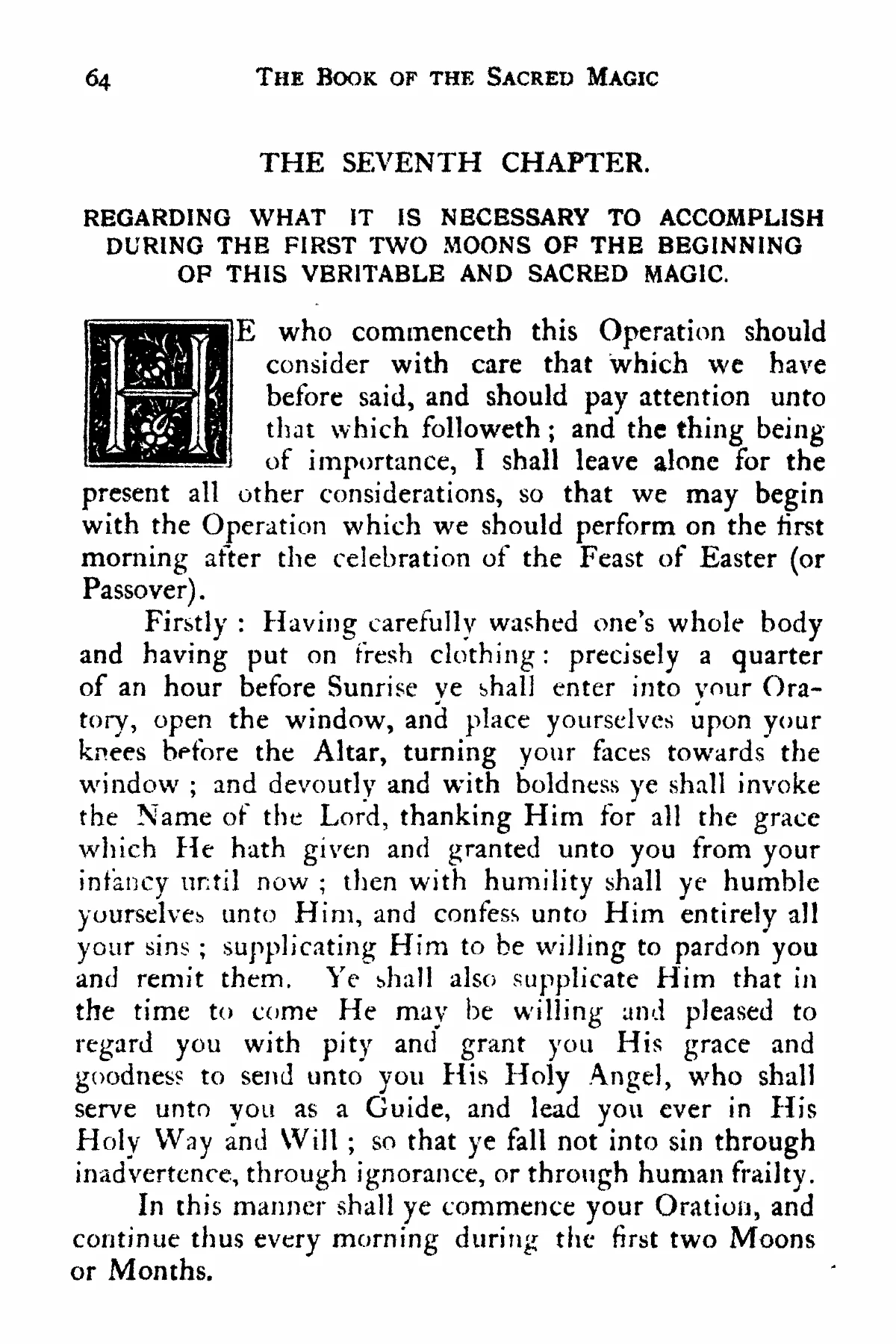 Open the book
Book II.VII: the request for a guide
The holy angel is asked to prevent errors of ignorance and human weakness.
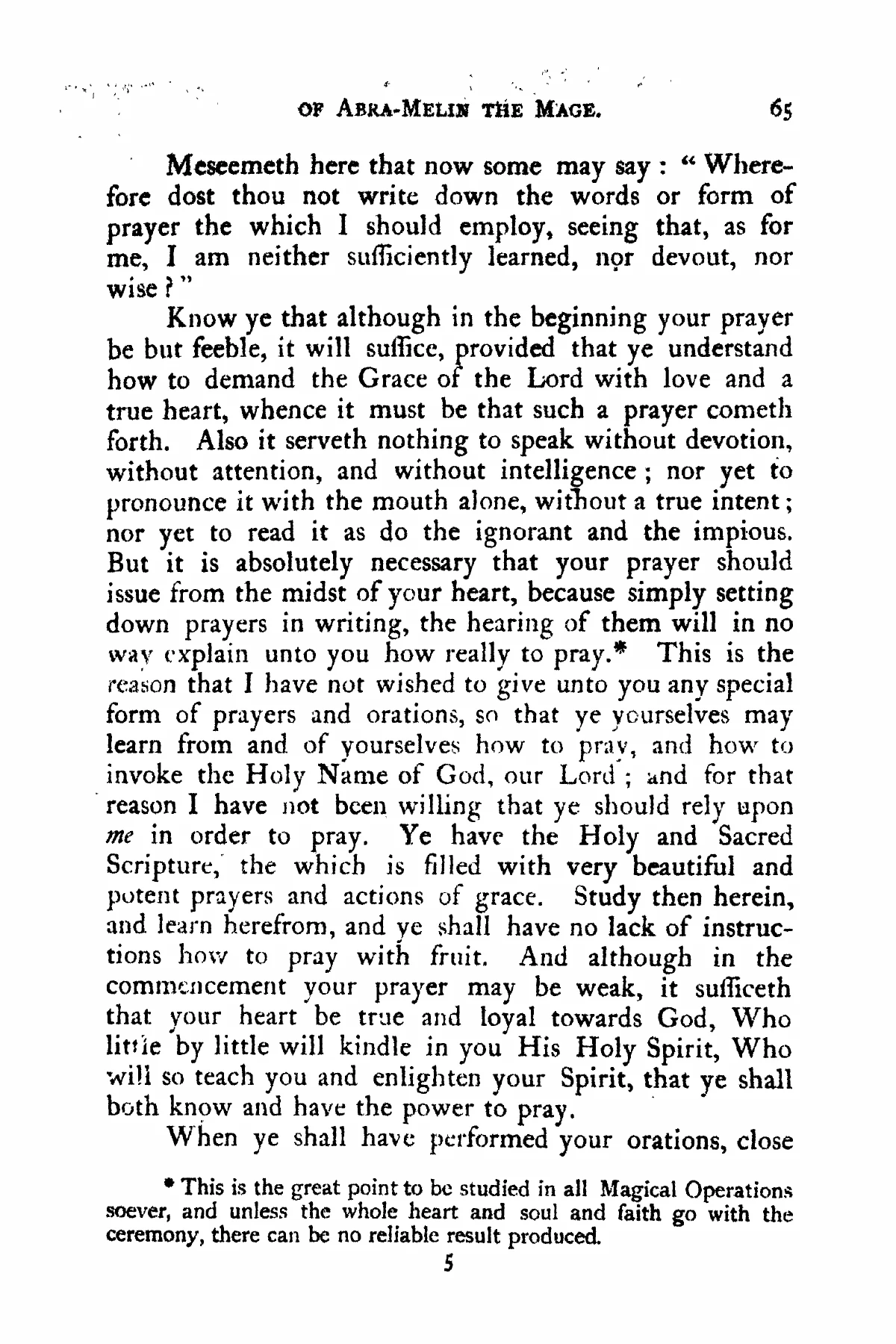 Open the book
Book II.VII: learning to pray
The text explains why it does not prescribe a fixed formula.
The book hands the pupil to a teacher
On the following page the narrator says he has entrusted the student to a greater master. The practitioner is told to receive ample instruction about spirits and to write careful notes. The transfer is not from study to thoughtless action. It is from instruction through a written book to instruction through the angelic conversation the book promises. Chapter XIV nevertheless continues to explain the operation for completeness. The written text and the angel’s guidance are therefore complementary at this stage, not competing authorities. The angel supplies judgment and particular direction; the book remains an organized account to be understood. This clarifies why copying the later squares alone would omit the foundation the author treats as decisive: the symbols are embedded in a relationship of teaching and permission.
Follow one capacity through three stages
Compare the request for guidance on scan 115, the claim of invisible assistance on scan 129 and the promised instruction on scans 135–136.
- 01
Begin with the need
The first request concerns avoiding error through ignorance or weakness. The practitioner’s problem is limited understanding, not simply lack of a powerful symbol. The guardian’s office is introduced as an answer to that need. This makes the later emphasis on correction a continuation of the opening request.
- 02
Recognize the intermediate stage
Before the visible meeting, chapter XII describes the guardian as guiding the heart and understanding. Within the text’s account, learning has already begun. The relationship is not measured solely by whether an appearance has occurred. This connects the work of preparation with the teacher’s eventual arrival.
- 03
Identify the promised result
At the conversation, the angel recalls faults, corrects mistakes and explains further action. The student is directed to take notes. The result is therefore a more informed and accountable practitioner, equipped with guidance for the particular powers that follow. The encounter’s teaching content matters as much as its splendor.
Abramelin’s central promise is a guided relationship. The powers of the later chapters depend upon the wisdom, correction and authority that the text locates within it.
The text beside the teaching.
These selected pages accompany this free lesson. Enlarge a page and compare its details with the teaching.
Book II.VII: the request for a guide
The holy angel is asked to prevent errors of ignorance and human weakness.
What to carry into the next lesson
- Explain why the guardian angel is first a guide and teacher, and how the promised conversation changes the practitioner’s relationship with the rest of the book.
- The angel’s office is to guide judgment and conduct. The later powers depend on instruction and permission, so an appearance without that teaching would omit the relationship’s purpose.
Compare the request for guidance on scan 115, the claim of invisible assistance on scan 129 and the promised instruction on scans 135–136.
Can you explain it in your own words?
Try answering first, then open the explanation to compare your reasoning.
01Why is the guardian’s correction of mistakes as important as the promised appearance?
The angel’s office is to guide judgment and conduct. The later powers depend on instruction and permission, so an appearance without that teaching would omit the relationship’s purpose.